
Introduction
AI now enters EFL assessment in several guises: automated writing evaluation, generative feedback, speech-recognition applications and conversational assistants. A system may correct language, identify a weakness, suggest a revision or attach a score. Assessment then stretches beyond the script or teacher conference to include prompts, machine replies, learner choices and institutional decisions. Whether the reply arrives quickly is a secondary matter. The more demanding question is whether learners become better able to recognise quality, defend a revision and perform without the same support on a later task.
Uncertainty makes that question harder to answer. A learner may doubt the accuracy or relevance of a machine response; a teacher may be unsure how much assistance the task permits; an institution may not yet have settled questions of access, privacy, authorship or responsibility. Abundant advice may still leave a learner with polished alternatives but no clear basis for choosing among them. Faster feedback may also conceal the decisions that produced the final text. When a scoring or detection system is adopted before its intended use has been validated, uncertainty moves from the classroom into institutional judgement. Such concerns are not an ethical appendix to assessment. They shape what the evidence means and where learners direct their effort.
The Algerian evidence brings this tension close to Aleph’s readership. Bessadat and Korichi (2025) surveyed 15 university teachers about AI-supported formative assessment in writing. Responses were broadly favourable, although accuracy, cost, limited training and the possible loss of human interaction remained prominent concerns. Four fifths of the respondents had not actually used the tools. The study depicts readiness and hesitation, not learner benefit: its small convenience sample and perception data cannot support an outcome claim. Institutional interest is visible; classroom impact is still an open question.
A comparable unevenness runs through the international literature. Reviews record rapid growth around ChatGPT and automated writing feedback, alongside short interventions, heterogeneous tools, narrow measures and few convincing transfer tests (AlTwijri & Alghizzi, 2024; Lo et al., 2024; Shi & Aryadoust, 2024; Teng, 2024). Positive findings are common, particularly for writing, speaking, motivation and engagement. They do not always survive closer separation of experience from performance. Biju et al. (2024), for example, reported narratives of lower anxiety and stronger motivation in the AI-assisted group, yet the groups did not differ significantly on the post-test measure of writing. A favourable experience does not establish a performance advantage; a non-significant difference also does not establish equivalence. The two outcomes deserve separate treatment.
This separation exposes the gap addressed here. Existing accounts organise the field around tools, advantages and risks, saying less about what learners do before a later task or how securely each link in that process is supported. Motivation, affect, self-regulation, engagement, feedback literacy and validity usually occupy neighbouring discussions rather than a shared explanatory account. Three questions guide the review: what can current studies support about motivation and engagement; where do counter-evidence and design limitations narrow those claims; and how might a process-oriented framework connect AI feedback with learner judgement, revision and independent transfer?
1. Conceptual Foundations
1.1 Assessment for Learning and Feedback Use
Learning-oriented assessment is defined by use, not by the delivery of information. Sadler (1989) located improvement in three learner accomplishments: grasping what quality entails, comparing present work with that standard and acting on the discrepancy. Hattie and Timperley (2007) described feedback in relation to goals, current progress and the next move. Nicol and Macfarlane-Dick (2006), meanwhile, tied formative assessment to learners’ ability to generate and use internal feedback. Boud and Molloy (2013) instead asked how environments enable learners to seek, interpret and apply information. Fluent machine prose becomes educational feedback only when it informs a decision that can be tested in subsequent work.
Generative systems make this distinction difficult to ignore. Their replies can sound assured even when they are wrong, irrelevant or based on criteria that differ from those of the task. A polished rewrite may quietly change stance, register or evidential force. Likewise, a pronunciation score may reward conformity to a narrow speech model although intelligibility and interaction are the intended constructs. Validity resides in the inference drawn from an output and the use made of it, not in the technical sophistication of the application (Aloisi, 2023; Gardner et al., 2021; Swiecki et al., 2022).
1.2 Motivation, Affect and Engagement
Self-determination theory offers one way of explaining why the same tool can encourage one learner and constrain another. Motivation is more likely to be sustained when autonomy, competence and relatedness are supported (Deci & Ryan, 2000). Timely feedback may strengthen competence by making a manageable problem and subsequent progress visible. Private practice can also give learners control over timing, although neither benefit is inherent in the technology. A dense inventory of errors can communicate deficiency, an unsolicited rewrite can remove meaningful choice, and prolonged solitary work can weaken the relational side of learning. Dörnyei’s (2009) L2 motivational self system adds a longer view: feedback may connect present effort with a credible future language self, whereas relentless scoring may intensify an externally imposed ought-to self.
Affect matters because it changes how feedback is approached and used. Control-value theory relates achievement emotions to perceived control and to the value assigned to an activity (Pekrun, 2006). Private rehearsal can reduce the social cost of making an error. Opaque automated judgement can do the reverse by making the basis of evaluation harder to contest. Fredricks et al. (2004) distinguish behavioural, emotional and cognitive engagement, which guards against treating frequent prompting as proof of learning. Prompt counts show activity, not whether a learner planned, monitored understanding or became more independent. The important issue is not simply whether effort increased, but where it moved.
1.3 Feedback Literacy and Learner Judgement
Feedback literacy supplies the process concept needed at this point. Carless and Boud (2018) describe learners who can appreciate feedback, make judgements, manage its emotional consequences and take action. AI expands the volume of advice without conferring these capacities. Learners must judge whether a suggestion is correct, suitable, faithful to their meaning and useful beyond the present text. Small language-learning studies indicate that comparison and reflection tasks can help learners develop more critical routines around automated feedback (Gozali et al., 2024; Li & Kim, 2024). Li and Kim’s study concerns international university students in Australia. These studies illuminate a plausible process, although their limited and context-specific samples do not permit a causal or population-level conclusion.
2. Method
2.1 Review Design and Source Selection
We adopted a critical integrative review because the problem cuts across intervention studies, qualitative accounts, systematic reviews and theoretical scholarship. Because these materials answer different questions, they cannot reasonably be collapsed into one effect estimate. This is not a PRISMA systematic review, but a problem-led synthesis that compares claims with their designs and with contrary evidence.
Searches are reported for Google Scholar and the Algerian Scientific Journal Platform (ASJP), supplemented by backward and forward citation tracing. The reported search window was 1 July–2 August 2026, with topic-specific coverage from 2019 to the closure date of 2 August 2026. Appendix D1–D3 provides the author-reported queries, fields, language and date limits, returned counts and citation-tracing procedure. D4 records 430 identified notices, 287 after deduplication, 89 full texts assessed and 31 publications included within that flow. D5 distinguishes these 31 from the complete 36-publication inventory: the flow represents 27 topic-specific publications and four theoretical anchors, while five further anchors are present in the inventory. The records do not identify which individual anchors belong to either subset. The log is available, but its contemporaneous creation, exact historical execution and source-level deduplication decisions cannot be independently established from the retained documentation. The counts are reported descriptively; they do not establish exhaustive coverage or PRISMA compliance.
The reference list and both panels of Appendix A1 identify the same 36 distinct publications under shared identifiers A01–A36. The corpus comprises nine theoretical anchors and 27 topic-specific publications: four field-specific reviews, three general assessment analyses and 20 primary investigations. The latter comprise 19 learner or teacher empirical studies and one computational detector audit. Fan et al. (2025), a non-EFL learning study, and Liang et al. (2023), a detector audit, inform contextual interpretation rather than direct estimates of EFL feedback effectiveness. Li and Kim (2024) likewise concern international students learning English in an Australian university, widening the language-learning context beyond EFL-only settings. Sources addressing assessment validity, learner engagement or informal learning were retained purposively for their analytical relevance. The reported exclusion label “not EFL/ESL” is not a universal eligibility rule for these contextual and theoretical sources; a complete historical allocation of exceptions is unavailable. Appendix A2 reports mutually exclusive analytical roles with explicit denominators. Secondary reviews do not contribute additional independent participants or replications of studies already represented in the inventory.
2.2 Extraction, Comparison and Evidential Judgement
Sources are compared by assessment function, outcome type, design, comparison condition and temporal reach where these features can be documented. Appendix A1 provides a complete bibliographic inventory and descriptive source characteristics; Appendix B supplies the extraction schema and worked examples. Appendix C records targeted source-verification checks and fields that remain undetermined. These materials support documentary transparency but do not constitute a contemporaneous record of the original extraction. The available documentation attributes verification collectively to the authors but does not record the original division of selection and extraction tasks, the number of readers at each stage or how disagreements were handled. Those procedures are therefore not reconstructed. The comparison is organised around learner outcomes, contrary findings and the theoretical accounts in Section 2.
The evidence map uses descriptive inferential categories, not a standardised confidence scale: assessed performance evidence, reported experience, process evidence and contextual assessment analysis. These categories identify the kind of claim a source can inform; they do not rank entire clusters as if a formal appraisal had been completed. Comparison conditions, human rating and delayed measures strengthen particular inferences, whereas self-report, bundled interventions and limited follow-up restrict them. No formal risk-of-bias instrument or second independent coding of this review was used. Author-led interpretation without a documented independent selection or extraction check leaves scope for selection and confirmation bias. The synthesis therefore offers bounded interpretations and research hypotheses rather than pooled effects, prevalence estimates or demonstrated causal mechanisms. Targeted source-verification checks are recorded separately in Appendix C; they do not validate the historical search as a whole.
Table 1. Evidence types and limits of inference
|
Evidence cluster |
Representative evidence |
Bounded claim |
Main constraint |
Inferential scope |
|
Writing and revision |
Mahapatra (2024); Sarı & Han (2024); Song & Song (2023); Tran (2025) |
Some guided packages improve assessed writing; revision frequency is a separate outcome. |
Samples are often small or intact; interventions are brief, training is bundled and transfer is rarely tested. |
Assessed performance and revision |
|
Motivation and affect |
Alazemi (2024); Biju et al. (2024); Mohammed & Khalid (2025); Wang & Wen (2025) |
Private and timely support may reduce anxiety and improve experience in some settings. |
Self-report dominates; novelty and additional attention remain plausible explanations. |
Reported affective experience |
|
Engagement and self-regulation |
Ma & Chen (2024); Teng & Huang (2025); Zhang (2024); Zhou & Hou (2024) |
Reported engagement varies by dimension; cognitive gains are not consistent. |
Activity and questionnaire scores cannot establish deeper learning or causation. |
Reported engagement |
|
Feedback literacy |
Gozali et al. (2024); Li & Kim (2024); Shi & Aryadoust (2024) |
Comparison and reflection may strengthen critical use of feedback. |
Direct studies of the process are small and closely tied to their contexts. |
Qualitative process evidence |
|
Validity and fairness |
Aloisi (2023); Gardner et al. (2021); Liang et al. (2023); Swiecki et al. (2022) |
Automated output needs validation for its purpose and continued human review. |
Part of the evidence concerns assessment broadly or AI detection rather than EFL feedback. |
Contextual assessment analysis |
|
Algerian context |
Bessadat & Korichi (2025) |
Teachers recognise formative possibilities but seek accuracy, training and human supervision. |
n = 15; 80% were non-users, and perception data cannot establish learner outcomes. |
Teacher perceptions only |
Source: authors’ critical synthesis.
The final column describes inferential scope, not confidence grades or a validated appraisal instrument. Reviews provide synthesis context; overlapping primary studies are not independent replications. Normative safeguards are discussed separately in Sections 4.3 and 6.
3. What the Evidence Can—and Cannot—Support
3.1 Language Performance and Revision
Mahapatra (2024) provides evidence of assessed writing performance after a guided ChatGPT intervention: 35 intervention and 37 comparison participants were analysed from 134 initially consenting students. The six-hour intervention ran over one month, and a delayed test followed approximately two months after the post-test. Two human raters assessed writing. Although the article reports random assignment to class sections, it describes the study as quasi-experimental; the design and substantial exclusions constrain causal interpretation. Sarı and Han (2024) compared combined automated–teacher feedback with teacher-only feedback over 16 weeks. Benefits concerned writing performance and self-efficacy; between-condition differences in self-regulated strategies were not significant, and anxiety did not improve. Song and Song (2023) also reported assessed writing gains in a context-specific intervention. Tran (2025), by contrast, primarily examined revision frequencies in 14 Vietnamese undergraduates over a 15-week course. More revisions do not, by themselves, establish better writing or independent learning, and the two feedback sequences did not differ significantly. These studies support specific claims about instructional packages and outcomes, rather than a common causal effect of AI alone.
Biju et al. (2024) compared two groups of 35 learners over eight weeks. Narrative data favoured the AI-assisted experience, while the between-group post-test difference in writing was not statistically significant. That result does not demonstrate either superiority or equivalence. In Alazemi (2024), reading and affective outcomes followed a package combining Nearpod, formative activities and a different delivery format; an isolated AI effect cannot be inferred. Gozali et al. (2024) examined 18 Indonesian learners using ChatGPT alongside Grammarly and QuillBot in a qualitative case study. This illuminates feedback use, rather than estimating a population effect. An assisted revision, a human-rated test and an unaided transfer task must consequently remain separate outcomes.
3.2 Motivation, Affect and Engagement
Enjoyment, reduced anxiety, motivation and psychological ease recur in studies of AI-supported activity (Alazemi, 2024; Biju et al., 2024; Mohammed & Khalid, 2025; Sayed et al., 2024; Wang & Wen, 2025). These accounts credibly describe the settings studied, but their causal reach is narrower: many rely on self-report, intact classes and brief exposure. Novelty, additional attention, training and the privacy of rehearsal remain credible alternative explanations. Work on speaking suggests that low-risk practice can support confidence and involvement (Sayed et al., 2024; Wang & Wen, 2025; Zhang, 2024). Whether the benefit survives in another context or appears in unaided speaking is much less certain. Zhang (2024) reported no significant between-group difference in motivation despite favourable speaking results and interview accounts. Sayed et al. (2024) followed one intact class of 28 Ethiopian learners, with a delayed speaking test three weeks after the immediate post-test and no external control group. ChatGPT also scored the tests. These features limit causal attribution and independent validation of the speaking outcome; a delayed score is not, by itself, evidence of unaided transfer.
Ma and Chen (2024) studied 350 first-year students in ten intact classes, with 175 students per condition. The intervention combined a three-hour AI workshop with semester-long application, and questionnaires were administered after 16 weeks. Reported engagement gains concern this package and self-reported engagement, not an independently tested language-learning effect. Teng and Huang (2025) found differences in affective and behavioural writing engagement, but not a significant between-group difference in cognitive engagement. Zhou and Hou (2024) offer interview accounts from teachers and learners rather than a causal estimate. The models in Fan and Zhang (2024) and Liu et al. (2025) likewise concern associations and proposed pathways; statistical mediation in such models does not establish temporal or causal mediation by feedback. Durable motivation and independent performance require additional evidence.
3.3 Counter-evidence: Offloading, Validity and Fairness
Ease of use can move effort away from the very process an assessment is meant to develop. Fan et al. (2025) reported “metacognitive laziness” when generative AI took over parts of learning. Their study did not concern EFL assessment, so it should not be treated as direct language evidence. It does, however, identify a plausible failure route. When a system diagnoses, reformulates and evaluates before the learner has attempted those judgements, the visible product may improve while self-monitoring receives less practice. The study distinguished essay-score improvement from knowledge gain and transfer, for which group differences were not significant.
A second challenge comes from assessment scholarship. Technical novelty does not cancel the need to define a construct and validate an intended use (Gardner et al., 2021). Aloisi (2023) connects algorithmic opacity with questions of validity and trust in high-stakes scoring. Swiecki et al. (2022) argue for arrangements in which AI extends rather than replaces human interpretive responsibility. Human judgement is not unbiased, but automated output also carries decisions about training data, linguistic norms and target constructs.
For multilingual writers, fairness is particularly pressing. Liang et al. (2023) found that seven GPT detectors misclassified human-written TOEFL essays in a comparison with US school essays. This audit concerns the tested texts and detector versions, not every current detector or all multilingual populations. Detection is not formative feedback, yet it enters the same assessment environment when institutions use it to police work produced with AI assistance. Learners are placed in an untenable position if a policy invites them to learn with AI and then subjects their writing to an unreliable detector. A detector score cannot, on its own, support a high-stakes allegation.
4. A Process-Oriented Framework
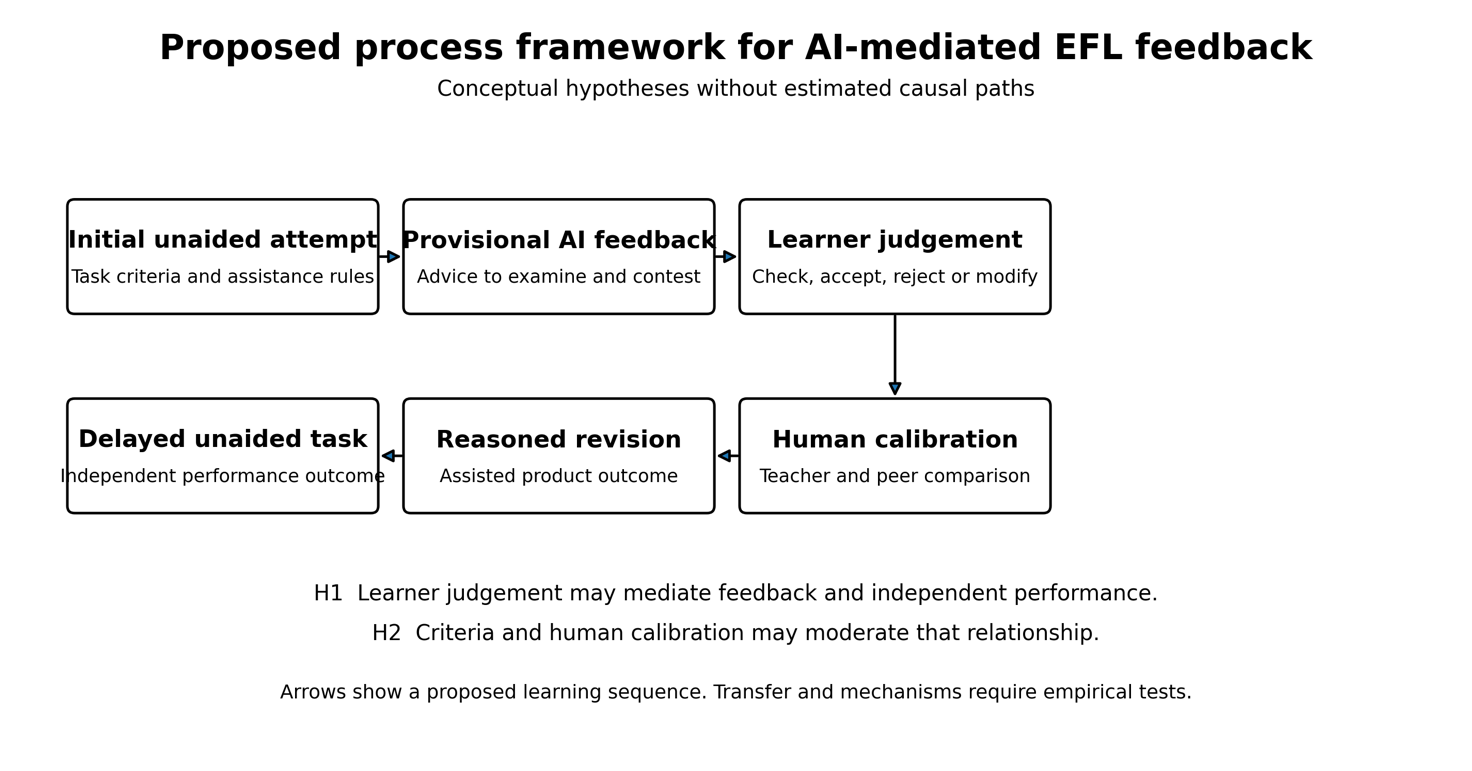
The literature makes more sense when AI feedback is treated as one event in a sequence rather than as a direct cause of an outcome. A learner meets a task whose criteria, stakes and permitted assistance may be clear or ambiguous, and produces an initial attempt. The system returns provisional evidence. The learner then accepts, rejects or modifies that advice. Human calibration tests the choice against linguistic and disciplinary purposes; revision follows; and a later task shows whether anything has transferred. Uncertainty is present throughout. Learning depends on keeping judgement visible and consequential.
Figure 1. Proposed process framework for AI-mediated EFL feedback
Source: authors’ conceptual synthesis.
Arrows represent proposed instructional links, not estimated effects. H1 concerns learner judgement as a possible mediator; H2 concerns criteria and human calibration as possible moderators. Neither relationship has been validated by this review.
Five mechanisms sit inside this sequence. Competence calibration turns a diffuse difficulty into a manageable target, but only if progress as well as error can be recognised. Autonomy is supported when learners choose when to practise and which advice to take; it gives way to dependency when the system decides by default. Private work may regulate affect by lowering the interpersonal cost of error, whereas opaque scoring can heighten anxiety. Feedback literacy grows through comparison, disagreement and reasoned uptake. Engagement, finally, is redistributed rather than simply increased. Routine correction outside class might release time for discussion or outsource planning and monitoring. Task and feedback design determine which possibility prevails.
Table 2. Proposed observation indicators for future evaluation
|
Process mechanism |
Learning possibility |
Failure mode |
Proposed observation indicator |
|
Competence calibration |
Feedback identifies a manageable gap and makes progress noticeable. |
Dense correction conveys deficiency or creates an unwarranted sense of mastery. |
Can the learner name the criterion and improve a fresh example? |
|
Autonomy support |
Learners decide when to practise and which advice merits use. |
Routine acceptance transfers decisions to the machine. |
Are accepted and rejected suggestions justified? |
|
Affective regulation |
Private rehearsal reduces the social cost of error. |
Opaque scoring or authoritative prose encourages anxiety and deference. |
Is the response explicitly provisional, with a route for discussion or appeal? |
|
Feedback literacy |
Comparison develops evaluative judgement and responsible uptake. |
Fluent prose is mistaken for accuracy, appropriateness or authorship. |
Do learners test the output against criteria, peers and trusted sources? |
|
Engagement redistribution |
Routine correction releases time for higher-order dialogue. |
Prompting displaces planning, monitoring and productive struggle. |
Does later unaided performance improve, rather than only the assisted draft? |
Source: authors’ conceptual synthesis.
These are candidate observation prompts, not validated instruments. They require operational definitions, piloting, reliability checks and context-specific validity evidence. Independent transfer should be observed on a fresh comparable task after a pre-specified delay, without AI, teacher or peer assistance, under documented conditions, with blinded human rating where feasible.
Two research hypotheses follow. H1 proposes that reasoned learner judgement may mediate the relationship between access to machine feedback and subsequent independent performance. A test would measure judgement before a later unaided outcome, compare feedback access under matched conditions and assess the proposed indirect pathway while considering alternative explanations. H2 proposes that explicit criteria and human calibration may moderate that relationship. A factorial or well-matched design could vary those supports, keep tasks and exposure comparable, and test interaction effects on assisted revision and delayed unaided performance separately. These hypotheses are theoretically motivated; the reviewed studies do not jointly validate the proposed mediation or moderation.
5. Pedagogical and Institutional Implications
Teachers can keep judgement visible by asking for an initial unaided attempt, stating which criteria a system may address and presenting its response as one source of evidence rather than the answer. A brief revision memorandum can record accepted, rejected or altered suggestions and the reasons, while peer comparison exposes the difference between fluent wording and a suitable argument. Teacher attention is especially valuable for higher-order purposes, recurring misconceptions and cases in which machine advice conflicts with the learner’s intention. Such a sequence preserves productive struggle without withholding timely help.
Assessment design also needs a workable distinction between assistance and substitution. Broad tool use may be appropriate for brainstorming, low-stakes rehearsal and surface checking. A task intended to show independent performance requires a controlled stage or a later unaided component. Automated scores must be validated for the population, purpose and language construct at hand. One number cannot represent argument quality, pragmatic appropriateness and authorial
responsibility. For detection, the findings of Liang et al. (2023) make sole reliance on detector output indefensible in allegations involving EFL writers.
Institutional policy should be intelligible before learners submit their work. It needs to specify permitted assistance, treatment of data, routes of appeal and responsibility when a system is wrong. Access belongs in the same conversation because paid models, connectivity and digital confidence are unevenly distributed. Professional development must connect tool use with validity, multilingual fairness, privacy and feedback literacy, not stop at prompt demonstrations. In Algeria, the cautious interest recorded by Bessadat and Korichi (2025) favours training and supervised pilots over rapid adoption for consequential decisions.
6. Research Agenda
Future studies need to follow feedback through the work it is expected to change. Prompt records, revision histories, accepted and rejected suggestions, learner explanations and episodes of teacher calibration can reveal where judgement takes place. An independent transfer task is indispensable: an assisted draft is a product outcome, whereas a later unaided performance offers stronger evidence of learning. Delayed measures would help separate novelty from sustained motivation. Transfer protocols should pre-specify the delay and assistance rules, use a fresh task matched for construct and difficulty, and distinguish retention on similar tasks from generalisation across genres or contexts. Motivation should be followed over repeated occasions rather than inferred from an immediate post-intervention response.
More credible counterfactuals are equally important. A comparison between AI-supported instruction and ordinary teaching often alters time on task, feedback frequency, teacher attention and delivery mode at once. Factorial or carefully matched designs could separate tool access, feedback timing, explanation and human calibration. Motivation should be studied alongside behaviour and performance, not inferred from satisfaction. Qualitative accounts still have an essential place, particularly when they capture resistance, mistrust and identity. They should illuminate those experiences, not be made to bear causal conclusions.
The field also needs a wider geographic and linguistic range. Multi-site studies in Algeria and comparable multilingual settings could address local English norms, Arabic and French repertoires, unequal access, teacher workload and institutional policy. The present purposive inventory does not support prevalence estimates by region, learner level or language activity. Younger learners, oral assessment and lower-proficiency students warrant deliberate inclusion in future sampling. Reports should identify model versions, prompts, permitted revisions and data governance. An intervention described only as “AI” cannot be replicated or interpreted confidently.
Conclusion
The reviewed literature supports a bounded account of AI-mediated EFL assessment. Some guided instructional packages yield improvements in assisted revision or assessed writing, and some learners report a more favourable experience. These are different outcomes. The synthesis does not establish an isolated AI effect, durable motivational change or general independent transfer. The accompanying appendices now provide the reported search procedure, screening counts and a reconciled corpus inventory. The absence of source-level historical assignments and an independent extraction check nevertheless limits reproducibility and prevents exhaustive coverage claims.
A process-oriented account shows why tool-centred claims are insufficient. Machine output does not become development by itself. Criteria, learner judgement, emotion, feedback literacy, human calibration and institutional rules intervene. Where feedback can be questioned and learner action remains visible, AI may extend learning-oriented assessment. Where those conditions disappear, immediacy can hide dependency, invalid inference or inequity. AI therefore has a defensible but limited role: it can contribute evidence to a judgement; it should not be allowed to own that judgement.