
Introduction
Artificial intelligence has moved rapidly from a speculative topic to an ordinary component of higher-education environments. In language education, and particularly in writing instruction, tools such as ChatGPT, Grammarly, and QuillBot are increasingly used to generate ideas, propose reformulations, support editing, and provide immediate feedback. Review studies in higher education confirm both the acceleration of AI research and the persistence of unresolved ethical, pedagogical, and institutional questions (Bond et al., 2024; Crompton & Burke, 2023).
In EFL writing classrooms, the issue is especially delicate because writing is not merely a linguistic product. It is also a process of planning, selecting, revising, organising, and assuming responsibility for one’s wording. Research on automated feedback suggests that such tools can improve performance at a non-negligible level, especially for revision and surface correction, but the effects remain heterogeneous across contexts and interventions (Fleckenstein et al., 2023). Generative AI, therefore, cannot be treated as a neutral productivity device. It affects the economy of effort, the temporality of drafting, and the pedagogical meaning of authorship itself.
Recent syntheses in ESL/EFL education show that ChatGPT and related tools may assist both learners and teachers in brainstorming, language support, material preparation, and feedback routines. Yet the same literature repeatedly identifies risks associated with overreliance, shallow textual production, academic misconduct, bias, and insufficient institutional guidance (Lo et al., 2024; Tlili et al., 2023; UNESCO, 2023). This tension between affordance and risk is particularly relevant in contexts where local policy is still emerging and teachers often must improvise their own rules of use.
Teachers occupy a decisive place in this transformation. They do not simply observe AI from outside; they interpret it, domesticate it, authorise it, or resist it. Studies on faculty members in higher education show that perceptions of AI are shaped by pedagogical usefulness, institutional support, self-efficacy, usability, and professional development opportunities (Mah & Groß, 2024; Ofosu-Ampong, 2024). However, such work remains unevenly distributed geographically, and evidence from Algerian EFL settings is still scarce.
The present article addresses that gap through an exploratory study conducted in the English Department of the University of Tlemcen. More specifically, it asks three questions: first, how do teachers position themselves with regard to AI tools in the Written Expression module; second, what pedagogical affordances do they attribute to such tools; and third, what risks, limits, and conditions of acceptable use do they identify? The article does not seek statistical generalisation. Its contribution is more modest but still useful: to provide a context-sensitive account of teachers’ perceptions in a local university environment at a moment when AI is reshaping academic writing practices faster than institutions can formalise their responses.
1. Conceptual and pedagogical background
The growth of research on AI in higher education has been substantial, but several reviews warn against a purely technocentric understanding of adoption. Zawacki-Richter et al. (2019) had already shown that the field was dominated by system-oriented approaches and paid insufficient attention to educators’ perspectives. More recent reviews confirm both the expansion of the field and the need for stronger ethical, methodological, and contextual rigour (Bond et al., 2024; Crompton & Burke, 2023).
From a pedagogical perspective, AI-assisted writing tools offer several plausible affordances. They can support brainstorming, lexical enrichment, reformulation, grammar revision, and draft-level feedback. Instructors may also use them to design prompts, propose model structures, or create differentiated support for students. In EFL contexts, where revision is often labour-intensive and feedback time is limited, such tools may serve as scaffolds that help learners notice errors, test alternatives, and sustain drafting.
These affordances, however, remain partial and conditional. Automated or generative systems may facilitate textual production without necessarily strengthening conceptual control, rhetorical awareness, or disciplinary argumentation. In other words, AI can accelerate writing without guaranteeing deeper learning. This distinction is crucial in university settings, where writing is linked not only to linguistic correctness but also to epistemic work: selecting evidence, structuring reasoning, and assuming intellectual responsibility for claims.
UNESCO (2023) argues for a human-centred approach to generative AI in education, placing transparency, data protection, teacher preparation, and policy design at the core of implementation. Similarly, recent work on educators’ perceptions emphasises that the educational value of AI depends less on the tool itself than on the pedagogical framework within which it is used. A tool that remains invisible to assessment policy, classroom rules, and teacher mediation may quickly migrate from assistance to substitution.
This article, therefore, approaches AI not as a self-sufficient innovation, but as a pedagogical and institutional object whose meaning depends on the forms of regulation surrounding it. In the specific case of EFL writing instruction, the central issue is not whether AI exists or whether students already use it. The more pressing question is how teachers understand its place, its utility, and its limits in relation to writing as a formative university practice.
2. Methodology
This study adopts an exploratory descriptive design. Its purpose is not to measure causal impact, but to document how university teachers perceive the integration of AI tools into the Written Expression module. The enquiry is based on an online questionnaire that combines closed-ended items and open-ended comments. This mixed structure enabled the collection of both orienting numerical traces and more reflective formulations of teachers’ concerns and expectations.
The participant group consisted of ten teachers from the English Department of the University of Tlemcen, all of whom had experience teaching writing at the undergraduate level. The sample was purposive rather than representative. It was selected because the respondents were directly concerned by the pedagogical object under discussion. For this reason, the study should be read as a situated account of a small professional community rather than as a basis for broad generalisation.
The questionnaire explored several dimensions: familiarity with AI tools, perceived pedagogical usefulness, reservations related to ethics and learning, support for curricular integration, and interest in further training. The closed items were treated descriptively, while the comments were read thematically in order to identify recurring lines of argument. Because the original response set was unevenly completed across items, the quantitative traces are presented with caution and subordinated to an interpretive discussion.
Ethically, the revised version of the article adopts a principle of modest inference. No identifying information is reported. The analysis does not claim that the findings represent all EFL teachers in Algeria or even all teachers at Tlemcen University. Instead, the article treats the responses as a useful local indicator of how AI is entering the horizon of writing pedagogy in one university department.
3. Findings
The figures reproduced below were present in the initial manuscript but absent from the first revised version; they are reintegrated here because they document part of the empirical material on which the discussion rests. However, they do not all rely on the same number of valid responses, and one familiarity item produced a heterogeneous visual output in the original questionnaire export. For that reason, the figures are treated as documentary evidence and interpreted with caution within the broader qualitative reading of the dataset.
3.1. Professional experience, familiarity with AI tools, and the local ecology of use
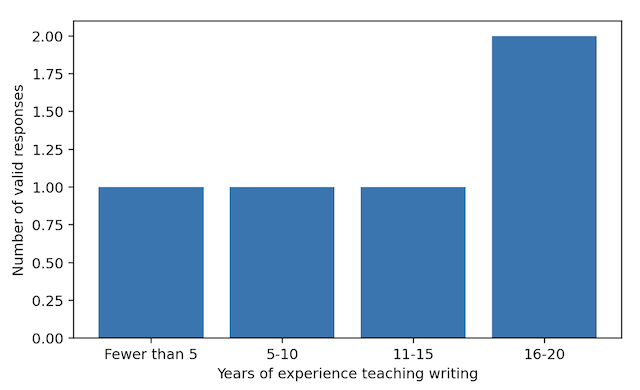
Although the full sample comprised ten teachers, the visual trace relating to teaching experience includes a smaller set of valid coded responses. Even so, it suggests that the subgroup captured in this item was not composed mainly of novices. Most of the valid responses indicate more than ten years of experience in teaching writing, which matters because perceptions of AI in this study emerge from an already established pedagogical practice rather than from a purely speculative position.
Figure 1. Distribution of reported writing-teaching experience among the valid responses
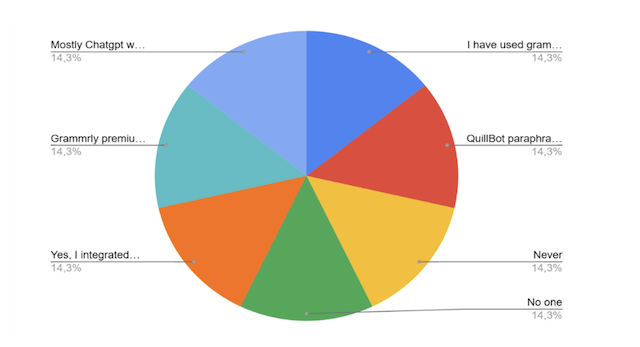
The responses show that AI tools had already entered the participants' professional horizons. The three most salient names across the material are ChatGPT, Grammarly, and QuillBot. This is consistent with the current literature, which identifies generative chatbots and writing-support platforms as among the most visible entry points for AI into language teaching and academic writing (Lo et al., 2024; Tlili et al., 2023).
At the same time, the original familiarity/use output must be read carefully. The exported visual combines mentions of specific tools with broader stances or self-positioning statements, suggesting that the item was not coded into analytically homogeneous categories. Rather than forcing a precision that the source material does not support, the present version retains the figure as a documentary indicator of the tools and attitudes circulating in the local context.
Figure 2. Documentary output reproduced from the original questionnaire export for the familiarity/use item
3.2. Pedagogical affordances, reservations, and conditions of acceptable integration
Across the responses, AI was not rejected outright. Teachers generally recognised that AI-assisted tools may support the early and middle phases of writing. Three advantages recur particularly frequently: idea generation, linguistic revision, and immediate feedback. In practical terms, respondents saw potential value in using AI to help students overcome writer’s block, test formulations, notice grammatical weaknesses, and revise drafts more efficiently.
This positioning is important. It shows that teachers do not necessarily imagine AI as a replacement for instruction, but rather as a supplementary scaffold that may assist drafting and revision under human supervision. Such a view echoes the broader literature on faculty use, where AI is often perceived as useful when it saves time on repetitive tasks or supports formative work without displacing pedagogical judgement (Mah & Groß, 2024).
Seen from this angle, the local responses point toward what may be called a moderated utilitarianism: teachers are prepared to recognise practical benefits, but only insofar as the tool remains pedagogically subordinate to the teacher and intellectually subordinate to the student.
The participants’ positive evaluations are nevertheless accompanied by substantial reservations. The first concerns over-reliance. Several responses suggest that teachers fear a form of passive dependence in which students may use AI to bypass the cognitive work of planning, selecting, and reformulating ideas. In EFL writing, this is not a minor concern because the learning process depends precisely on repeated effort, revision, and metalinguistic attention.
The second concern relates to authorship and academic integrity. Teachers draw attention to plagiarism, to the difficulty of distinguishing assistance from substitution, and to the confusion that may arise between machine-supported drafting and student-owned production. Here, the issue is not only disciplinary or punitive. It is fundamentally pedagogical: what counts as legitimate support, what should be acknowledged, and how should responsibility for wording and ideas be maintained in assessment contexts?
A third line of concern involves privacy and trust. Respondents indicated unease about the handling of students’ texts, the opacity of AI outputs, and the reliability of automatically generated content. These concerns resonate with broader debates on the ethical use of generative AI in education, especially where institutional guidance remains weak or absent (UNESCO, 2023; McGrath et al., 2023).
The response pattern concerning curricular integration is revealing. Among the valid responses captured in the original visual output, support for integrating AI into the Written Expression curriculum clearly outweighs refusal. This suggests that teachers are not adopting a blanket anti-AI stance. Rather, they appear willing to envisage integration provided that it is selective, explicit, and normatively framed.
Figure 3. Support for integrating AI tools into the Written Expression curriculum among the valid responses
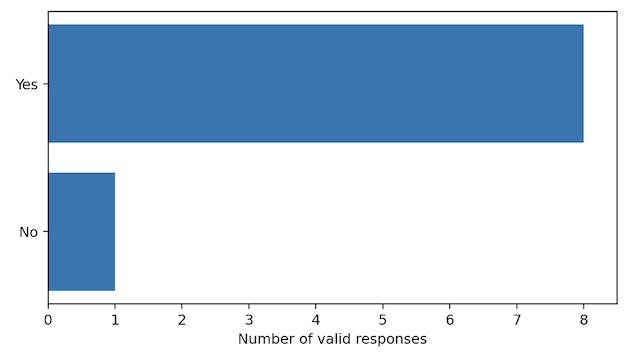
This result is coherent with the written comments and with the overall logic of the dataset. Teachers do not seem to oppose AI because it is technologically new. Their reservations concern the terms of use: whether students are trained to use it critically, whether assessment is redesigned accordingly, whether teachers themselves receive guidance, and whether the institution establishes clear rules. In other words, the question is less one of principle than of governance.
3.3. Synthesis of the main tendencies
In order to synthesize the empirical tendencies identified throughout this section, the following table presents a structured overview of the participants’ perceptions regarding the integration of AI tools into EFL writing instruction. It organizes the findings around the main analytical dimensions that emerged from the questionnaire, namely professional positioning, perceived pedagogical affordances, major reservations, and implementation requirements. This tabular presentation is intended not only to condense the data but also to clarify the interpretive movement of the discussion by showing how reported uses, concerns, and expectations converge toward a model of cautious and mediated pedagogical integration.
Table 1. Synthetic reading of the main tendencies emerging from the questionnaire.
|
Dimension |
Observed tendency |
Pedagogical implication |
|
Professional positioning |
The respondents approached AI from an existing practice of university writing instruction rather than from abstract speculation. |
Teachers’ judgments are rooted in classroom responsibility and assessment concerns. |
|
Perceived benefits |
AI is associated with brainstorming, language revision, and faster forms of formative feedback. |
AI may be used as a scaffold for drafting and revision when tasks are explicitly framed. |
|
Main reservations |
Teachers emphasise dependency, plagiarism, blurred authorship, privacy concerns, and weakened critical engagement. |
Writing tasks and assessment criteria must distinguish support from substitution. |
|
Conditions of acceptability |
Respondents call for training, clearer institutional rules, and teacher mediation. |
Responsible integration requires policy, professional development, and curricular redesign. |
4 Discussion
The findings converge toward a position that may be described as cautious pedagogical openness. Teachers recognise the practical usefulness of AI in supporting certain stages of writing, but they refuse to equate usefulness with educational legitimacy. This distinction is central. It shows that the respondents are not trapped in a simplistic opposition between technophilia and technophobia. Instead, they articulate a more mature and professionally grounded position: AI may help, but only within rules that preserve learning, responsibility, and academic integrity.
This pattern is consistent with recent research on faculty perceptions in higher education. Mah and Groß (2024) show that professional development, perceived benefits, and self-efficacy strongly shape how faculty members position themselves vis-à-vis AI. Ofosu-Ampong (2024) similarly underlines the importance of institutional support, organisational policy, and usability in lecturers’ acceptance of AI for teaching and learning. The present study, although much smaller in scale, confirms the same structural logic in a local Algerian EFL context: acceptance remains conditional and mediated by pedagogical judgement rather than automatic enthusiasm.
At the same time, the Tlemcen data sharpen one point that is particularly important for writing instruction. Teachers’ concerns are not reducible to general anxiety about technology. They are specifically tied to the status of writing as an intellectual practice. Brainstorming support or grammar assistance may be acceptable; the substitution of machine-generated text for student work is not. What is at stake, then, is the preservation of writing as a formative activity through which students learn to organise thought, revise language, and assume ownership of discourse.
The study also highlights the importance of institutional framing. Teachers cannot be expected to regulate AI coherently if institutions remain silent. Clear guidelines about acceptable use, acknowledgement practices, assessment design, and data protection are indispensable. Recent work on institutional AI guidelines confirms that governance is becoming a central dimension of higher education responses to generative AI, particularly regarding teaching and assessment (UNESCO, 2023).
The limitations of the present study must be stated plainly. The sample is small; the figures do not rely on identical response totals; and the analysis rests on a questionnaire rather than on interviews or classroom observation. Moreover, one familiarity item produced heterogeneous visual output in the original export, reducing its analytical precision. These limits do not invalidate the study, but they define its scope. The article should be read as a local exploratory contribution and as a basis for more robust future research, not as a definitive account of AI integration in Algerian EFL writing instruction.
Conclusion
This article has examined how a small group of university teachers at the University of Tlemcen perceive the integration of AI tools into EFL writing instruction. The revised analysis shows neither categorical rejection nor uncritical endorsement. What emerges instead is a carefully qualified acceptance: teachers recognise that AI may support brainstorming, revision, and feedback, but they insist that these affordances remain subordinate to pedagogical intent, institutional rules, and the preservation of student responsibility.
For that reason, the educational question is not whether AI should simply be allowed or banned. It is how it should be framed, mediated, and assessed. In writing instruction, this means clarifying what uses count as legitimate assistance, redesigning tasks so that the process remains visible, training teachers to evaluate AI-assisted work, and protecting students from both academic and ethical harm.
Future research would benefit from enlarging the participant pool, integrating student perspectives, conducting interviews, and observing actual classroom or assessment practices. Such developments would make it possible to move beyond exploratory perception data toward a richer analysis of how AI is transforming writing pedagogy in higher education. Even at its modest scale, however, the present study shows that the question of AI in EFL writing is no longer hypothetical. It has already become a practical, ethical, and institutional issue that teachers must negotiate in real time.