
Introduction
Projective techniques occupy a historically important yet methodologically contested place in clinical psychology. Instruments such as the Rorschach Inkblot Test, the Thematic Apperception Test (TAT), sentence-completion techniques and figure-drawing tasks differ substantially in administration, scoring systems, purposes and psychometric evidence. It would therefore be inaccurate to treat all of them as a homogeneous diagnostic class. Structured personality inventories, including the MMPI and Big Five measures, constitute relevant comparators, but their properties must be assessed instrument by instrument rather than inferred from a general contrast between “objective” and “projective” approaches.
The scientific status of projective methods has long been disputed. Critiques have focused on reliability, validity and interpretative subjectivity in particular uses; other scholarship has examined the potential clinical value of specific scoring procedures and performance-based measures. The sustained debate makes the documentary trajectory of this literature worth analysing. It does not make publication counts or citation totals equivalent to evidence about clinical accuracy.
Bibliometric analysis can describe the temporal, geographical and thematic organisation of a literature. By examining records, citations, affiliations and co-occurrence patterns, it can identify features of scholarly communication and the visibility of particular research topics. This study describes Scopus-indexed research on projective tests in psychology from 2000–2024. Its conclusions concern indexed literature rather than the validity or effectiveness of the tests themselves.
The study consequently investigates the documentary representation of projective assessment in the selected Scopus corpus. It cannot establish worldwide clinical use, diagnostic accuracy or the efficacy of these techniques. Its focus is on publication frequency, citation attribution, document distribution and identifiable scholarly networks.
The overarching research question is formulated as follows:
What bibliometric patterns are observable in Scopus-indexed research on projective tests and related assessment techniques between 2000 and 2024?
Five complementary questions specify the scope of the analysis:
-
How has research output on projective tests evolved from 2000 to 2024, and what temporal patterns can be observed?
-
Which countries, research institutions, and authors have made the most significant contributions to this field?
-
Which works have exerted the greatest impact on the development of the literature, as indicated by citation counts and scholarly recognition?
-
How is research on projective tests distributed across different document types and languages, and what does this suggest about accessibility and dissemination?
-
What collaboration networks exist among researchers, and which thematic trends characterize the body of literature on projective tests?
These questions delimit a descriptive bibliometric investigation. Their interpretation necessarily depends on database coverage, the exact retrieval strategy, extraction date, relevance screening and operational definitions. In particular, author, country and language counts cannot be treated as exhaustive measures of worldwide clinical research.
1. Literature Review and Conceptual Framework
The literature on projective assessment develops along two closely related but analytically distinct lines of inquiry. The first concerns the scientific status of projective techniques, particularly the reliability of their scoring procedures, the validity of their interpretations, and their contribution to clinical assessment. The second concerns their place within scientific production, including the persistence of particular research traditions, the circulation of influential publications, and the disciplinary contexts in which these instruments are discussed. Distinguishing these perspectives is essential to the present study. Whereas psychometric investigations assess the evidential foundations of particular instruments and their uses, bibliometric analysis examines the organisation and dissemination of the literature devoted to them. This section situates the research within these complementary debates while clarifying the conceptual boundaries of the proposed bibliometric mapping.
Early discussions on the scientific value of projective techniques emphasized their potential clinical contribution when applied by well-trained practitioners (Blatt, 1975). However, the debate intensified considerably with the publication of Lilienfeld, Wood, and Garb (2000), who critically evaluated the empirical foundations of projective techniques and questioned their scientific status. This work generated substantial controversy and prompted a series of scholarly responses, including critiques that highlighted methodological limitations in evaluating projective tests and defended their contextual and clinical utility (Hibbard, 2003).
Subsequent work has documented the continuing use of projective techniques in applied contexts (Piotrowski, 2015). Bibliometric approaches, meanwhile, have mapped research in other health-related areas (Maulana et al., 2023). The precise novelty of the present mapping still requires comparison with earlier reviews and searches specifically devoted to projective assessment. Its scope is limited to Scopus-indexed records captured by the reported query.
2. Methodology
The study adopts a descriptive bibliometric approach to examine the representation of projective tests and related assessment techniques in Scopus-indexed publications between 2000 and 2024. Its methodological framework combines bibliographic retrieval, document selection, descriptive indicators, and the visual exploration of scholarly relationships. Particular attention is given to the definition of the documentary corpus, the identification of relevant analytical variables, and the distinction between publication-level characteristics and network-based indicators. Because the validity of bibliometric findings depends on the consistency and traceability of the underlying records, the methodological presentation also identifies the information available for assessing the reported dataset. The following subsections describe the search and selection strategy before addressing data extraction, indicator construction, and analytical procedures.
2.1. Database, Search Strategy and Selection
Scopus served as the sole bibliographic database. It offers structured publication metadata, citations, institutional affiliations and keywords, but does not cover all disciplinary, regional or professional research outlets. This choice therefore defines a database-specific corpus rather than an exhaustive inventory of worldwide work. Earlier comparisons of bibliographic databases (Falagas et al., 2008) provide useful context without guaranteeing equivalent coverage across specialties.
The search combined expressions related to projective techniques with a clinical psychology or personality-assessment block and was applied to titles, abstracts and keywords. The surviving methodological description records the following search expressions; the complete executable query and the date on which it was run are unavailable.
“projective test*” OR “projective technique*” OR “Rorschach test” OR “Thematic Apperception Test” OR “TAT” OR “House-Tree-Person test” OR “Sentence Completion Test”.
These terms were combined with:
“clinical psychology” OR “personality assessment”
The search was restricted to 2000–2024, the Scopus subject area Psychology and five document types: articles, reviews, book chapters, books and conference papers. The study recorded 12,168 initial hits and a final set of 806 documents. The detailed sequence of exclusions, duplicate handling and relevance checks was not archived. Because the abbreviation “TAT” has meanings outside projective assessment, some retrieved material may have belonged to adjacent literatures.
The difference between the two recorded totals is 11,362. It cannot be interpreted as a documented count of excluded duplicates or irrelevant records, since the intermediate search stages are unknown. This archival limitation affects the possibility of reproducing the corpus, and the subsequent analyses must be interpreted accordingly.
2.2. Data Extraction, Indicators and Analytical Procedures
The study exported bibliographic records in CSV format and analysed author names, titles, years, sources, citations, affiliations, languages, abstracts and keywords. The CSV file was not preserved. Accordingly, the stated corpus size cannot now be independently reconciled with every published figure. Publication year and document type are normally counted once per record, whereas affiliations and terms may admit multiple assignments depending on the counting convention.
The descriptive analysis considered seven sets of indicators:
-
Number of publications per year
-
Citation patterns and identification of most influential papers
-
Document types
-
Language representation
-
Geographical distribution of research output by country
-
Research collaboration networks (co-authorship analysis)
-
Keyword co-occurrence and thematic trends
Descriptive indicators were supplemented by a VOSviewer co-authorship visualisation and a separate title-term word cloud. The preserved material does not identify the VOSviewer version, counting and clustering options, term thresholds or author-name disambiguation rules. The images therefore serve as descriptive representations of the analysis undertaken, not as fully reproducible network estimates. A title-word cloud is not equivalent to a keyword co-occurrence network.
The bibliographic record constitutes the primary unit for interpreting document frequencies. Country affiliations may be counted more than once per publication, and a visible chart may depict only a subset of a broader dataset. Since the extraction and complete source tables are unavailable, all such distributions are treated as reported historical figures whose coverage and denominators cannot be independently established. No inference of clinical test quality is drawn from citation or co-authorship measures.
3. Results
The results are organised around six complementary dimensions of the bibliometric landscape: temporal publication patterns, co-authorship relationships, document types, title-term frequencies, publication languages, and geographical affiliations. Taken together, these dimensions are intended to describe how research associated with projective assessment is distributed and represented within the selected documentary corpus. The analysis distinguishes patterns visible in the surviving figures from corpus-level findings that cannot be reconstructed after the loss of the original data export. This distinction is particularly important where graphical representations and reported totals do not fully correspond. Accordingly, the results are presented descriptively, with explicit attention to their evidential status, rather than as definitive measures of the global development or scientific validity of projective techniques.
3.1. Annual Publication Patterns
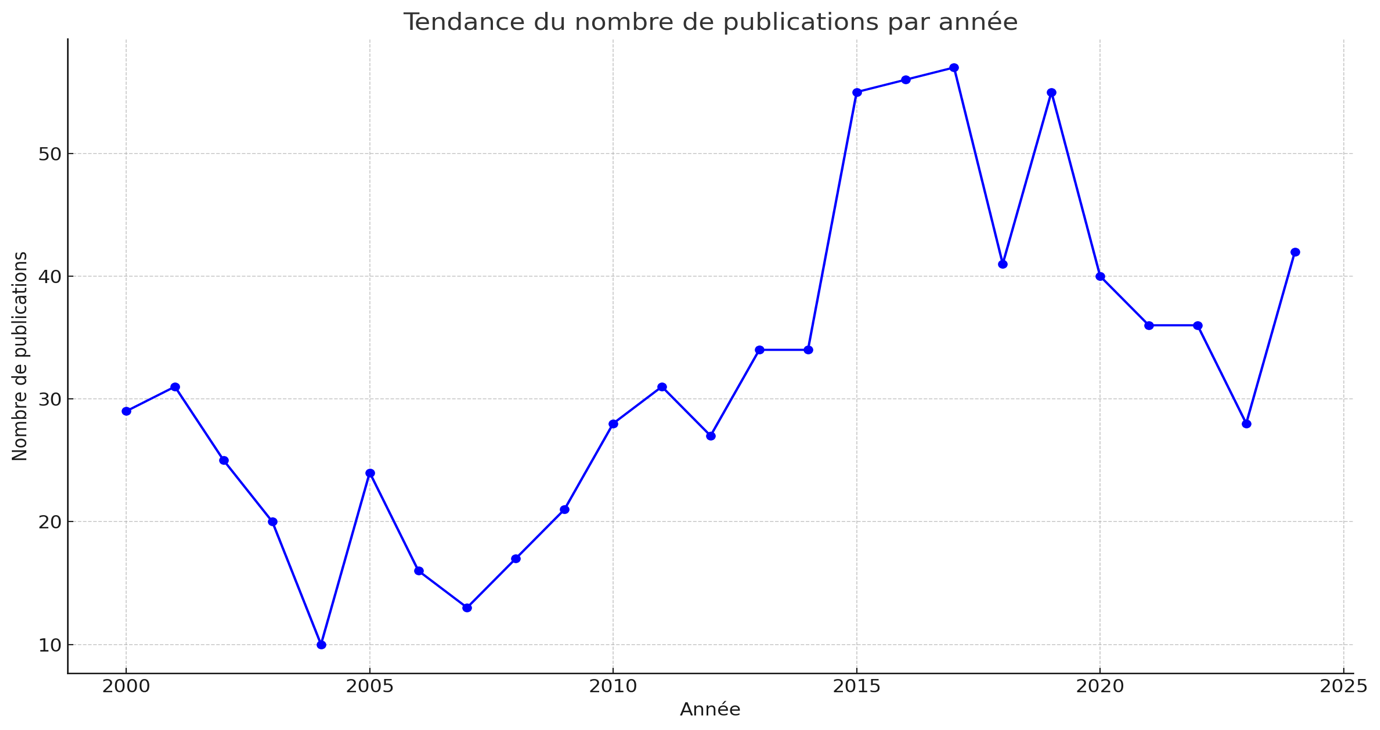
Figure 1. Annual publication counts shown in the surviving Scopus-derived graphic (2000–2024)
Source: author’s Scopus-based analysis; original frequency table unavailable.
The surviving annual series shows marked fluctuations, with comparatively high plotted counts in several years after 2014 and declines in intervening years. It therefore does not show uninterrupted growth. The original annual frequency table is no longer available, and the plotted values cannot be reconciled independently with the stated set of 806 documents. These observations concern the shape of the figure and do not establish an explanation for year-to-year changes.
3.2. Co-authorship and Research Collaboration
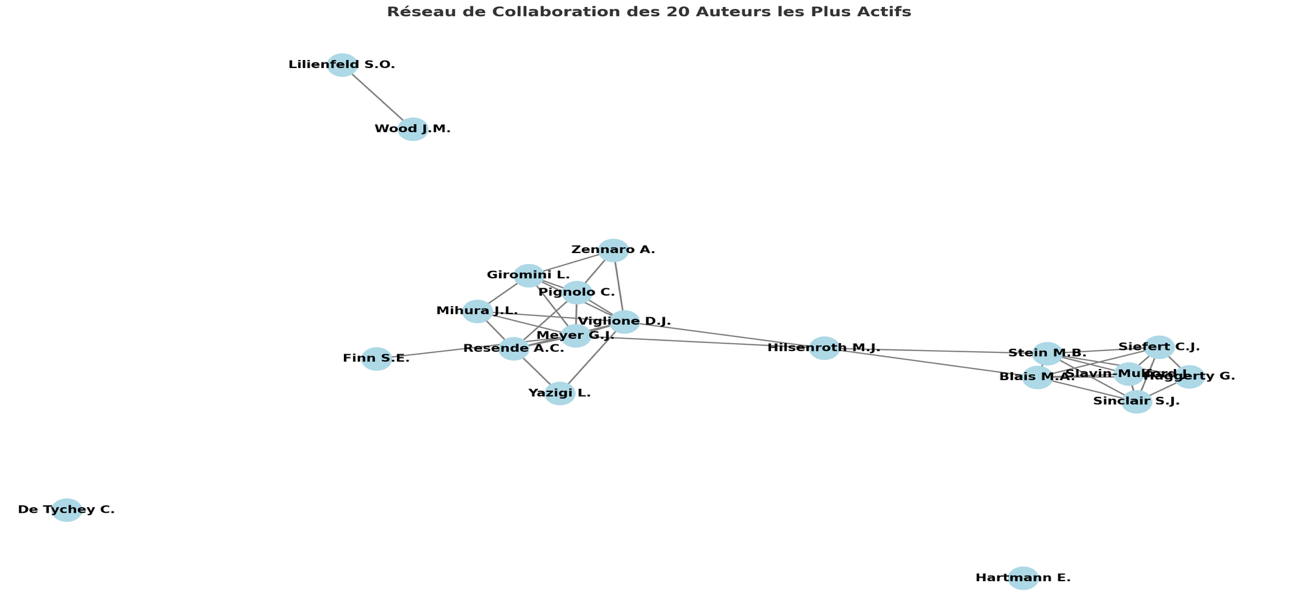
Co-authorship links represent joint publications between the author names included in the map. The visible network contains a connected central portion as well as isolated or weakly connected nodes. The figure does not encode a sufficient geographical basis for identifying the strength of collaboration between world regions. Its interpretation is restricted to the displayed subset and to the visual relationships represented there.
Figure 2. Selected co-authorship network generated with VOSviewer
Source: author’s VOSviewer visualisation; source network file unavailable.
The figure indicates a heterogeneous structure: several researchers are connected within a common component, whereas others appear peripheral. Without the original author-identification and threshold settings, it is not possible to establish comparative centrality or generalise the drawing to the entire international research community.
3.3. Document Types
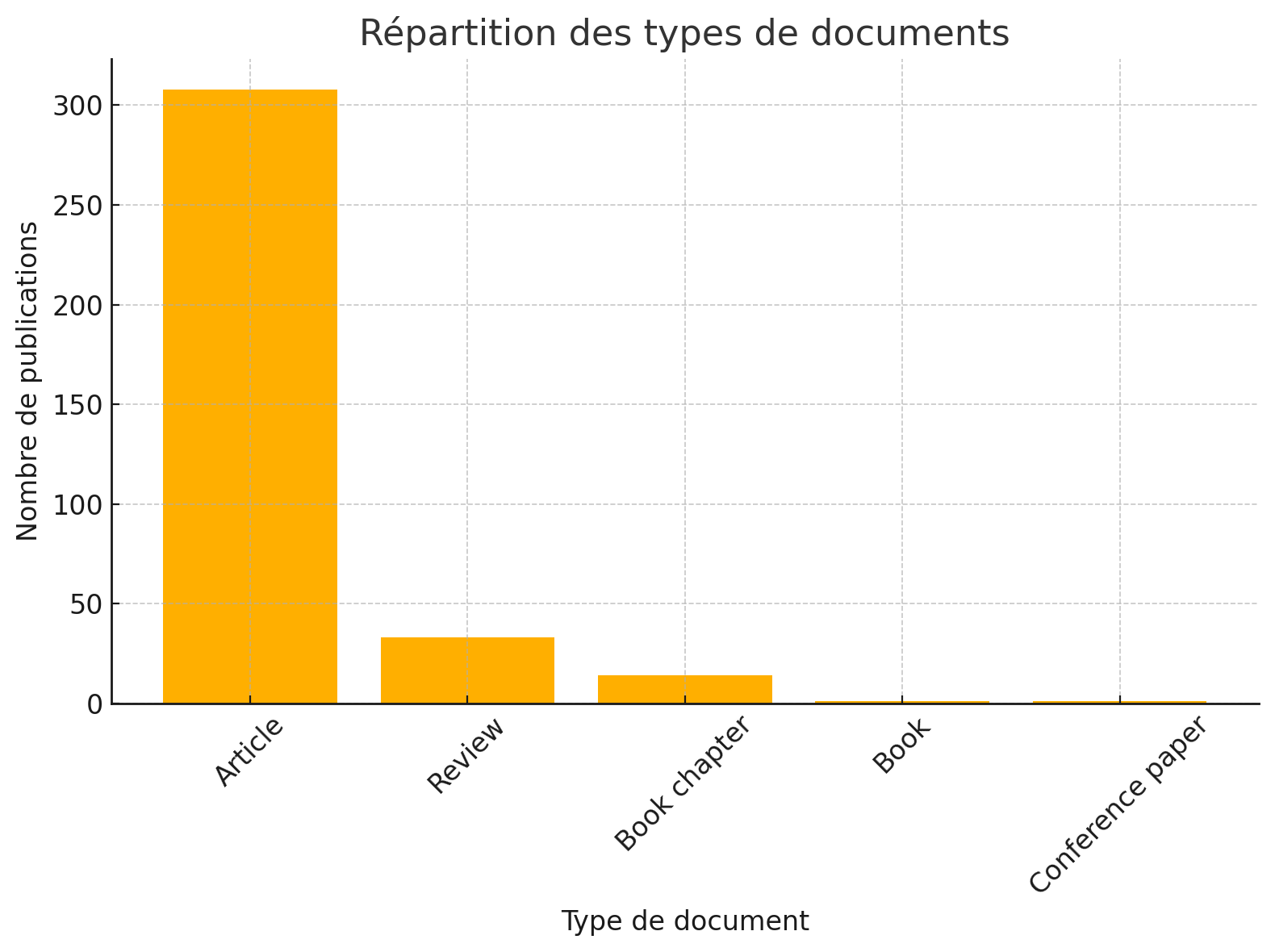
In the retained document-type graphic, journal articles constitute the largest displayed category, followed by reviews and book chapters. Books and conference papers are represented by very small bars. These bars do not sum to the announced 806 records, and the available material does not establish whether the graph reflects a subsample or an incomplete extraction. Consequently, the figure permits a comparison among the shown categories but not a reliable distribution for the full stated corpus.
Figure 3. Document types represented in the surviving chart
Source: author’s Scopus-based analysis; the categories shown do not account for the entire reported corpus.
The mismatch between the figure and the overall recorded corpus is consequential. Without the source frequency table, the percentages of articles, reviews and chapters in the full dataset cannot be derived from this image. The figure is retained as a historical representation of the analysis rather than treated as a census of all selected documents.
The apparent predominance of journal articles is limited to the plotted categories. A whole-corpus estimate would require the original records and a mutually exclusive document-type classification.
3.4. Title-Term Frequencies
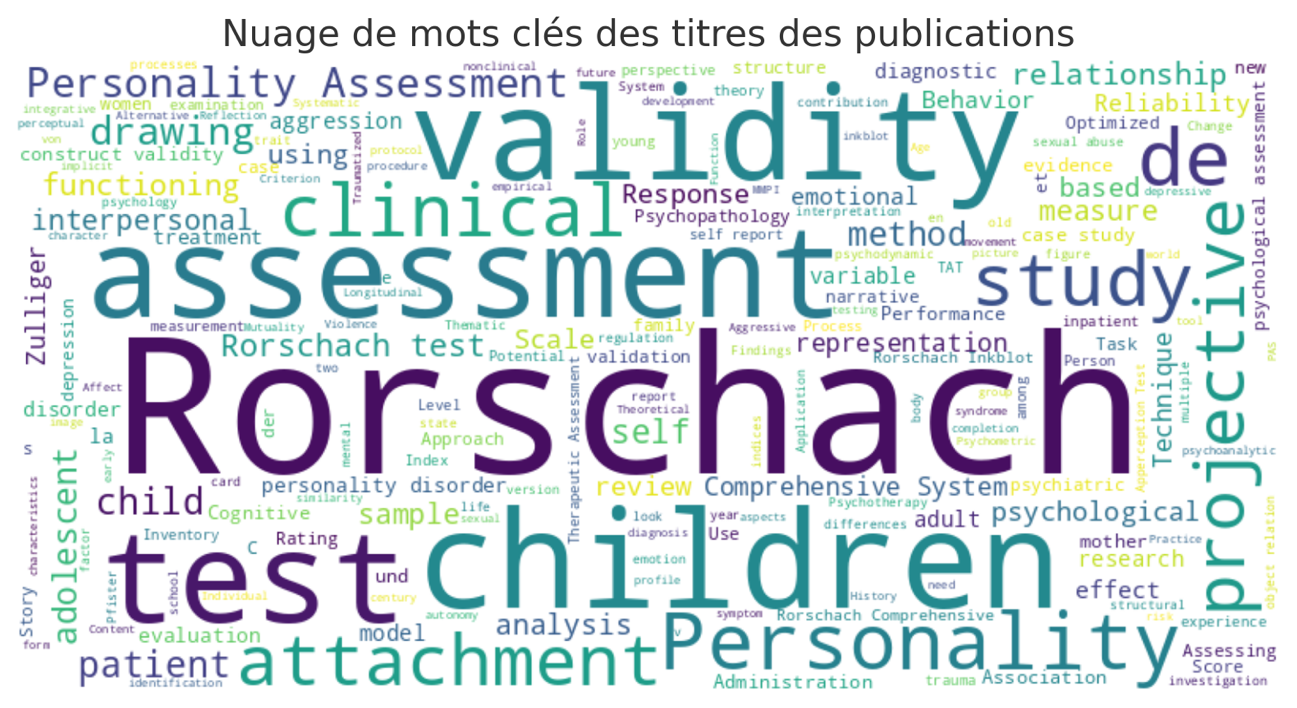
The available title-term visualisation gives prominence to Rorschach, test, assessment, children, validity and personality. Its typographic sizes indicate relative frequency within the source text processed for the word cloud, but the underlying token counts and preprocessing are unavailable. A lexical frequency display is not a map of keyword co-occurrence.
A thematic network would require explicit links among terms and a documented procedure for thresholding, normalization and grouping. The displayed word cloud supports only the more limited observation that certain clinical-assessment expressions are visually prominent in the analysed titles.
Figure 4. Word cloud of terms appearing in publication titles
Source: author’s analysis of publication titles.
Rorschach-related terminology is particularly conspicuous in the figure. That visual prominence is compatible with sustained attention to the instrument but does not by itself measure the importance of the TAT or establish emerging thematic clusters.
3.5. Publication Languages
The language chart records several publication languages but does not provide an exhaustive classification of the stated corpus. Its figures are therefore interpreted as frequencies of the displayed categories, not as a complete international language distribution.
Figure 5. Publication languages represented in the surviving chart
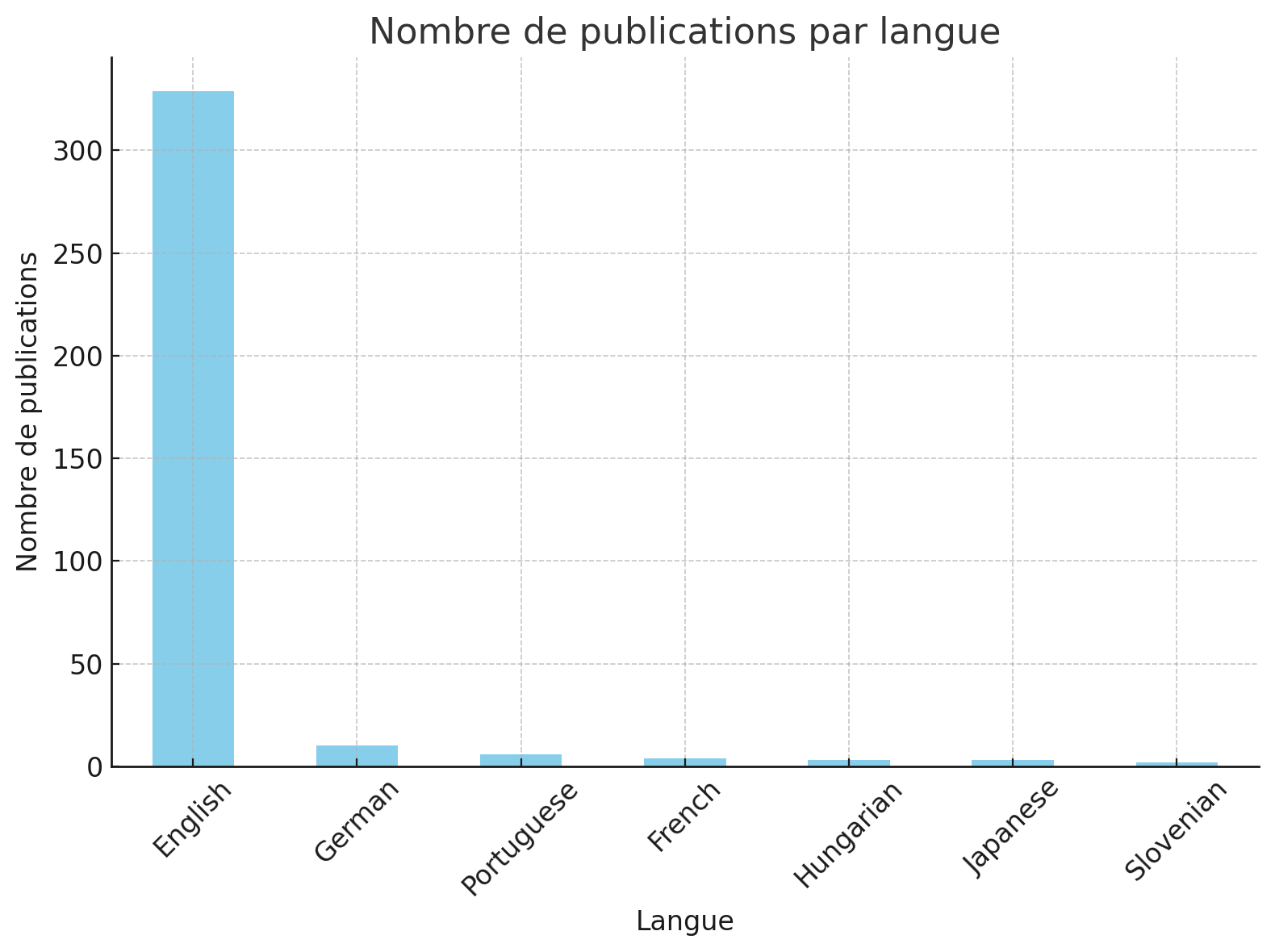
Source: author’s Scopus-based analysis; only selected language categories are represented.
The chart shows 325 documents labelled as English, 20 as German, 14 as Portuguese, 12 as French, 12 as Japanese, 10 as Hungarian and 5 as Slovenian. The displayed counts total 398, compared with 806 records reported for the corpus. The archived material does not explain the difference. English is the largest category shown, but the chart does not establish the proportion of English-language documents in the full corpus.
Table 1. Publication languages displayed in the surviving Scopus-based results (2000–2024)
|
Reported language |
Documents |
|
English |
325 |
|
German |
20 |
|
Portuguese |
14 |
|
French |
12 |
|
Japanese |
12 |
|
Hungarian |
10 |
|
Slovenian |
5 |
|
Subtotal of listed languages |
398 |
Note. The seven displayed categories sum to 398, whereas the study recorded a corpus of 806 documents. The original language fields are unavailable; no language is assigned to the difference.
The unevenness of the visible language counts may reflect both scholarly publication practices and the coverage of the database. Since unplotted or missing classifications cannot be distinguished, the present material does not support a numerical estimate of language-based indexing bias.
3.6. Country Affiliations
The geographical figure uses institutional affiliations as its point of reference. Such indicators describe locations attached to publications, not the nationality of researchers or the countries in which projective instruments were administered. The source does not establish whether records with several country affiliations were counted in full or fractionally.
Figure 6. Country affiliations represented in the surviving chart
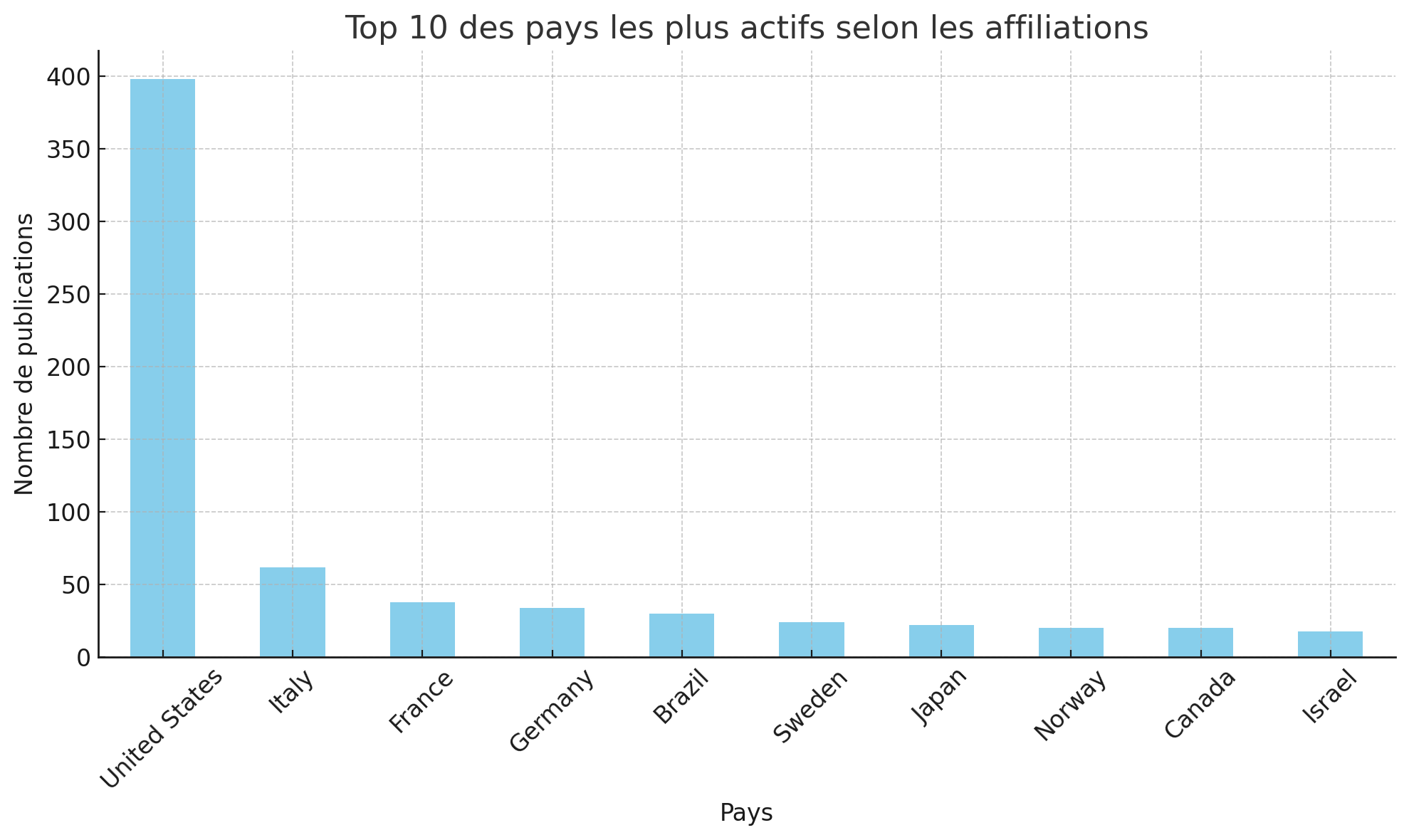
Source: author’s Scopus-based analysis; counting convention unavailable.
The United States is the largest displayed country category, followed by Italy, France, Germany and several other countries. A value of 398 was recorded for United States affiliations, but the underlying affiliation records and counting method were not preserved. Consequently, it cannot be interpreted as a verified percentage of unique publications or evidence of corresponding clinical-test use.
4. Discussion
The findings raise several questions concerning the interpretation of bibliometric visibility, the structure of the literature on projective assessment, and the methodological conditions under which research trends can be meaningfully compared. Their significance lies not only in the publication patterns suggested by the available visualisations but also in the distinction between documentary prominence and scientific validation. The discussion therefore considers the scope of the observed trends, the interpretative limits of citation and network indicators, and the implications of incomplete bibliographic archives. It also examines how the heterogeneity of projective techniques complicates the construction of a coherent research corpus. These considerations provide the basis for assessing the contribution of this historical mapping while making its limitations explicit.
The original citation list offers a particularly useful example of the importance of conceptual screening. A later bibliographic examination corrected the attribution of Murray’s Explorations in Personality: the 2008 anniversary edition credits Henry A. Murray as author and D. P. McAdams for the foreword, not as a coauthor. Meyer et al. (2001) addresses psychological assessment broadly, including the status of projective methods. Payne et al. (2005), by contrast, concerns an affect-misattribution procedure in implicit attitude measurement; Russell and Fish (2016), Douglas and Martinko (2001), and Elliott et al. (2018) address other psychological topics. Their appearance in a broad search cannot be equated with direct contributions to projective-test research. The time-specific Scopus citation counts are not recoverable, so a ranking of the field’s most cited papers is not presented as a verified finding.
English is the most frequent language shown in the surviving plot, but the listed language categories cover only 398 of the 806 recorded documents. Likewise, the prominence of United States affiliations is visible without the counting method needed for valid proportional comparisons. Such limits should not be concealed through extrapolation from the incomplete displays.
The title-term cloud and co-authorship image illustrate complementary aspects of research visibility: the vocabulary associated with publication topics and the connections among selected authors. Neither visualisation demonstrates the presence of a particular statistical cluster or a measured international collaboration intensity. Their strongest defensible contribution is descriptive.
More fundamentally, bibliometric prominence is not evidence of psychometric quality. A projective instrument may be widely cited because it has a long clinical history, because it is used in empirical studies, or because researchers question its interpretation or reliability. Validity and clinical usefulness must be examined for specified instruments, scoring systems and settings rather than inferred from the frequency of mentions or the volume of citations (Lilienfeld et al., 2000; Hibbard, 2003; Meyer & Kurtz, 2006).
The study has substantial limitations. It relies on a single database; the full executed search, exclusion log, final Scopus export, and VOSviewer source files have not been preserved. The date of extraction and the rules for deduplication, affiliation assignment and network construction are not recoverable. Several figures cover only a fraction of the reported corpus. These constraints do not invalidate every descriptive observation, but they prevent a reproducible count of the field or a reliable reconstruction of the original ranking and geographic and linguistic distributions.
A further limitation concerns the conceptual boundary of the corpus. Projective techniques, performance-based methods, general personality assessment and implicit attitude procedures overlap in some research discussions, but they do not designate the same class of instruments. The broad search, especially the acronym TAT, may have captured irrelevant records. The retrospectively checked references confirm the presence of neighbouring rather than directly projective literatures. For that reason, the dataset cannot be assumed to represent an exclusively projective-test corpus without re-screening.
A future reanalysis could use a more specific, fully documented search, maintain record-level identifiers and evaluate the relevance of each retrieved publication. It could also distinguish individual techniques and their scoring approaches rather than treating projective assessment as a uniform category. Comparison with other databases and systematic reviews of clinical validation evidence would then be possible, provided their purposes and evidential bases remain clearly separated.
The distinction between visibility and clinical evidence remains central. Publication and citation measures describe how scholarship is disseminated; studies of clinical validity and reliability must examine the relation between scores, intended uses, populations and assessment conditions. A frequently cited procedure may be controversial as well as influential, so citations alone supply no single direction of evidence for its clinical usefulness.
The relevance of the retrieved corpus also conditions the meaning of every bibliometric indicator. If papers on implicit attitudes or workplace aggression are counted as projective assessment merely because they match broad terms, citation figures and thematic patterns may be displaced toward unrelated research. Even perfect arithmetic could not resolve that conceptual problem. Search specificity and content screening are therefore substantive methodological requirements, not simply technical refinements.
For reproducible bibliometric work, the exact query and search date, the record identifiers, the successive selection steps and the final tables behind each figure should be retained. Network analysis additionally requires the software version, thresholds, counting procedure, normalization, clustering settings and any thesaurus applied. In the present study these materials were not preserved, and a retrospective reanalysis of the same records is no longer possible. The remaining figures provide an archival view of the analysis, not an auditable replacement for its underlying dataset.
The present contribution should consequently be understood as a bounded descriptive account of a historical Scopus-based exploration. Its more durable value lies in identifying the questions and conceptual distinctions required for a rigorous mapping of projective-assessment scholarship. It neither estimates the prevalence of clinical use nor adjudicates the diagnostic accuracy of any particular technique.
Conclusion
This study examined how research on projective tests and related assessment procedures appeared in Scopus-indexed literature from 2000 to 2024. The surviving figures depict fluctuations in annual output, a prominent lexical presence of the Rorschach in titles, selected author collaborations and uneven distributions in the plotted language and affiliation categories. These results describe what remains observable in the historical material; they do not supply a fully reproducible picture of the 806-record corpus originally reported.
A retrospective check of the citation list further showed that the initial retrieval captured research from adjacent areas of psychology. This finding highlights the importance of distinguishing projective assessment from broader personality assessment and implicit measurement. More generally, the visibility of an instrument in publication records cannot be used as a substitute for evidence of its psychometric validity or clinical utility. The bibliometric and clinical questions remain distinct even when they concern the same test.
The loss of the original Scopus export, the executable search and the software settings prevents independent reconstruction of the numerical distributions. Rather than conceal this constraint, the analysis limits its claims to the displayed evidence. Future research should rebuild a relevance-screened, fully documented corpus, compare individual instruments and retain accessible source tables. The study thus contributes a critical descriptive perspective on the organisation of this literature while identifying the conditions necessary for a more precise and reproducible account.