
Introduction
Contemporary educational systems are undergoing profound transformation as Artificial Intelligence (AI) increasingly reshapes teaching and learning processes. This transformation shifts education from knowledge transmission toward collaborative knowledge construction and highlights Higher-Order Thinking Skills (HOTS), particularly critical and creative thinking, as essential competencies for learning and professional life in the digital age (Bozkurt et al., 2023; Siemens, 2005).
Despite these technological advances, teachers remain the central factor influencing educational quality. Work on teacher education emphasizes the importance of teachers’ pedagogical expertise and their ability to connect professional knowledge with instructional practice (Darling-Hammond, 2017). These concerns also inform the examination of AI-mediated learning environments. Nevertheless, Miao et al. (2021) provides guidance for examining the educational purposes and conditions of AI integration. Likewise, Al-Dahshan (2019) argues that many teacher education programs remain insufficiently prepared for the educational demands of the Fourth Industrial Revolution.
Consequently, teacher education faces a critical challenge: preparing teachers to facilitate thinking in learning environments increasingly supported by intelligent technologies. This challenge requires integrating cognitive, metacognitive, reflective, pedagogical, and technological dimensions within teacher preparation, enabling AI to function as a cognitive partner rather than merely a technical resource (Luckin, 2018; Chen et al., 2020; Majdoub, 2025).
Although a growing body of research has examined AI in education and higher-order thinking, these topics have generally been investigated separately, leaving limited understanding of how to systematically integrate them within teacher education. To address this gap, the present study uses a critical integrative review to synthesize current evidence, identify conceptual and pedagogical gaps, and develop the Smart Quadruple Integration Model (SQIM) as a conceptual framework for redesigning teacher education in AI-mediated learning environments.
Accordingly, the study pursues three objectives:
-
To synthesize the literature on teacher education for higher-order thinking in the era of Artificial Intelligence.
-
To identify the conceptual, pedagogical, and technological challenges influencing teacher preparation for AI-enhanced learning.
-
To propose the Smart Quadruple Integration Model (SQIM) as a conceptual framework for fostering higher-order thinking in AI-mediated educational contexts.
The study addresses the following research questions:
-
RQ1. How has the literature conceptualized teacher education for fostering higher-order thinking in the era of Artificial Intelligence?
-
RQ2. What conceptual, pedagogical, and technological challenges emerge from integrating Artificial Intelligence into teacher education?
-
RQ3. How can the synthesized evidence inform the development of an integrated conceptual framework for preparing teachers to promote higher-order thinking in AI-mediated learning environments?
1. Conceptual framework
The conceptual framework brings together thinking skills, artificial intelligence, and teacher education to clarify the foundations of the proposed Smart Quadruple Integration Model (SQIM). It considers how cognitive, pedagogical, technological, and reflective dimensions connect to prepare teachers to foster higher-order thinking in AI-mediated learning environments. Five complementary areas structure this framework:
-
The nature of thinking skills. Thinking skills constitute a core construct in contemporary educational theory, referring to cognitive processes that enable learners to analyze, evaluate, interpret, and generate knowledge. Rather than being viewed as innate abilities, they are increasingly understood as competencies that can be systematically developed through intentional pedagogical practices (Saadeh, 2005). Within digital learning environments, thinking extends beyond individual cognition to include the ability to navigate distributed knowledge networks, establish meaningful connections, and critically evaluate information in complex digital contexts (Siemens, 2005). Consequently, current educational discourse emphasizes the development of Higher-Order Thinking Skills (HOTS), particularly analysis, evaluation, and reasoning, through learner-centred and inquiry-oriented instructional environments (Al-Faqih & Al-Kilani, 2017; Nasr, 2000).
-
Major thinking skills. This study focuses on four complementary thinking skills relevant to AI-enhanced education. Critical thinking enables learners to evaluate information and question the credibility of AI-generated outputs (Al-Shehri, 2025). Creative thinking supports the generation of original ideas and innovative problem-solving in AI-assisted learning environments (Salman, 2024; Al-Shurah, 2024). Reflective thinking encourages teachers to critically examine their instructional practices and improve their professional performance (Majdoub, 2025; Al-Freihat, 2018). Finally, metacognition refers to learners’ awareness and regulation of their own thinking processes, supporting self-regulated learning and informed human–AI interaction (Bozkurt et al., 2023; Memarian & Doleck, 2025).
-
Artificial intelligence in education. Artificial Intelligence (AI) refers to computational systems capable of performing tasks associated with human cognitive functions, such as learning, reasoning, and decision-making (Nantaburom & Wetcho, 2026). In education, its applications include adaptive learning, Intelligent Tutoring Systems, and learning analytics, which increasingly inform instructional design. These technologies can support personalized learning experiences, immediate feedback, and cognitive engagement, depending on their design and conditions of use. Their integration also encourages teachers to adopt new roles as designers and facilitators of AI-supported learning environments (Luckin, 2018; Chen et al., 2020; Haleem et al., 2022).
-
Teacher education and thinking skills development. Teacher education is widely recognized as a key determinant of educational quality and reform (Darling-Hammond, 2017). Contemporary preparation programs increasingly seek to integrate pedagogical, technological, and cognitive knowledge, with the TPACK framework providing an important reference for technology integration (Mishra & Koehler, 2006). Nevertheless, existing programs continue to face challenges in meeting the educational demands of the Fourth Industrial Revolution and in meaningfully embedding AI within teacher preparation. These challenges highlight a persistent difficulty in connecting technology integration with thinking skills development (Al-Dahshan, 2019; Al-Anzi, 2024).
-
Toward an integrated AI-based framework. Active learning approaches, including Problem-Based Learning, Inquiry-Based Learning, and Project-Based Learning, offer opportunities to engage learners in analysis, evaluation, and knowledge construction. Their contribution to higher-order thinking depends on instructional design, cognitive demands, and the support provided to learners. These considerations intersect with work on learning design and teachers’ competencies for AI integration (Mayer, 2020; Setiyawan et al., 2025). However, the literature also raises concerns about excessive emphasis on technological knowledge, weak integration between pedagogy and AI, and insufficient attention to reflective and metacognitive dimensions (Al-Massad & Al-Farani, 2023; Belhimiti & Khabab, 2026). Drawing on Luckin’s (2018) discussion of human and machine intelligence, this study approaches AI as a potential cognitive partner providing adaptive scaffolding. These theoretical and practical considerations establish the rationale for SQIM, a conceptual framework that connects cognitive, pedagogical, technological, and reflective dimensions within teacher education (Majdoub, 2025; Ouyang et al., 2026).
2. Methodology
This study uses a critical integrative review to examine how teacher education can support higher-order thinking in AI-mediated learning environments. An integrative design allows empirical studies, conceptual work, and institutional guidance to inform the same research question while retaining their different evidential roles (Torraco, 2016; Whittemore & Knafl, 2005). Empirical studies describe practices or examine outcomes in specific settings; conceptual texts provide distinctions for interpreting those practices; and institutional documents help frame educational responsibilities (Miao & Holmes, 2023). The Smart Quadruple Integration Model (SQIM) is the conceptual outcome of bringing these materials into dialogue. The methodological procedure combines documentary search and selection, quality assessment, data extraction, and thematic synthesis.
2.1 Search strategy and publication selection
The search and selection procedure was organized around the review’s temporal coverage, documentary sources, eligibility criteria, and successive screening stages.
-
Temporal coverage and search languages. The review covers publications from 2000 to 2026, connecting foundational work on thinking instruction and teacher education with recent research on generative AI. The final search was conducted in October 2026, with English and Arabic as the search languages.
-
Databases and additional sources. The search retrieved 110 records from Scopus (32), Web of Science (24), ERIC (21), ScienceDirect (18), and additional sources (15), including Google Scholar, ASJP, and Al-Mandumah. Search terms combined three conceptual groups: teacher education, higher-order thinking, and artificial intelligence. The following expression summarizes the search logic.
("Teacher Education"
OR "Preservice Teacher Training"
OR "Teacher Professional Development")
AND
("Higher-Order Thinking Skills"
OR "HOTS"
OR "Critical Thinking"
OR "Metacognition"
OR "Socratic Questioning")
AND
("Artificial Intelligence"
OR "Generative AI"
OR "Large Language Models"
OR "AI-Driven Pedagogy")
-
Inclusion criteria. Eligible publications addressed preservice or in-service teacher education and contributed to understanding HOTS, critical evaluation, metacognition, or inquiry-based pedagogy. Foundational publications on thinking instruction and teacher preparation were considered alongside research on digital and AI-mediated educational contexts. Eligible document types included peer-reviewed journal articles, seminal academic books, conference proceedings, authoritative institutional policy documents, and a research working paper retained for its pedagogical relevance. Publications were restricted to English or Arabic and to the period 2000–2026.
-
Exclusion criteria. Publications were excluded when they investigated K–12 students without a teacher-training component, addressed technical AI development without a pedagogical framework, or consisted of non-peer-reviewed opinion pieces or commercial promotional materials. The inclusion of a research working paper was treated separately from these excluded publication categories.
-
Identification and initial screening. Of the 110 records retrieved, 18 duplicates were removed, leaving 92 unique records for title and abstract screening. At this stage, 41 records were excluded, and 51 reports were sought for full-text retrieval.
-
Full-text retrieval and eligibility assessment. Two reports could not be retrieved (EX-06 and EX-08). The remaining 49 reports were assessed in full, of which 14 were excluded, and 35 publications were included. Appendix A records eight exclusions for quality-related reasons, two for publication status, two for population mismatch, and two for thematic scope. Reports that could not be retrieved were distinguished from publications excluded after full-text assessment.
-
Composition of the included corpus. The final selection register contains 35 publications: 26 journal articles, five academic books, two conference papers, one working paper, and one institutional guide. These categories describe publication formats. The distinction between empirical, theoretical, and institutional contributions is considered separately when interpreting the evidence.
Figure 1. Reported publication selection pathway
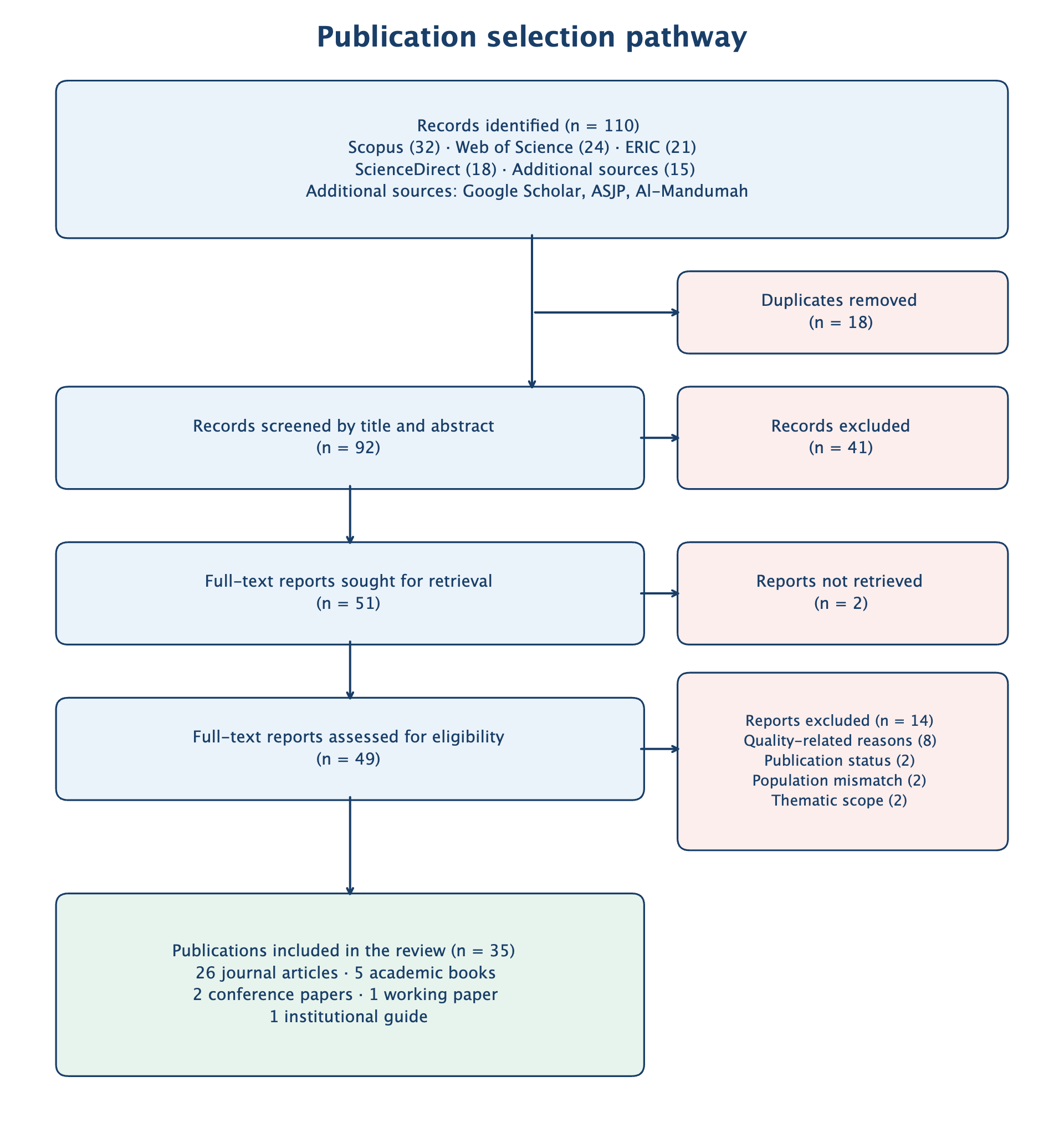
Figure 1 distinguishes the identification and screening of records from the retrieval and assessment of reports. It presents 51 reports sought for retrieval, two reports not retrieved, 49 full-text reports assessed for eligibility, 14 exclusions after assessment, and 35 included publications.
Source: Diagram reconstructed from the reported record counts and the selection register. Reporting conventions draw on Page et al. (2021).
2.2 Quality assessment and thematic synthesis
The selected publications were examined using a Quality Assessment Scheme (QAS), followed by structured data extraction and thematic synthesis. These procedures supported the interpretation of heterogeneous sources and the development of the SQIM framework.
-
Assessment criteria and scoring. The QAS assigns equal weight to four criteria, each scored from 0 to 2: 0 indicates that the criterion is not met, 1 that it is partially met, and 2 that it is fully met. Conceptual clarity concerns theoretical grounding and the definition of the constructs relevant to each publication. Methodological rigor concerns the transparency and appropriateness of the research design and analytical procedures. Educational relevance concerns the contribution to teacher education and the development of thinking skills. Analytical depth and contribution concern the depth of analysis, evidential support, and contribution to the integrative synthesis.
-
Retention threshold and score distribution. Only publications meeting the retention threshold of QAS ≥ 5/8 were included. Appendix B records 17 publications scoring 8, nine scoring 7, and nine scoring 6. Appendix A identifies eight exclusions for quality-related reasons. The individual scores of excluded publications are not available, which limits independent reconstruction of the threshold’s application.
-
Interpretation across document types. The QAS provides a common reading framework for heterogeneous sources. Methodological rigor must nevertheless be interpreted according to document type: empirical design for investigations, coherence and evidential grounding for conceptual work, and the basis of recommendations for institutional guidance. The assessment matrix records the scores but does not provide a source-by-source justification for each rating, which limits the reproducibility of the assessment.
-
Data extraction. A data extraction matrix was used to organize information on authorship, publication year, and Corpus ID; study design, population, sample size, and methodology, where applicable; empirical findings and theoretical or conceptual propositions; methodological limitations and contextual constraints; and alignment with the proposed SQIM dimensions. Appendix B presents the quality ratings and thematic assignments; the complete extraction matrix is not reproduced.
-
Thematic analysis and framework development. Qualitative synthesis followed Braun and Clarke’s (2006, 2021) thematic approach through familiarization, initial coding, theme development, theme review, theme definition, and interpretive writing. Teacher preparation, thinking instruction, and AI integration organize the thematic discussion. The four SQIM dimensions develop the conceptual implications of this synthesis. The examples in Table 3 are integrative interpretations rather than verbatim extracts or a complete record of individual coding decisions.
2.3 Ethical considerations and methodological limitations
The study draws on published literature and did not involve recruiting human participants. Its reporting distinguishes responsibility for the analysis from the use of editorial assistance and identifies the main limits affecting the interpretation of the synthesis.
-
Generative AI disclosure and author responsibility. Generative AI tools were used for translation support, language editing, and manuscript preparation. The author retains responsibility for the selection decisions, analysis, interpretation, and final text.
-
Language and database coverage. The search was restricted to English and Arabic and to the databases and repositories consulted. Relevant publications in other languages or inaccessible repositories may therefore have been omitted.
-
Heterogeneity of the evidence. Combining empirical investigations, conceptual frameworks, and institutional guidance requires attention to their different purposes and evidential roles. Conceptual propositions and policy recommendations cannot be interpreted as equivalent to observed learning outcomes. Generalization across teacher education settings therefore requires caution.
-
Documentary traceability. The absence of individual scores for excluded publications, source-specific justifications for the reported QAS ratings, and a complete published extraction and coding record limits the independent reconstruction of the review. These constraints affect the auditability of the selection and synthesis procedures.
-
Temporal coverage and empirical scope. Generative AI tools and educational practices change rapidly. The review therefore examines literature produced within a particular period rather than providing a lasting account of all available applications. SQIM remains a conceptual proposal derived from the synthesis; its feasibility and effects on teaching and learning require empirical investigation.
3. Critical synthesis of previous studies
Teacher education provides a foundation for understanding how pedagogical competencies develop within increasingly complex learning environments. Drawing on a critical integrative analysis of 35 selected publications, this section examines three connected areas: teacher education, the development of thinking skills, and the educational integration of artificial intelligence. These publications contribute different forms of knowledge, including empirical findings, theoretical perspectives, and institutional guidance. The synthesis therefore considers both their contributions and the limits of the conclusions they support. It then explains how these contributions inform the proposed Smart Quadruple Integration Model (SQIM).
3.1 Teacher education and the development of thinking skills
The reviewed literature connects the quality of teacher preparation with teachers’ capacity to design learning situations that require analysis, evaluation, creativity, and reflection. Across these contributions, a recurring concern is the relationship between professional knowledge and its enactment in instructional practice.
-
Professional preparation and the theory–practice relationship. Darling-Hammond (2017) emphasizes the importance of coherent teacher education programs that connect professional knowledge with opportunities to learn through practice. In the Arab context, Al-Dahshan (2019) calls for redesigning teacher preparation in response to the educational demands associated with the Fourth Industrial Revolution. These perspectives establish a broad rationale for reform, but they do not, by themselves, determine how particular training activities affect teachers’ classroom practices. Al-Freihat (2018) and Al-Faqih and Al-Kilani (2017) address teachers’ engagement with thinking strategies and point to differences in their application. Read together, these contributions suggest that familiarity with an instructional approach should be distinguished from the ability to use it consistently and appropriately.
-
Thinking instruction as an explicit pedagogical responsibility. Nasr (2000), Saadeh (2005), and Jakhrab and Al-Azouzi (2021) place thinking instruction within teacher preparation or instructional practice. Zohar’s (2004) work similarly draws attention to the difficulties involved in embedding higher-order thinking within subject teaching. These contributions support an approach in which thinking is made explicit through questions, tasks, scaffolding, and assessment. For teacher education, the central issue is how teachers identify the intellectual operations required by a task and recognize them in learners’ responses. An activity may invite participation without necessarily eliciting sustained reasoning; its cognitive demands therefore need to be examined alongside its classroom organization.
-
Teachers’ perspectives and evidence of learning. Salman (2024) and Al-Shurah (2024) approach creative thinking through teachers’ accounts or perspectives, while Al-Shehri (2025) addresses critical thinking in AI-mediated settings from teachers’ perspectives. Such contributions help identify perceived opportunities, practical concerns, and possible uses of educational technologies. However, reported benefits and direct assessments of learners’ reasoning support different conclusions. Positive perceptions can inform the design of a training program, but claims of improved thinking require evidence from learners’ explanations, decisions, revisions, or other relevant performances. This distinction is central to the present synthesis and to the proposed assessment orientation of SQIM.
3.2 AI integration: contributions and limits of existing frameworks
The integration of AI introduces questions about technological competence, instructional design, and the distribution of intellectual responsibility. The reviewed literature provides resources for examining these questions, although broad frameworks, accounts of technology use, and assessments of learning should retain their distinct evidential roles.
-
From technology integration to AI-related competencies. The TPACK framework provides a vocabulary for examining the relationships among teachers’ technological, pedagogical, and content knowledge (Mishra & Koehler, 2006). AI-TPACK extends this discussion to competencies associated with incorporating AI into teaching (Setiyawan et al., 2025). These frameworks help clarify the knowledge teachers may need when selecting and using technologies. The present review draws on this contribution while asking a more specific design question: how can teachers organize AI-mediated activities so that learners exercise and demonstrate higher-order thinking? This question concerns the enactment of professional knowledge in particular tasks and interactions.
-
Educational applications and the interpretation of their contributions. Al-Abbas and Hassan (2025) examine educational uses of AI applications, including Narakeet, while Al-Harbi and Al-Farhan (2024) connect teachers’ digital competencies with students’ future-oriented thinking. Al-Massad and Al-Farani (2023) contribute teachers’ perspectives on AI applications in education. Alongside Chen et al.’s (2020) analysis of AI in educational systems and Miao et al.’s (2021) institutional guidance, these publications broaden the discussion of possible educational uses. Their contributions nevertheless need to be interpreted in relation to their purposes and methods. Transforming instructional content, documenting teachers’ views, and examining learners’ thinking are related activities, but they do not provide interchangeable evidence of educational effectiveness.
-
Human–AI interaction and educational responsibility. Work on human–AI collaboration, including Ouyang et al. (2026), provides a basis for examining interaction patterns. Selwyn (2019) and Biesta (2022) offer conceptual perspectives for considering the educational purposes and responsibilities involved. For teacher education, these contributions invite attention to what learners are expected to do when AI assistance becomes available. A system may generate an explanation, suggest an alternative, or respond to a question; the pedagogical issue is how learners examine that contribution, justify their decisions, and revise their reasoning. SQIM takes this issue as a focus for designing teacher education activities.
Table 1 positions SQIM alongside TPACK and AI-TPACK by distinguishing their principal concerns and their implications for instructional design. The comparison identifies SQIM’s proposed emphasis; it does not establish its superiority or demonstrate its effectiveness.
Table 1. Comparison of TPACK, AI-TPACK, and the proposed SQIM framework
|
Analytical dimension |
TPACK (Mishra & Koehler, 2006) |
AI-TPACK (Setiyawan et al., 2025) |
SQIM (proposed framework) |
|
Primary focus |
Relationships among technological, pedagogical, and content knowledge |
Competencies for integrating AI in relation to pedagogy and content |
Connections among thinking skills, inquiry-based pedagogy, AI use, and reflective practice |
|
Treatment of technology or AI |
Technology considered in relation to pedagogical purposes and subject content |
AI considered within teachers’ professional knowledge and integration practices |
AI assistance considered within activities requiring learners to examine, justify, and revise their responses |
|
Metacognitive engagement |
Examined through the instructional practices developed from the framework |
Examined in relation to the competencies and practices addressed |
Explicitly targeted through scrutiny of AI outputs, explanation of choices, and reflection on revisions |
|
Main analytical focus |
Teachers’ interrelated knowledge domains |
Teachers’ knowledge and competencies for AI integration |
Interactions among the teacher, the learner, and the AI system within a learning task |
|
Assessment orientation |
Characterization of teachers’ technological, pedagogical, and content knowledge |
Examination of competencies for AI integration |
Proposed examination of learners’ reasoning, questioning, revisions, and exercise of intellectual responsibility |
|
Status in the present review |
Established conceptual reference for technology integration |
AI-specific framework examined in the selected literature |
Conceptual proposal requiring operational specification and empirical validation |
Source: Author’s comparative synthesis based on Mishra and Koehler (2006), Setiyawan et al. (2025), and the proposed SQIM framework. The SQIM column describes intended design features.
TPACK helps characterize the knowledge involved in technology integration, while AI-TPACK addresses competencies for incorporating AI into teaching. SQIM draws on these concerns and adds a focus on what teachers and learners do at key points in an AI-mediated activity. Its assessment questions concern the evidence that would indicate whether an activity elicited higher-order thinking and how that evidence might guide subsequent teaching.
3.3 Cross-cutting findings and conceptual foundations of SQIM
The three thematic axes provide complementary perspectives on teacher preparation. Their intersection highlights the design of learning tasks, the intellectual work expected of learners, and the evidence teachers use to evaluate that work. Table 2 summarizes these relationships.
Table 2. Thematic organization of the reviewed literature
|
Research axis |
Principal concern |
Selected reference sources |
Question for teacher education |
|
Axis 1. Teacher education, professional performance, and competency development |
Relationships among professional knowledge, preparation, and instructional practice |
Darling-Hammond (2017); Biesta (2022); Trust and Whalen (2020); Al-Dahshan (2019); Al-Anzi (2024); Majdoub (2025) |
How can professional knowledge inform the design of tasks, scaffolding, and assessment? |
|
Axis 2. Thinking skills and strategies for teaching thinking |
Pedagogical conditions for critical, creative, reflective, and future-oriented thinking |
Nasr (2000); Saadeh (2005); Al-Faqih and Al-Kilani (2017); Al-Freihat (2018); Jakhrab and Al-Azouzi (2021); Abrami et al. (2015); Mayer (2020); Koh et al. (2015); Al-Harbi and Al-Farhan (2024); Al-Shurah (2024) |
How can learners exercise and demonstrate intellectual responsibility when AI assistance is available? |
|
Axis 3. AI, digitalization, and pedagogical frameworks |
Educational uses of AI, integration competencies, and human–AI interaction |
Luckin (2018); Al-Abbas and Hassan (2025); Al-Shehri (2025); Al-Massad and Al-Farani (2023); Ouyang et al. (2026); Setiyawan et al. (2025); Miao et al. (2021); Bozkurt et al. (2023) |
What can an AI system contribute to inquiry, and how should that contribution be examined within the learning task? |
Source: Author’s thematic synthesis of the selected literature. The references are illustrative; the complete primary assignments are recorded in Appendix B.
The axes organize the interpretation rather than divide the literature into mutually exclusive domains. Some publications contribute to more than one question. For descriptive counting, Appendix B assigns each publication to one primary axis: 11 publications in teacher education, 12 in thinking skills, and 12 in AI and pedagogical frameworks. These counts describe the organization of the corpus; they do not measure the relative importance, evidential strength, or effectiveness of an axis.
-
Convergence around purposeful instructional design. Across the three axes, the synthesis brings professional knowledge, thinking instruction, and technology use into a common design problem. Teachers need to identify the reasoning an activity should elicit, select appropriate forms of assistance, and decide how learners will make their thinking visible. Within an AI-mediated task, this may involve examining an assumption, comparing explanations, checking a source, or defending a revision. The relevant question is how the activity connects these actions to an educational purpose.
-
Limits of the available evidence. The corpus includes publications with different purposes, methods, and levels of analysis. Conceptual arguments clarify educational concerns; institutional guidance frames responsibilities; teachers’ accounts describe experiences and perceptions; and empirical investigations examine practices or outcomes under particular conditions. Their integration supports the construction of a conceptual framework, but it does not establish a uniform effect of AI on higher-order thinking. Claims about such effects must remain proportionate to the evidence provided by each publication.
-
The design question addressed by SQIM. The review connects three established concerns: preparing teachers, teaching thinking, and integrating AI. The question pursued here is how these concerns can be coordinated within tasks, interactions, and assessment practices that make learners’ reasoning observable. SQIM proposes four dimensions for organizing that coordination: cognitive and metacognitive, inquiry-based pedagogical, AI-augmented technological, and reflective and transformative. These dimensions constitute an interpretive outcome of the review and a basis for subsequent investigation.
Table 3 makes the conceptual construction explicit. It connects questions arising from the synthesis with interpretive links and pedagogical design questions. The formulations represent the author’s reasoning across the reviewed literature rather than direct quotations or independently established findings.
Table 3. Conceptual links between the critical synthesis and the proposed SQIM dimensions
|
Question arising from the synthesis |
Interpretive link |
Pedagogical design question |
Proposed SQIM dimension |
|
What can a learner reasonably infer from a plausible AI-generated answer? |
Examination of claims, assumptions, and their evidential basis |
Which claim, assumption, or source should the learner check, and how should the resulting judgment be explained? |
Cognitive and metacognitive |
|
How can AI assistance contribute to an inquiry process? |
Organization of questioning, tentative explanations, counterexamples, and revisions |
When should the activity require a reason, an alternative explanation, or a revision? |
Inquiry-based pedagogical |
|
Which AI function is appropriate for a particular learning task? |
Selection of a bounded form of assistance in relation to the intended intellectual work |
What can the system contribute, and which decisions and justifications must the learner undertake? |
AI-augmented technological |
|
What evidence can inform the teacher’s next instructional decision? |
Reflection on learners’ work, explanations, and revisions |
What changed in the learner’s reasoning, and what adjustment to teaching does that evidence suggest? |
Reflective and transformative |
Source: Author’s interpretive synthesis. The rows describe the conceptual construction and intended pedagogical orientation of SQIM; they do not report empirical validation of the model.
Together, these links explain why the proposed framework extends beyond technological readiness. It asks teacher education to connect the thinking to be developed, the learning situation designed to elicit it, the function assigned to AI, and the evidence used to examine what learners have done. SQIM’s contribution lies in this proposed coordination. Its educational value will depend on how clearly its dimensions can be operationalized and how they perform when examined in teacher education settings.
4. Results and discussion
The critical integrative review brings together research on teacher education, thinking instruction, and the educational use of artificial intelligence. Its results consist of interpretive findings across the selected publications rather than measurements of an intervention. Three concerns emerge from this synthesis: connecting professional knowledge with instructional practice, distinguishing AI assistance from evidence of thinking, and preparing teachers to examine learners’ reasoning in AI-mediated activities. The following discussion considers these findings, the constraints affecting their implementation, and their implications for the proposed SQIM framework.
4.1 Main findings of the integrative synthesis
Across the three thematic axes, the literature highlights the relationship between educational intentions and the activities through which learners are expected to think. AI introduces additional possibilities for generating, presenting, and revising content, but the educational significance of these possibilities depends on how they are incorporated into teaching.
-
Connecting professional knowledge with instructional practice. Darling-Hammond (2017) and Zohar (2004) address professional preparation and the teaching of thinking from different perspectives, while Al-Dahshan (2019) situates teacher preparation within the educational changes associated with the Fourth Industrial Revolution. Read alongside Al-Freihat (2018) and Abrami et al. (2015), these contributions support a distinction between knowing a thinking strategy and designing tasks through which learners can apply and explain it. The implication for teacher education is that conceptual knowledge should be connected with opportunities to formulate questions, anticipate learners’ responses, and examine the reasoning elicited by an activity. Because the publications differ in purpose, setting, and research design, their convergence does not establish the prevalence of a single theory–practice difficulty across teacher education systems.
-
Distinguishing assistance with content from the development of reasoning. The reviewed publications address different educational functions of technology. Al-Abbas and Hassan (2025), for example, examine an application involving Narakeet and the transformation of instructional content, while Al-Massad and Al-Farani (2023) consider teachers’ perspectives on AI applications. Such contributions inform the discussion of possible uses and perceived opportunities. However, making material more accessible or easier to present does not, by itself, demonstrate improvement in higher-order thinking. That objective requires an instructional decision about what learners must examine, compare, justify, or revise. Within this synthesis, the relevant distinction concerns the contribution of a resource to completing a task and the intellectual work that the task requires learners to undertake.
-
Making reasoning available for examination. Work on thinking instruction, including Nasr (2000) and Saadeh (2005), provides a basis for considering how learners’ intellectual activity can become explicit. When considered alongside the questions raised by Bozkurt et al. (2023) and Miao et al. (2021) about educational uses of AI, this concern becomes especially relevant to interpreting completed work. A coherent answer may provide limited evidence of how a learner reached a conclusion or evaluated the assistance received. Teacher education therefore needs to address the design of activities that elicit explanations, comparisons, source checks, and justified revisions. These are proposed forms of evidence to examine; their usefulness depends on the learning objective and the conditions of assessment.
Together, these findings shift the discussion toward the relationship among the intended thinking process, the function assigned to AI, and the evidence used to assess learning. This relationship provides the central rationale for SQIM.
4.2 Constraints and conditions for AI-mediated thinking instruction
The synthesis also brings into dialogue institutional concerns, teachers’ professional perspectives, and instructional design questions. These operate at different levels. Program organization can shape the opportunities available for practice, while classroom decisions determine how those opportunities are used. The corpus supports consideration of the following constraints and conditions without establishing that they occur uniformly across settings.
-
Program coherence and preparation for educational change. Al-Dahshan (2019) and Majdoub (2025) contribute to the discussion of how teacher education can respond to changing educational demands. Biesta’s (2022) world-centred perspective offers a complementary conceptual basis for asking which educational purposes should guide such responses. Their connection in this review is interpretive: preparation for technological change involves decisions about educational purposes as well as professional competencies. For program design, this means connecting discussion of AI with subject teaching, thinking instruction, and opportunities for reflective practice. Introducing an additional technology component may have limited value if prospective or practising teachers have few opportunities to examine its pedagogical consequences.
-
Time, curricular priorities, and opportunities for inquiry. The work on learning and thinking instruction represented by Mayer (2020) and Saadeh (2005) informs the review’s concern with the organization of instructional activity. From this perspective, a design tension arises when content coverage leaves insufficient space for questioning, explanation, and revision. The present synthesis does not quantify curriculum overload or establish how often it occurs across institutions. It instead identifies a condition relevant to implementation: activities intended to develop higher-order thinking need time for learners to consider alternatives and justify decisions. Teacher preparation should therefore include practice in selecting manageable tasks whose cognitive demands can be examined within the available teaching time.
-
Assessment aligned with the thinking being elicited. Al-Faqih and Al-Kilani (2017) inform the discussion of thinking strategies in instructional practice, while Setiyawan et al. (2025) address competencies associated with AI integration. These concerns involve related but distinct assessment objects. Evidence that a teacher can operate or select an AI application does not establish that the resulting activity develops learners’ reasoning. Within the proposed approach, assessment should specify the thinking being sought and the observable work through which it will be examined. Depending on the task, this could include a justified comparison of answers, an explanation of a rejected claim, or an evidence-supported revision. These examples illustrate possible assessment practices; they are not presented as validated SQIM measures.
-
Professional judgment and teachers’ responses to change. Al-Anzi (2024) contributes to the discussion of teachers’ beliefs and dispositions toward AI integration. Selwyn (2019) provides a broader critical perspective on educational technology and professional responsibility. Read together, these contributions suggest that teachers’ responses should be examined in relation to the purposes, demands, and consequences of a proposed use. Concerns about reliability, workload, or the teacher’s role may identify matters that training needs to address. Professional development should create opportunities to discuss these concerns and test instructional choices, rather than assume that willingness to adopt a tool is sufficient evidence of pedagogical readiness.
-
Intellectual responsibility within human–AI collaboration. Ouyang et al. (2026) inform the discussion of collaboration patterns, while Al-Harbi and Al-Farhan (2024) connect AI applications, teachers’ digital skills, and students’ future-oriented thinking. Alongside the conceptual concerns raised by Selwyn (2019) and the institutional guidance of Miao et al. (2021), these contributions motivate attention to the distribution of work within a task. For SQIM, productive collaboration is a design objective: learners should have identifiable responsibilities for examining claims, selecting evidence, and explaining their decisions. AI assistance may contribute alternatives or feedback, but the activity must make clear how those contributions will be evaluated and used.
Table 4 summarizes the implications drawn from these findings. It identifies questions for teacher education rather than claiming an exhaustive diagnosis of the field.
Table 4. Synthesis findings and implications for the proposed SQIM framework
|
Synthesis theme |
Interpretation supported by the corpus |
Implication for teacher education |
Representative sources |
|
Professional preparation and educational purposes |
The literature connects professional knowledge, instructional practice, and broader questions about the purposes of education. |
Provide opportunities to relate technological choices to subject teaching, intended thinking processes, and professional judgment. |
Darling-Hammond (2017); Al-Dahshan (2019); Biesta (2022); Majdoub (2025) |
|
Thinking instruction and task design |
Contributions on thinking instruction support attention to explicit strategies, scaffolding, and opportunities to explain reasoning. |
Prepare teachers to design questions and tasks that elicit analysis, justification, consideration of alternatives, and revision. |
Nasr (2000); Saadeh (2005); Zohar (2004); Abrami et al. (2015); Al-Faqih and Al-Kilani (2017); Mayer (2020) |
|
Educational uses of AI |
The corpus includes accounts of applications, teachers’ perspectives, and frameworks for AI integration. These provide different forms of evidence. |
Distinguish the function performed by a tool from the learning objective and examine how the activity connects them. |
Miao et al. (2021); Bozkurt et al. (2023); Al-Massad and Al-Farani (2023); Al-Abbas and Hassan (2025); Setiyawan et al. (2025) |
|
Assessment of reasoning |
Thinking instruction and AI integration raise connected questions about what teachers and learners should be able to demonstrate. |
Develop task-specific criteria for examining explanations, evidence use, decisions, and revisions; investigate their reliability and usefulness. |
Al-Faqih and Al-Kilani (2017); Al-Shehri (2025); Setiyawan et al. (2025) |
|
Human–AI interaction and intellectual responsibility |
Conceptual, institutional, and collaboration-focused contributions raise questions about assistance, professional responsibility, and learners’ participation in reasoning. |
Specify which judgments learners must undertake and how they should evaluate and account for AI contributions. |
Selwyn (2019); Miao et al. (2021); Al-Harbi and Al-Farhan (2024); Ouyang et al. (2026) |
Source: Author’s critical synthesis of the selected literature. The implications are interpretive proposals for teacher education, not estimates of prevalence or demonstrated effects of SQIM.
4.3 Implications for SQIM and limits of the synthesis
The findings provide a rationale for coordinating four dimensions within teacher education: cognitive and metacognitive, inquiry-based pedagogical, AI-augmented technological, and reflective and transformative. Each dimension addresses a design question arising from the synthesis. Their coordination is SQIM’s proposed contribution.
-
Cognitive and metacognitive dimension. Teacher preparation should identify the thinking a task is intended to elicit and the judgments learners must make when using AI assistance. This dimension directs attention to examining claims, recognising assumptions, evaluating evidence, and monitoring understanding. In an illustrative activity, learners might compare an AI-generated explanation with a documented source and explain why they accept, qualify, or reject particular claims. The proposed mechanism is that explicit examination makes aspects of their reasoning available for discussion and assessment.
-
Inquiry-based pedagogical dimension. The synthesis suggests that access to an answer should be considered within a sequence of intellectual activity. Teachers need to decide when learners formulate an initial position, encounter an alternative, examine a counterexample, and revise an explanation. AI can be assigned a role within that sequence, but the pedagogical purpose must guide the interaction. This dimension therefore concerns the organization of questions, scaffolding, and opportunities for dialogue through which learners develop and defend their reasoning.
-
AI-augmented technological dimension. The selection of a system or function should follow from the learning task and the assistance required. Generating alternatives, transforming content, and providing feedback involve different contributions and require different checks. This dimension asks teachers to delimit the system’s role, examine its outputs, and specify how learners should use them. It also requires attention to whether the chosen assistance leaves learners sufficient intellectual work to undertake in relation to the stated objective.
-
Reflective and transformative dimension. Teachers need opportunities to examine what an activity elicited and decide what should change. Learners’ explanations, comparisons, and revisions may provide material for this reflection when interpreted alongside the task conditions and assistance received. The transformative orientation describes an intended process of revising instructional choices in response to such evidence. It does not indicate that the proposed framework has already demonstrated professional or learner transformation.
These dimensions describe design choices and proposed mechanisms. Their combination within SQIM remains a conceptual proposition whose educational value requires empirical investigation. In particular, future studies would need to specify the activities associated with each dimension, examine whether the proposed indicators capture relevant aspects of thinking, and investigate how the framework operates across subjects and teacher education settings.
The scope of the review also limits the conclusions that can be drawn. The 35 selected publications differ in document type, purpose, context, and evidential contribution. Bringing them into dialogue supports conceptual interpretation, but it does not provide a common effect estimate or establish that the identified concerns are equally prevalent across institutions. The English- and Arabic-language coverage and the selected search sources further delimit the literature represented.
Temporal differences require similar care. Foundational publications on thinking instruction can inform the design of AI-mediated activities, but they do not provide direct evidence about contemporary generative AI. Teachers’ accounts can identify perceived benefits and difficulties, while claims about changes in learners’ reasoning require appropriate performance evidence. These distinctions remain necessary when translating the synthesis into training activities and assessment practices.
The resulting contribution is a framework for connecting instructional purposes, AI functions, learners’ intellectual responsibilities, and teachers’ reflective decisions. SQIM offers a structured basis for designing and examining those connections. Whether that coordination improves teaching or learning, and under which conditions, remains an empirical question.
5. The Smart Quadruple Integration Model
SQIM organizes teacher preparation around four recurring decisions: the thinking to elicit, the inquiry through which it becomes visible, the function assigned to AI, and the evidence used to revise teaching. These decisions correspond to four interdependent dimensions: cognitive and metacognitive, inquiry-based pedagogical, AI-augmented technological, and reflective and transformative. Their integration constitutes a conceptual proposal developed from the review, rather than an intervention whose effectiveness has already been established.
The dimensions can inform one another throughout a lesson cycle. Difficulties in students’ final explanations, for example, may lead the teacher to revise the initial task, provide additional subject knowledge, or change when assistance is offered. The model therefore treats integration as a process of instructional judgment and adjustment. It does not require AI to be used at every stage.
5.1 The cognitive and metacognitive dimension
This dimension draws on discussions of thinking instruction by Zohar (2004), Nasr (2000), and Al-Faqih and Al-Kilani (2017). It connects knowledge about thinking strategies with opportunities to apply them in tasks requiring analysis, evaluation, and explanation. In AI-mediated activities, the specific concern is how teachers and learners examine generated content and account for the judgments they make.
-
Critical appraisal of AI-generated content. Within SQIM, algorithmic critical thinking refers to examining claims, assumptions, evidence, and omissions in AI-generated outputs. The expression describes a proposed educational focus; it does not designate a separately validated cognitive construct or imply access to the system’s internal computational processes. This focus connects with the questions about critical thinking addressed by Al-Shehri (2025). For example, learners examining a generated explanation of climate change may compare particular claims with teacher-selected scientific sources, identify an unsupported inference, and explain whether the evidence warrants the conclusion. The task focuses on the justification of claims rather than the fluency or apparent confidence of the generated text.
-
A classroom illustration. Students investigating a local environmental question first formulate a tentative explanation using a short, teacher-selected set of observations. They then examine an AI-generated alternative prepared and checked by the teacher. Their task is to identify one point of agreement, one unsupported claim, and one question requiring additional evidence. The generated text becomes an object of analysis against which learners examine their own explanations. The comparison gives them a reason to revisit both accounts rather than simply replace their initial attempt.
-
Metacognitive regulation. The metacognitive component appears when students explain why they sought assistance, what changed after the comparison, and what remains uncertain. A short reflective account can provide more useful information than a general statement that the tool helped. A learner might explain that the system suggested a factor not previously considered, while acknowledging that the available evidence did not establish its relevance to the local case. Such an account connects assistance with the monitoring and regulation of reasoning. It remains one source of evidence to interpret alongside the learner’s work.
-
A counterexample and its revision. A task asking students to produce an AI summary and then answer questions whose wording closely mirrors that summary may provide limited opportunities for analysis or evaluation. Even an accurate summary does not establish that learners have examined its reasoning. A SQIM-informed revision would change the intellectual demand: students might compare the summary with its source, identify a qualification that was lost, and explain why that qualification matters. The technological resource is retained, but its pedagogical function changes.
5.2 The inquiry-based pedagogical dimension
This dimension concerns the organization of questions, problems, evidence, and dialogue. It draws on the review’s discussion of thinking instruction and inquiry, including Saadeh (2005), Mayer (2020), and Al-Shurah (2024), while retaining the distinctions among their theoretical and empirical contributions. Problem-based, inquiry-based, and multimedia approaches offer different resources for instructional design; their relevance to SQIM depends on the task and the thinking it is intended to elicit.
-
Digital Socratic instruction as a proposed practice. The expression digital Socratic instruction describes a teacher-designed sequence in which AI-generated questions or alternatives are used to support examination of a problem. Its educational purpose is to sustain questioning and justification. The teacher remains responsible for deciding whether the exchange serves the intended learning and for intervening when it introduces an error or diverts attention from the problem. The term identifies a proposed practice within SQIM rather than a validated instructional method.
A teacher might begin an interaction with the following instruction:
Act as a Socratic tutor. I will provide a geometry problem. Ask one question at a time to help me examine the problem and justify my reasoning. Do not provide the final answer immediately. If my response contains an error, ask a question that helps me reconsider it.
This instruction expresses an intended interaction. It cannot guarantee that the system will respond appropriately, and the teacher must examine the resulting questions before or during their educational use.
-
Prompt design within inquiry design. The educational quality of a prompt cannot be judged only by its length or technical sophistication. A short instruction eliciting a useful comparison may serve learning better than a detailed instruction producing a complete solution. Prospective teachers should therefore explain why a particular exchange is appropriate, what learner activity it is expected to support, and what evidence would indicate that the exchange has become unproductive. They should also plan how the activity could proceed through teacher questions, peer discussion, or prepared materials if the tool were unavailable.
-
A contrasting project scenario. An AI-generated project may appear inquiry-based because it contains open questions, group work, and a final presentation. Yet students may divide the work into disconnected searches and assemble generated sections without examining a shared problem. A stronger design establishes a common decision, requires groups to compare conflicting evidence, and asks each learner to defend part of the reasoning. The improvement concerns the organization of inquiry and individual responsibility within collective work. Generating more material would not resolve the initial design weakness.
5.3 The AI-augmented technological dimension
This dimension develops the technological questions raised by TPACK and the AI-related competencies discussed in the reviewed literature, including Setiyawan et al. (2025) and Al-Harbi and Al-Farhan (2024). It asks teachers to select a bounded technological function in relation to subject content, pedagogical purpose, and the intellectual work expected of learners.
Within SQIM, a cognitive assistant is a functional description of selected forms of assistance. It does not assign the system the professional responsibilities of a teacher or assume that its responses accurately represent a learner’s understanding.
-
Instructional preparation and resource adaptation. AI may be used to propose contrasting explanations, draft problem scenarios, or suggest examination questions. Teachers must check these materials for accuracy, relevance, accessibility, and consistency with the intended task. Content transformation represents a distinct function: the use involving Narakeet discussed by Al-Abbas and Hassan (2025), for example, should not be treated as evidence that the application diagnoses reasoning. The educational contribution of each resource depends on what it does within the activity.
-
Feedback and assessment support. A system may generate feedback suggestions or identify passages for closer examination. Such outputs require checking against the task, the subject matter, and explicit assessment criteria. Feedback on the wording or structure of a response should be distinguished from a judgment about the quality of its reasoning. SQIM therefore treats AI-generated feedback as material for teachers and learners to examine. Its accuracy and usefulness must be investigated in the setting in which it is used.
-
Learning analytics and interpretive limits. Work on human–AI collaboration, including Ouyang et al. (2026), informs the consideration of interaction records and patterns. However, an activity trace does not directly reveal the cognitive process that produced it. A long delay may reflect difficulty, careful thought, distraction, or an access problem. Frequent requests for assistance may indicate exploration or dependence. Interpretation should combine selected traces with learners’ explanations and subject-specific evidence. When interaction records are collected, their educational purpose, access conditions, and handling should be defined before use.
-
Technological judgment within professional knowledge. Teachers need sufficient understanding of a resource to recognize its limits, examine its outputs, and explain the rationale for using it. This involves more than operating an interface or reproducing a prompt. It includes deciding when a prepared resource, peer exchange, or direct explanation would serve the task more effectively. SQIM’s contribution is to connect these technological decisions explicitly with the evidence sought about learners’ reasoning.
5.4 The reflective and transformative dimension
This dimension connects professional preparation with the examination and revision of teaching. It draws on Darling-Hammond (2017) and the discussion of reflective practice represented by Majdoub (2025). Teachers are encouraged to formulate an instructional question, examine selected evidence, and use their interpretation to plan a subsequent adjustment. Such inquiry can inform professional practice without automatically constituting a formal action research study.
-
Digital portfolios as records of professional reasoning. A digital portfolio can bring together a lesson plan, selected learner responses, the prompts or resources used, and a short account of revision. Its value depends on selection and interpretation. A large collection of screenshots may offer little insight into professional judgment if the teacher does not explain what they show. A smaller collection can be more informative when it identifies an unexpected response, explains how the evidence altered an assumption, and specifies what will be examined next.
-
AI-assisted analysis as a provisional aid. An AI-assisted analysis might classify classroom questions or suggest recurring patterns in interaction. Any such classification needs to be checked against the original material and the criteria used. A report identifying a high proportion of closed questions, for example, would not by itself establish weak teaching: short recall questions may serve a legitimate purpose at a particular stage. The teacher must consider the sequence of activity, the subject content, and learners’ responses before deciding whether a change is warranted.
-
Revision that includes limiting AI use. Teachers should retain the option to conclude that a tool contributed little to the intended learning. If students concentrated on obtaining an acceptable response rather than examining evidence, the next cycle might delay assistance or remove it from part of the activity. Such a decision is compatible with SQIM. Its reflective orientation concerns the quality of professional judgment, including recognition that a technology may not serve a particular objective.
The four dimensions can be illustrated through a single hypothetical lesson sequence. Before any AI interaction, students examine a short account of a local environmental change and formulate an initial explanation. The teacher asks them to distinguish observations from assumptions and identify information that would strengthen their account. This establishes a starting point for comparison within the lesson; it is not a standardized research measure.
Students then compare their account with a generated explanation prepared and checked by the teacher. They locate a plausible point, a questionable inference, and a missing qualification. They may request a counterargument, but must evaluate it against the supplied evidence. The teacher intervenes when a factual error or misleading question would obstruct inquiry. The purpose of the exchange is to make reasoning available for discussion.
The final task is an independent explanation stating what can be concluded, what remains uncertain, and why. Students identify one revision made after the comparison and justify it. The teacher reviews selected responses to consider whether difficulties concern subject knowledge, interpretation of evidence, task wording, or the assistance provided. The next lesson can then address the difficulty identified.
Table 5. A hypothetical classroom scenario illustrating the four SQIM dimensions
|
Model dimension |
Teacher’s pedagogical action |
Target thinking processes |
Bounded AI contribution |
Evidence to examine |
|
Cognitive and metacognitive |
Ask learners to distinguish observations from assumptions and compare their initial explanation with an alternative. |
Analysis, evaluation, and monitoring of understanding |
Supply a contrasting explanation prepared and checked by the teacher. |
Identification of an unsupported claim and explanation of the evidence needed to assess it. |
|
Inquiry-based pedagogical |
Organize a shared environmental problem and sequence questions requiring reasons and counterarguments. |
Inquiry, logical reasoning, and synthesis |
Suggest questions or counterarguments for teacher review and learner examination. |
Learners’ responses to a counterargument and the reasons given for accepting or rejecting it. |
|
AI-augmented technological |
Select an appropriate function, check its outputs, and provide an alternative route through the task. |
Evaluation of assistance and informed decision-making |
Generate a bounded contribution, such as an alternative account or feedback suggestion. |
Explanation of how the contribution was checked, used, qualified, or rejected. |
|
Reflective and transformative |
Review selected work and exchanges, then identify an instructional adjustment. |
Learner reflection and teacher professional inquiry |
Help organize records or suggest patterns, subject to verification. |
A justified learner revision and the teacher’s explanation of the next instructional decision. |
Source: Hypothetical classroom illustration developed from the author’s framework. The activities and evidence described are proposed examples, not findings from an implemented intervention.
The scenario illustrates how all four dimensions can operate within one activity. A central piece of evidence is the learner’s explanation of what changed after comparison. A fluent final answer alone would leave open whether the learner had reconsidered the reasoning or adopted a formulation supplied by the system. The initial attempt, the comparison, and the independent explanation provide complementary material for examining that distinction.
5.5 Contribution and operational implications of SQIM
SQIM proposes a way of coordinating instructional decisions that are often discussed through separate concerns: thinking skills, inquiry design, technological competence, and reflective practice. Its contribution lies in making their relationships explicit within a common activity. The framework does not assume that these concerns are absent from existing approaches or that their combination has already produced improved outcomes.
Table 6 expresses this contribution through professional responsibilities and observable actions. These responsibilities can be discussed, modelled, and examined in teacher education without treating them as replacements for established teaching expertise.
Table 6. Teacher responsibilities and instructional decisions in the proposed SQIM framework
|
Dimension |
Professional responsibility emphasized |
Key instructional decision |
Illustrative pedagogical action |
|
Cognitive and metacognitive |
Examine claims and support learners’ regulation of reasoning. |
What thinking should the learner undertake, and how will it become visible? |
Ask learners to verify a generated claim, identify an assumption, and explain a revision. |
|
Inquiry-based pedagogical |
Design and guide an environment for questioning and justification. |
How should questions, evidence, alternatives, and feedback be sequenced? |
Organize a shared problem and require a justified response to a counterargument. |
|
AI-augmented technological |
Select and evaluate assistance in relation to content and pedagogy. |
Which system function is appropriate, and what are its limits? |
Test an output, delimit its use, and prepare an accessible alternative to the AI interaction. |
|
Reflective and transformative |
Interpret learning evidence and revise teaching. |
What does the available work suggest, and what should change next? |
Compare selected attempts and explanations, examine competing interpretations, and document an instructional adjustment. |
Source: Author’s development of the proposed SQIM framework from the critical integrative review.
Responsibility remains identifiable at each stage. A system can generate a contrasting explanation; the teacher decides whether the contrast is relevant and sufficiently accurate for the task; and learners weigh the evidence and defend their conclusions. The same distinction applies to feedback. A generated suggestion becomes educationally useful only through decisions about its relevance, validity, and use.
Figure 2 places the four dimensions around a common instructional problem, with teacher judgment at the centre. The arrows represent reciprocal relationships among design, interaction, and reflection. For example, a decision to delay AI feedback can change what learners attempt independently and what evidence becomes available for subsequent assessment.
Figure 2. Proposed conceptual architecture of the Smart Quadruple Integration Model (SQIM)
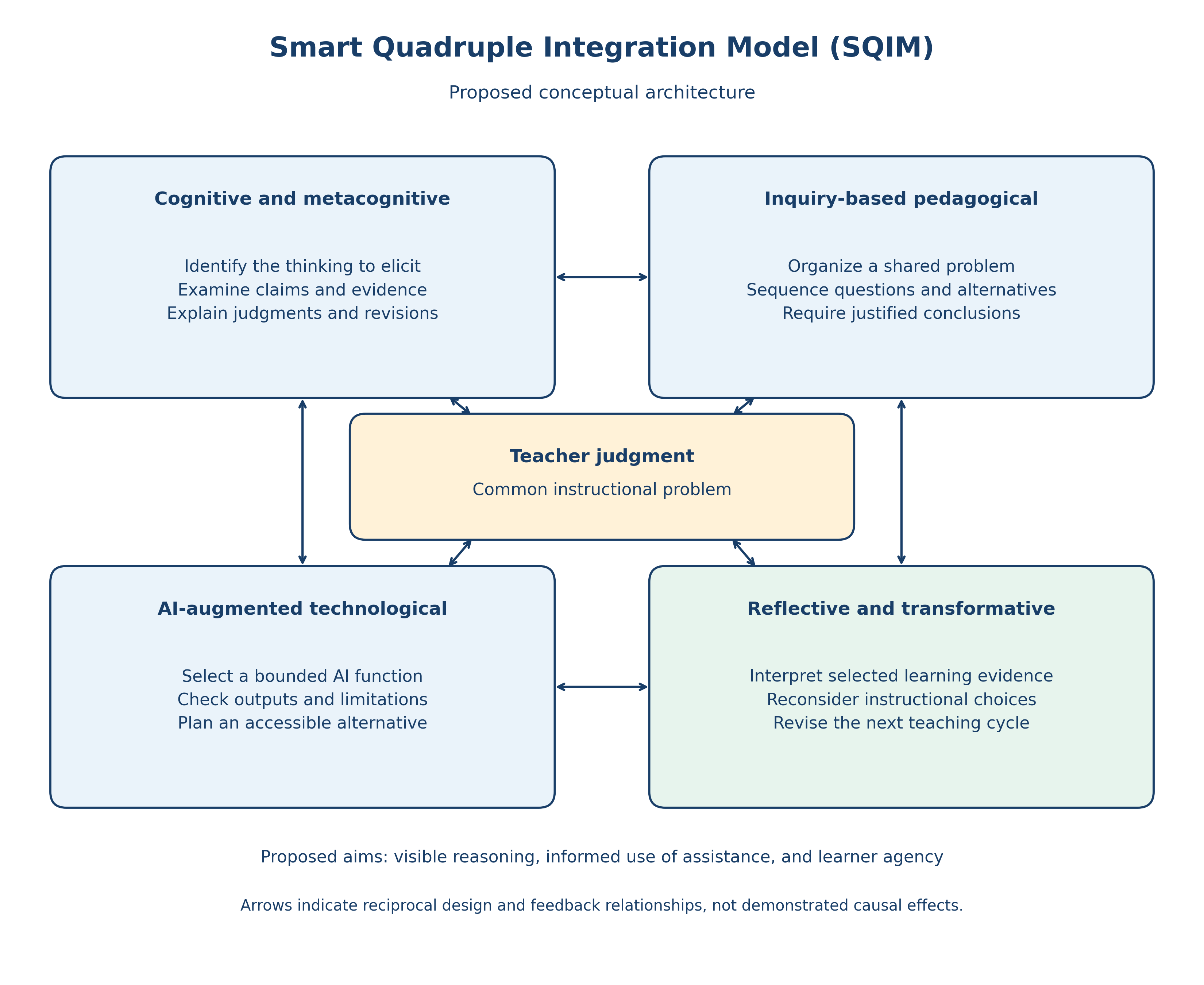
Source: Diagram developed from the author’s proposed framework. Arrows indicate reciprocal design and feedback relationships. The outcomes identified are intended aims rather than demonstrated effects.
The model places teacher judgment at the centre because teachers decide which intellectual work learners should undertake, what assistance is appropriate, and which artefacts can provide relevant evidence. This emphasis connects the proposal with the concerns about professional preparation and educational change discussed by Al-Dahshan (2019) and Al-Anzi (2024). It also relates to the questions of human agency raised in Miao et al. (2021) and Bozkurt et al. (2023).
Preparing teachers to exercise that judgment involves checking the sources and assumptions behind generated explanations, recognizing when a tool contributes little, and designing opportunities for learners to defend a decision independently. These responsibilities require subject knowledge and pedagogical interpretation alongside technological familiarity.
A central proposition of SQIM is that assistance may support autonomy when its purpose and limits are understood. Independence need not mean the absence of resources: learners already work with texts, peers, diagrams, and teacher explanations. AI presents a particular instructional difficulty because it can generate a complete response resembling the expected product of learning. Teachers therefore need to examine whether the assistance gives learners a productive way into the problem or removes the intellectual work the task was intended to elicit.
One proposed design sequence is commitment, comparison, and revision. Learners first express a position or method, encounter an alternative, and then justify what they retain or change. The initial commitment gives the comparison a specific purpose, while the revision makes its consequences available for discussion. This sequence is a design proposition rather than a universal procedure. Beginners, learners needing additional support, or those encountering unfamiliar content may need examples, shared formulation, or teacher guidance before they can produce an initial response.
The reflective dimension raises a further methodological issue. Digital records make some aspects of activity easier to capture than others. A transcript records exchanges with a system but may omit peer discussion, hesitation, or an unspoken judgment. A dashboard can summarize activity without establishing understanding. The availability of a metric should therefore not determine the definition of thinking used in the activity.
For this reason, SQIM proposes interpreting several forms of evidence together: the learner’s initial attempt, selected exchanges, a final explanation, and the teacher’s account of the task conditions. None provides a complete representation of cognition. Convergence may strengthen an interpretation, while disagreement should prompt closer examination. A learner who succeeds with assistance but cannot explain the reasoning independently presents a different instructional question from one who understands the argument but struggles to express it fluently.
This distinction matters across languages and educational contexts. Linguistic fluency should not become an unexamined proxy for reasoning, and polished AI-generated wording should not conceal uncertainty. Conversely, a hesitant formulation may contain a sound inference or an important distinction. Teachers can explore these possibilities through follow-up questions, alternative explanations, and attention to subject-specific evidence. Technology may inform that interpretation, but professional judgment remains necessary.
The operational contribution of SQIM is thus to connect four questions throughout a teaching cycle: what thinking is intended, how the activity elicits it, what assistance contributes, and what the resulting evidence warrants. These questions provide a basis for developing training activities and studying their implementation. Whether the proposed coordination improves higher-order thinking, professional judgment, or learner agency remains to be established through appropriately designed empirical research.
6. Conclusion
6.1 Main contribution
This critical integrative review examines the relationship among teacher education, AI integration, and the development of higher-order thinking. It identifies an instructional design question: how can teachers organize assistance so that learners continue to interpret evidence, question explanations, and justify their own decisions? Access to AI may expand the materials and feedback available, but its educational contribution depends on the activity in which it is used and the intellectual responsibilities assigned to learners.
The proposed Smart Quadruple Integration Model brings these concerns together through four interdependent dimensions: cognitive and metacognitive, inquiry-based pedagogical, AI-augmented technological, and reflective and transformative. Its contribution is a coordinated set of design and reflection questions that teachers and teacher educators can apply within particular subjects and learning environments. These questions concern the thinking to be elicited, the inquiry through which it becomes visible, the function assigned to AI, and the evidence used to revise teaching.
SQIM also highlights the distinction between a completed product and evidence of learning. A fluent assisted response may provide limited information about what a learner understands or can explain independently. The framework therefore proposes examining initial attempts, selected interactions, justified revisions, and subsequent explanations in relation to the conditions of the task. These materials can inform professional judgment, although none provides a complete representation of thinking.
The model remains a conceptual proposal. Its educational value will depend on whether its distinctions can be applied meaningfully in teacher preparation and whether the activities developed from them support the intended learning. Evaluation should examine what learners can explain, defend, or transfer after receiving assistance, as well as how teachers interpret that evidence and revise their practice.
6.2 Implications for teacher education and institutional support
The synthesis suggests several directions for teacher preparation and institutional support. These are proposals for development and investigation rather than recommendations derived from an empirical evaluation of SQIM.
-
Professional competencies and institutional priorities. Institutions can consider how existing professional standards address the relationship among AI use, thinking instruction, assessment, and teacher judgment. The immediate purpose should be to identify relevant competencies and investigate ways to develop them. Resources should support professional learning, access to appropriate materials, and opportunities to examine teaching practices alongside technological provision. Small collaborative development projects may offer a practical setting for testing these arrangements before broader adoption is considered.
-
Microteaching and the examination of instructional design. Microteaching offers one possible setting for working with SQIM. Prospective teachers can design a short inquiry task, specify its thinking objective, choose a bounded role for AI, and identify the evidence they would examine. Peers can then consider whether the activity gives learners responsibility for interpreting evidence and defending a conclusion. The subsequent discussion should examine the relationship among the objective, task, assistance, and assessment. Attractive materials or a confident presentation do not, by themselves, establish the quality of that relationship.
-
Comparison of learner responses. Teacher educators can present anonymized responses or clearly identified constructed examples illustrating different relationships between expression and reasoning. These might include a fluent but weakly justified answer, a hesitant but well-reasoned answer, and an answer improved through an explained revision. Prospective teachers can identify what each response warrants them to infer and propose follow-up questions. Constructed examples serve the development of interpretive judgment; they do not constitute evidence of the framework’s effectiveness.
-
Reflective portfolios and professional inquiry. Teachers can select a limited number of artefacts documenting a change in their thinking about instruction. Each artefact should include an explanation of its significance and the decision it informed. A portfolio can therefore include a task, selected learner responses, a relevant exchange, and an account of the next instructional adjustment. Its assessment should attend to the quality of analysis, including justified recognition of a limitation or an unsuccessful attempt. Collecting generated lesson plans without examining their use would provide a different and more restricted account of professional learning.
-
Ethical responsibilities within teaching decisions. Preparation programs should connect ethical discussion with the organization of learning activities. When students are expected to work independently at one stage and use assistance at another, the purpose of that distinction should be explained. Expectations for acknowledging AI contributions should be clear and proportionate to the task. Where records of interaction are collected, their educational purpose and handling should be specified. These decisions form part of instructional design and assessment.
-
Equitable participation and alternative resources. Tasks should remain accessible when a system is unavailable, unsuitable, or unequally accessible. Teacher-prepared examples, peer discussion, and selected texts can provide alternative opportunities for comparison and feedback. Planning such alternatives helps identify the specific contribution expected from AI and reduces the risk that access to a resource becomes confused with the intellectual capacity being assessed. Appropriate support may also vary depending on learners’ linguistic resources, subject knowledge, and educational needs.
These proposals can be explored through short modules and adapted to disciplinary requirements. A geometry activity may ask prospective teachers to examine how learners justify applying a definition. An environmental inquiry may focus on the interpretation of incomplete or conflicting evidence. In each case, the relevant question is how assistance relates to the reasoning learners subsequently demonstrate.
6.3 Limitations and directions for future research
The scope and composition of the review limit the conclusions that can be drawn. The selected publications differ in document type, purpose, context, and evidential contribution. Their integration supports conceptual interpretation, but it does not provide a common estimate of a learning effect or establish the prevalence of the identified concerns across teacher education systems. The reported selection counts describe the documentary process rather than the effectiveness of an educational intervention.
The review is also bounded by its search sources, English- and Arabic-language coverage, and the publications available during the search period. Foundational work on thinking instruction informs the conceptual discussion but does not supply direct evidence about contemporary generative AI. Similarly, teachers’ perceptions, institutional guidance, and measured learning outcomes support different kinds of inference. These distinctions constrain the claims that can be made from their synthesis.
A further limitation concerns the proposed framework itself. The four dimensions organize instructional questions, but their clarity, relationships, and practical usefulness have not been established through implementation. The classroom scenarios, suggested activities, and candidate indicators presented in this article are illustrations for development and investigation. They are not reported outcomes.
Future research should therefore proceed through complementary stages:
-
Examine conceptual clarity and feasibility. An initial study could investigate whether teacher educators and prospective teachers understand and apply the four dimensions consistently. Analysis of lesson plans, discussions, and reflective accounts could identify which distinctions inform decisions and which remain labels. This stage would support refinement of the framework and its accompanying materials. Favorable participant impressions would provide information about acceptability, while claims about instructional value would require additional evidence.
-
Investigate implementation across subjects and contexts. Classroom studies could examine how SQIM informs the design and conduct of activities in different disciplines. Comparative or quasi-experimental designs may then investigate outcomes, provided they account for relevant differences in content, teaching time, resources, teacher experience, and available support. Otherwise, an observed difference might reflect stronger preparation or additional inquiry time rather than the framework itself. Longer-term studies could examine whether changes in professional judgment or learning persist beyond an initial implementation.
-
Develop and validate assessment indicators. Assessment should extend beyond the quality of a final assisted product. Candidate indicators include independent explanation, justified responses to counterarguments, appropriate source checking, and transfer to a related problem without the same assistance. Teacher learning could be examined through changes in design rationales and interpretations of student work. These indicators require operational definitions and examination of their validity and reliability in the relevant settings.
-
Study learning analytics alongside other evidence. Interaction records may help examine assistance and revision, but their interpretation should be connected to learners’ explanations, task conditions, and subject-specific work. Research should investigate what particular traces can reasonably indicate and where alternative explanations remain possible. The availability of detailed records does not, by itself, establish access to cognitive or metacognitive processes.
The central proposition of SQIM is that teacher preparation can organize the relationship among thinking, inquiry, assistance, and reflection more explicitly. Its promise lies in the instructional questions it makes available for examination. Establishing its contribution requires evidence about how teachers use those questions and what learners can subsequently understand, justify, and do independently.