Introduction
Manuscript heritage is not preserved by digitization alone. A high-resolution image may reduce handling of a fragile original, yet it can also create a new preservation problem if master files are poorly documented, stored on a single device, detached from provenance metadata, or delivered through proprietary interfaces that cannot be migrated. The central issue is therefore not whether archives should become digital, but how institutions can build a chain of custody that links the material object, the digital surrogate, the descriptive record, the machine-generated transcription and the long-term preservation package.
In Algeria, this question is especially important because manuscript and archival holdings are institutionally dispersed. The National Library, the National Centre for Manuscripts, the National Archives Centre, religious institutions, local repositories, zaouïas and private khizanates preserve materials produced in different periods, scripts and administrative traditions. Recent public initiatives demonstrate that digitization has become an explicit heritage priority: the Ministry of Culture and Arts has long maintained a National Centre for Manuscripts, the 2024 decree creating the Centre for the Protection of Religious Heritage and Manuscripts explicitly assigns it functions of inventorying, indexing and digitizing religious manuscripts, and a digitization workshop was launched in May 2026 at the National Public Museum of Islamic Calligraphy in Tlemcen in coordination with the local branch of the National Centre for Manuscripts (Algérie Presse Service, 2026; Ministère de la Culture et des Arts, n.d.; République algérienne démocratique et populaire, 2024). These initiatives establish an institutional basis, but they do not by themselves provide a national digital preservation architecture.
This article examines three complementary families of technology—advanced imaging, artificial intelligence and digital infrastructures—in relation to the preservation and scholarly use of Algerian manuscript heritage. It distinguishes established practices from experimental possibilities and separates the documentary categories to which these technologies apply. Institutional examples are used to contextualize the analysis, while international research provides a basis for assessing technical capabilities and limits. The purpose is to identify the technical, archival and governance conditions under which digital tools can improve preservation, discoverability and scholarly access. This distinction is necessary because an experimentally successful technique does not, by itself, demonstrate either national deployment or suitability for the diversity of Algerian collections.
Methodologically, the article is a critical narrative review and strategic analysis. It combines peer-reviewed research on HTR and cultural-heritage imaging with international standards for records management, digital preservation and interoperability, as well as official Algerian sources documenting institutional mandates and current digitization initiatives. Because the article does not report a new experimental corpus, it treats performance figures from external systems as context-dependent benchmarks rather than results that can be transferred directly to Algerian collections. The analysis is organized around a simple sequence: define the heritage object; identify the barriers to use; distinguish capture from computation; connect images and transcriptions to interoperable metadata; and finally situate these technologies within a sustainable national preservation policy.
1. Defining the object: manuscripts, archival manuscripts, and digital surrogates
The expression manuscript heritage covers several documentary realities that should not be conflated. A manuscript codex is a hand-produced book or bound textual object. An archival manuscript may instead be a letter, register, administrative file, field notebook or series created in the course of an activity. Archives may also contain typewritten documents, photographs, maps and other non-manuscript materials. The distinction matters because the descriptive logic, conservation treatment and research use of a codex are not identical to those of an archival fonds.
For archival materials, provenance and original order remain central because meaning is produced by relationships among records, creators and activities. Contemporary archival description increasingly emphasizes such contexts rather than isolated item cataloguing. The International Council on Archives’ Records in Contexts framework formalizes this relational approach, while Encoded Archival Description remains widely used to encode finding aids (International Council on Archives, 2023). For manuscript books, codicological description, textual structure, scribal hands, bindings and material features may require additional conventions. A national programme should therefore avoid forcing all manuscript objects into a single descriptive template.
A second distinction concerns the digital surrogate. A digital image is not the manuscript itself; it is a representation created through a documented capture process. The scholarly value of that representation depends on resolution, tonal and colour accuracy, file format, calibration, completeness, naming conventions and the preservation of technical metadata. The FADGI technical guidelines, although developed in a United States federal context, are useful because they treat digitization as a measurable imaging process rather than a simple act of scanning. This approach is transferable: institutions need quality targets, capture documentation and validation procedures before they need sophisticated artificial-intelligence layers (Federal Agencies Digital Guidelines Initiative, 2023).
Once images are produced, a second informational object emerges: the derived text. A transcription generated by HTR has a different evidential status from the image and from a human-validated edition. The system may assign confidence values, but confidence does not eliminate error. For scholarly use, the relationship between image, automatic transcription, corrections and editorial interventions should remain traceable. The safest digital architecture therefore preserves several linked layers rather than replacing one with another: preservation master image, access derivative, machine transcription, validated transcription, descriptive metadata and, where appropriate, scholarly annotation.
2. Algerian manuscript heritage: access, dispersion, and documentary sovereignty
The Algerian documentary landscape combines the consequences of historical dispersion with the practical fragmentation of present-day custody. Research on municipal archives has shown the historiographical importance of local holdings and the uneven state of their identification and accessibility (Guillopé, 2024). At another scale, the transfer of Algerian archives to France during the decolonization period continues to shape debates about sovereignty, provenance and access (Soufi, 2014). These are not identical problems: one concerns internal description and institutional capacity; the other concerns collections located outside the national territory. Yet both point to the same strategic need—reliable information about what exists, where it is held and under what conditions it can be consulted.
Digitization can mitigate geographic distance, but only after holdings have been identified and rights have been clarified. A national portal that merely aggregates images without durable identifiers, collection-level context and provenance data would reproduce fragmentation in digital form. Conversely, a shared discovery layer could connect descriptions held by different institutions while allowing custodians to retain control over master files. This is where interoperability becomes more important than centralization: the goal is not necessarily to place every collection in one database, but to ensure that different systems can exchange structured descriptions and deliver images in predictable ways.
The institutional landscape already contains elements on which such a strategy could build. The National Centre for Manuscripts has a statutory role in the protection and conservation of manuscript heritage. The 2024 Centre for the Protection of Religious Heritage and Manuscripts has explicit responsibilities for inventory, classification, indexing and digitization. In May 2026, the Tlemcen digitization workshop provided a concrete example of cooperation between a museum and a branch of the National Centre for Manuscripts (Algérie Presse Service, 2026; Ministère de la Culture et des Arts, n.d.; République algérienne démocratique et populaire, 2024). These documented initiatives are more modest than a fully integrated national platform, but precisely for that reason they are a sound starting point for policy.
Digital sovereignty in this field should therefore be defined operationally. It means Algerian institutions can identify their collections, produce preservation-quality digital masters, document rights and provenance, export metadata in open formats, preserve files long term, and provide researchers with reliable access without depending on a single commercial platform. Sovereignty is not achieved by adding a blockchain layer to an undocumented repository; it is achieved by controlling the full lifecycle of trustworthy digital objects.
3. Preservation before digitization: material risk and capture quality
Material fragility must be assessed in relation to the chemical composition of supports and inks, their production history and their storage conditions. Not all historic papers are lignin-rich, and not all manuscript supports age in the same way. Wood-pulp papers, particularly many modern papers, may contain lignin and acidic compounds that accelerate embrittlement. Parchment, rag paper and mixed supports present different conservation profiles. Iron-gall ink poses a distinct risk: depending on formulation and environmental conditions, iron ions and acids can corrode ink, cause embrittlement, and lead to loss along written lines (Guild, 2018; Library of Congress, n.d.). Conservation assessment must therefore precede capture decisions, especially for tightly bound, brittle or corroded objects.
Digitization reduces future handling only when the imaging process itself is safe. Book cradles, non-contact capture, controlled illumination and trained operators are not optional refinements for fragile manuscripts. The appropriate resolution should be linked to object size, script detail and intended use rather than chosen as a marketing number. Colour targets, focus control, exposure consistency, and file integrity checks are part of the evidence that a digital image can serve as a reliable surrogate. Preservation masters should be stored in non-lossy or suitably standardized formats, while access derivatives may use compressed formats optimized for delivery.
This distinction also changes how institutions should evaluate equipment. A scanner that is fast but requires flattening a fragile binding may be unsuitable. A camera-based copy stand may be safer, but only if geometric distortion, lighting and focus are controlled. Advanced imaging should never become a pretext for exposing an object to unnecessary handling. The material condition of the manuscript determines the workflow; technology adapts to the object, not the reverse.
Digitization programmes also create new preservation obligations. Master files need redundant storage, fixity checking, documented migration strategies and metadata recording what was captured, how, when, by whom, and with which equipment. These requirements belong to digital preservation rather than imaging alone. The OAIS reference model, updated as ISO 14721:2025, provides a conceptual framework for ingest, archival storage, data management, access and preservation planning. ISO 15489-1:2016, by contrast, addresses the creation, capture and management of records and should not be presented as a file-format interoperability standard. The two standards are complementary but answer different questions (International Organization for Standardization, 2016, 2025).
4. From images to searchable text: HTR and computational enrichment
In archival practice, artificial intelligence has increasingly been examined as a support for processing and access (Moufflet, 2022). For manuscript collections, its most consequential use is not a generic promise of automation but the conversion of images into searchable textual data. Handwritten text recognition (HTR) systems learn correspondences between page images and verified transcriptions. Contemporary platforms such as Transkribus and open research environments such as eScriptorium show that HTR can reach high character-level accuracy on suitable material, but performance depends heavily on the script, handwriting variation, page layout, image quality, and the representativeness of the training data. Transkribus itself reports that well-matched public models may reach approximately 95–98% character accuracy, whereas challenging scripts or degraded material require custom training and often perform less well. These figures are benchmarks, not guarantees (Transkribus, n.d.).
The methodological implication is important for Algerian collections. An Arabic or Maghrebi-script HTR programme cannot be justified by citing an accuracy rate obtained on unrelated Latin-script material. It needs ground-truth data drawn from the target collection or from historically and palaeographically comparable documents. A credible pilot would define a sampling strategy, transcribe a controlled number of pages, split the data into training, validation and held-out test sets, report character error rate (CER) and word error rate (WER), and document the effect of layout, degradation and scribal variability. The result should be reproducible and the ground truth preserved as a research asset (Nockels et al., 2024; Tsochatzidis et al., 2021).
HTR changes access because it makes full-text search possible across material that was previously discoverable only through catalogues or manual reading, extending earlier work on digitized manuscript documents and information retrieval (Bensefia et al., 2003). Nockels et al. (2024) emphasize that this shift has consequences for the scale at which historians and other researchers can approach handwritten collections. Yet large-scale access also changes error distribution. A catalogue error may affect one record; an HTR model can reproduce the same systematic misrecognition thousands of times. Human validation therefore remains essential for high-stakes textual interpretation, names, dates and quotations.
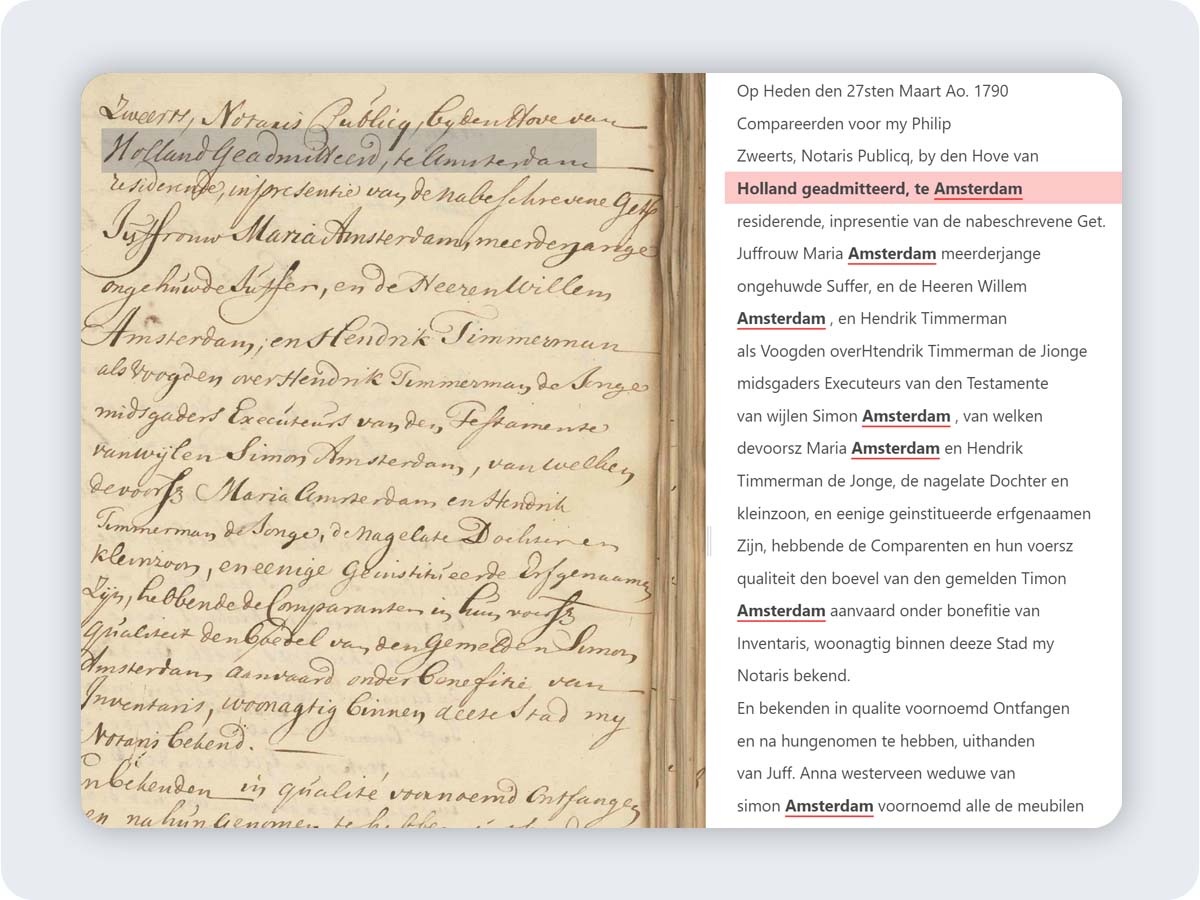
The two illustrations present complementary views of image-based transcription. Figure 1 shows line segmentation and alignment between a manuscript image and its corresponding text in the Transkribus interface. Figure 2 juxtaposes a manuscript page with a transcription in which repeated occurrences are highlighted. These examples clarify how images and textual representations can be consulted together. They serve an explanatory purpose and should not be interpreted as evidence of recognition accuracy on Algerian manuscripts, nor as results generated from an experimental corpus within this study.
4.1. Transkribus as an example of an HTR workflow
A typical HTR workflow begins with image import and page segmentation, continues through line detection and recognition, and ends with correction, export and reuse. The value of such a platform lies as much in workflow management as in recognition accuracy: it allows institutions to link images and text, maintain versions, train models and export structured results. For long-term preservation, the critical question is whether the institution can export both image references and textual/structural data in open formats that remain usable outside the platform (Transkribus, n.d.).
In a national programme, commercial or hosted services can be useful for experimentation, but they should not become the sole repository of authoritative data. Ground truth, trained-model documentation, exported PAGE XML or TEI, and validated transcriptions should be deposited in institutional storage. This protects the investment made in manual correction and allows models to be retrained or compared as technology evolves.
Figure 1. Line segmentation and image–text alignment in the Transkribus interface
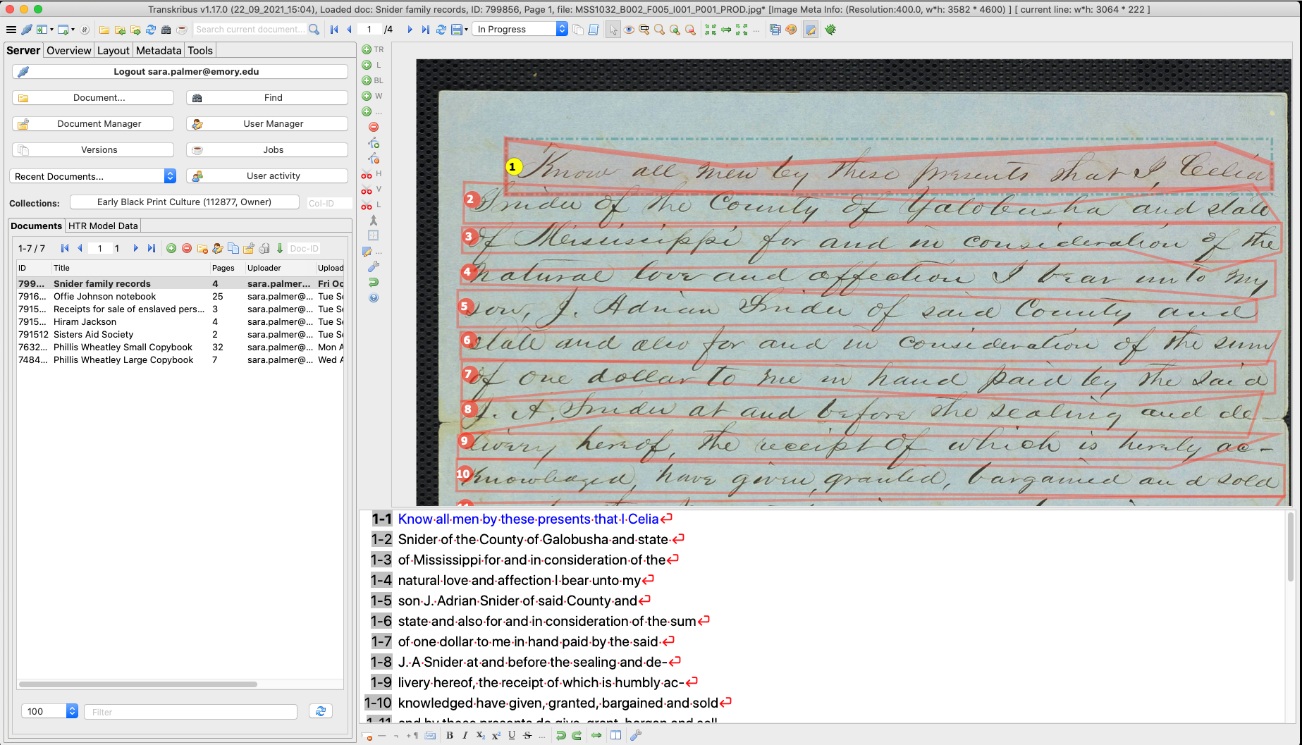
Figure 2. Manuscript image and corresponding transcription with highlighted occurrences.
4.2. Natural language processing, named entities, and indexing after transcription
Once a transcription exists, natural language processing (NLP) methods can support further enrichment: named-entity recognition can identify people, places, institutions and dates; topic models can help exploratory navigation; language identification can separate multilingual passages; and semantic linking can connect names to authority files. These techniques should not be described as substitutes for archival description. They generate candidate annotations whose quality depends on the underlying transcription and the domain knowledge represented in training data.
The most productive division of labour is therefore hierarchical. Archivists define provenance, fonds structure, access conditions and controlled vocabularies. HTR converts images into searchable text. NLP proposes entities, topics or links. Domain specialists validate ambiguous readings. Researchers and, where appropriate, citizen contributors may help correct transcriptions or enrich contextual information. Each intervention should be logged so that users can distinguish original description, machine output and human correction.
For Arabic-script heritage, special attention is required for historical orthography, optional diacritics, ligatures, variant letter forms, script styles and multilingual passages. The challenge is not simply that manuscripts are 'old'; it is that the statistical regularities on which recognition depends may vary by period, scribe, material tradition and editorial practice. A model trained on modern printed Arabic is therefore not equivalent to a model trained on handwritten Maghrebi or Ottoman materials.
5. Advanced imaging for manuscript analysis
High-resolution visible-light imaging should remain the baseline for most digitization. Advanced imaging becomes valuable when ordinary capture cannot answer a specific conservation or research question. Multispectral imaging records an object under multiple wavelength bands, often extending into ultraviolet and infrared regions. In manuscript studies, it can separate inks from substrate, reveal erased or faded writing and enhance palimpsest undertexts. Its importance is well established, but best practice requires calibration, documentation and careful interpretation because the most informative combination of bands varies by object (Jones et al., 2020; Tonazzini et al., 2019).
Work at the Bibliothèque nationale de France provides a documented example: a CNRS video report shows multispectral imaging used to recover erased ancient texts in palimpsests, with researchers and manuscript specialists contributing to the investigation (CNRS, 2023). The example illustrates a targeted research application rather than a general digitization procedure. Spectral imaging should therefore be selected on the basis of an identified material or textual problem, with acquisition conditions and interpretation documented. Its relevance lies in recovering information that ordinary visible-light imaging cannot make sufficiently legible, rather than in applying the same advanced technique indiscriminately to every manuscript.
Three-dimensional digitization requires similar qualification. Surface 3D scanning is valuable for bindings, seals, reliefs and objects whose geometry carries evidence. Volumetric techniques such as computed tomography can sometimes reveal hidden or inaccessible writing in closed, carbonized or structurally fragile objects. The virtual unwrapping of the En-Gedi scroll provides a documented example of text recovery using micro-computed tomography and computational processing (Seales et al., 2016). Such methods are technically demanding and material-dependent; they do not routinely replace two-dimensional manuscript imaging. The article therefore distinguishes between 3D documentation of form and volumetric imaging of concealed structures rather than treating all '3D digitization' as a single technology.
The cultural-heritage literature also shows that virtual reconstruction can be useful for fragmented objects, but large-scale digitization or interactive visualization should not automatically be described as 3D fragment reassembly. A presentation environment may offer spatial or three-dimensional exploration while the underlying preservation workflow remains based on two-dimensional imaging and cataloguing. The evidential claim must therefore match the acquisition and reconstruction method actually documented by the project.
6. Building a sustainable digital infrastructure for Algerian manuscript heritage
The contribution of digital technologies to manuscript preservation depends on the infrastructure through which images, transcriptions and descriptive records are managed, shared and preserved. For Algerian institutions, this requires connecting technical standards with clearly assigned responsibilities, sustainable resources and coordinated implementation. This section first examines the standards that support interoperability, preservation metadata, and trustworthy access, then considers how these components can inform an incremental national strategy.
6.1. Interoperability, preservation metadata, and trustworthy access
A sustainable digital manuscript environment depends on standards that operate at different layers. ISO 15489 provides records-management principles; OAIS provides a reference model for long-term digital preservation; EAD and Records in Contexts support archival description; PREMIS structures preservation metadata about objects, events, agents and rights; TEI and PAGE XML can encode transcriptions and page structure; and IIIF provides interoperable mechanisms for delivering and presenting digital images. None of these standards alone solves the entire problem. Their value lies in combination (International Council on Archives, 2023; International Image Interoperability Framework Consortium, 2020a, 2020b; International Organization for Standardization, 2016, 2025; Library of Congress, 2015).
For access, IIIF is particularly relevant because it separates image delivery from local interface design. An institution can retain its master files while exposing standardized image services and manifests that other viewers or scholarly tools can reuse. This reduces duplication and makes cross-institutional comparison possible. A researcher could, in principle, compare manuscript witnesses held in different Algerian repositories without each institution abandoning its own catalogue. Interoperability is therefore a practical expression of institutional autonomy rather than its opposite.
Preservation metadata is equally important. A trusted object needs identifiers, provenance, file format, checksum history, creation event, migration events and rights information. PREMIS offers a mature vocabulary for this purpose (Library of Congress, 2015). Traceability is essential for linking these events across the lifecycle of a digital object, but it does not require blockchain. Conventional repositories already use checksums, audit logs, write controls, replicated storage and preservation-event metadata to demonstrate integrity.
Blockchain may be useful in specific multi-institutional settings where mutually distrustful actors need a distributed, append-only record. Yet it introduces governance, complexity, energy, key-management and sustainability questions of its own. It should therefore be treated as an optional architecture to be justified by a defined trust problem, not as a generic guarantee that 'authenticity is never in question'. Archival authenticity remains an institutional and evidential property grounded in provenance, documented procedures, controlled custody and verifiable integrity checks.
6.2. Toward an Algerian national strategy
The most realistic national strategy is incremental. The first phase is a survey: identify major manuscript-holding institutions and collections, record condition, volume, scripts, cataloguing status, rights and digitization priority. Such a survey should include national institutions but also local and religious repositories whose holdings may be poorly represented in central catalogues. The outcome is not yet a digital library; it is a controlled map of the documentary landscape.
The second phase is standardization of capture and metadata. Institutions need a shared minimum technical profile for master images, derivatives, file naming, identifiers, descriptive fields and preservation metadata. This profile should be demanding enough to ensure reuse but simple enough to be applied outside the best-equipped institutions. Where archives, libraries and manuscript centres use different descriptive systems, mapping rules should be defined rather than imposing one vocabulary on every collection.
The third phase is selective computational enhancement. HTR pilots should begin with coherent corpora for which sufficient ground truth can be created and palaeographic expertise is available. Arabic-script models should be evaluated separately by script type and period. Pilot success should be judged by reported error metrics, correction time, exportability and scholarly usefulness, not by demonstration screenshots. NLP and entity extraction should follow only after transcription quality is high enough for the intended use.
The fourth phase is interoperable dissemination. A national discovery portal could harvest or federate metadata from participating repositories while IIIF services deliver images and annotations. Access conditions can remain differentiated: some collections may be open, others restricted by condition, rights, privacy or custodial agreement. The important point is that restrictions are represented explicitly rather than enforced through undocumented ad hoc practices.
The fifth phase is long-term preservation. Master files, metadata and validated transcriptions require redundant storage, integrity checking, disaster recovery, format monitoring and migration planning. An OAIS-aligned repository can provide the conceptual architecture, but governance must specify which institution is responsible for preservation, who can modify records, how versions are tracked and how resources are funded over decades. Digital heritage programmes fail when project funding creates files faster than institutions can preserve them.
Training cuts across all five phases. A multidisciplinary centre of excellence could support these phases by coordinating a network of competencies, shared training resources and methodological support across participating institutions, without necessarily requiring the creation of a new building. Conservators, archivists, manuscript specialists, imaging engineers, computer scientists, metadata librarians and legal experts need common workflows and shared vocabulary. Training should therefore include preservation imaging, palaeography, metadata standards, HTR evaluation, digital preservation, rights management and research data management.
7. Technical, epistemological, and ethical challenges
Complex page layouts remain a major challenge for automatic recognition. Marginalia, interlinear additions, multiple columns, catchwords, seals, illuminations and damaged edges complicate segmentation before recognition even begins. Errors introduced at the layout stage can propagate into the transcription. For this reason, HTR evaluation should report not only a global character error rate but also the types of pages or scripts on which the model fails.
Historical abbreviation systems create a second challenge. Expansion is an editorial act, not merely a recognition task. A diplomatic transcription may preserve abbreviations while a normalized edition expands them. Machine systems can assist either workflow, but the choice should be documented because it affects search, quotation and philological interpretation. The same principle applies to diacritics and historical spelling: normalization can improve retrieval while simultaneously obscuring evidence about the original writing system.
Multilingualism is a third challenge and a potential resource. Algerian holdings may contain Classical Arabic, Ottoman Turkish, French, Spanish, Latin and local linguistic varieties, sometimes within related collections and occasionally within the same document. Automatic language identification can route text to appropriate models, but code-switching, names and formulaic expressions may defeat simple classification. Multilingual corpora therefore require language-aware annotation and, in many cases, human review.
Ethically, digitization changes exposure. Materials that were previously difficult to consult may contain personal, religious, legal or culturally sensitive information. Open access should not be assumed merely because a digital copy exists. Rights, privacy, community expectations and custodial agreements need to be encoded in access policy. Participatory transcription projects likewise require clear terms: volunteers should know how their contributions are credited, licensed and corrected, and institutions should not outsource expert responsibility to crowdsourcing.
Finally, AI introduces epistemic asymmetry. Users often see a clean transcription without seeing uncertainty. Interfaces should make machine-generated status visible and, where feasible, expose confidence or validation information. Search systems should preserve a route back to the page image. The manuscript remains the evidential anchor; computational layers increase access to it but should not conceal their own fallibility.
Conclusion
The digital future of Algerian manuscript heritage should be judged less by the novelty of individual technologies than by the reliability of the chain that connects conservation, imaging, description, computation, access and preservation. HTR can transform discoverability, multispectral imaging can recover otherwise inaccessible textual information, and interoperable image services can connect dispersed collections. But each tool has a domain of validity. HTR requires representative ground truth and explicit evaluation; multispectral imaging requires a defined research question and documented capture; 3D and volumetric methods are specialized rather than universal; and blockchain is not a substitute for archival governance.
Algeria already has institutional foundations on which a coherent strategy can be built: a National Centre for Manuscripts, a National Archives Centre, a statutory centre for religious manuscript heritage, the National Library, university expertise, and documented digitization initiatives. The next step is to connect these capacities through shared standards, preservation responsibilities and reusable data. A national programme should begin with an inventory and technical profile, then develop selected HTR pilots, interoperable delivery and long-term preservation services. Such a sequence is less spectacular than announcing an all-encompassing platform, but it is more likely to produce durable results.
The wider scientific benefit is substantial. Once images, metadata and validated transcriptions are preserved and interoperable, manuscript collections become accessible not only to historians and philologists but also to linguists, information scientists, conservation researchers and digital-humanities teams. The decisive principle is therefore one of documented augmentation: technology should extend what can be seen, searched and compared while preserving the evidential relation to the original object. That is the condition under which digital innovation can strengthen both access and sovereignty over Algeria's manuscript heritage.