
Introduction
Photography, since its technical emergence in the nineteenth century, has never been a purely mechanical reproduction of the visible. It is a practice of recording, selecting, framing, archiving, and interpreting. In contemporary media ecologies, this practice has become inseparable from digital circulation: images travel instantly across screens, platforms, and publics, acquiring social, political, and ethical effects that exceed the moment of capture.
This article does not approach the image only as an aesthetic object. It examines the press photograph as a visual discourse whose force becomes particularly decisive in situations of war. War photography does not merely illustrate an already established narrative; it can challenge official discourse, expose civilian vulnerability, make suffering visible, and produce forms of witnessing that textual description alone cannot always sustain.
The history of photojournalism has repeatedly demonstrated this documentary and testimonial capacity. From Vietnam to Afghanistan, from anti-colonial struggles to contemporary uprisings, photographs have preserved traces of violence, resistance, grief, and collective endurance. Their power lies in a double movement: they record a fragment of reality while also arranging that fragment through distance, angle, light, body posture, and the symbolic economy of the frame.
Since 7 October 2023, the war in Gaza has generated an unprecedented circulation of images across news agencies, digital platforms, and social networks. These images have made visible destroyed neighborhoods, overcrowded shelters, wounded civilians, displacement routes, and the collapse of ordinary life. Within this visual flow, older Palestinians constitute a particularly significant yet often under-examined figure: they embody vulnerability, memory, intergenerational continuity, and the cumulative violence of repeated dispossession.
The present study focuses on press- and platform-circulated photographs depicting older adults in Gaza after 7 October 2023. Rather than treating these images as self-evident documents, it reads them as complex semiotic objects. Each photograph is analyzed at the denotative level, where visible elements are described, and at the connotative level, where cultural, political, and ethical meanings are interpreted within the wider context of war, displacement, and media reception.
The article is framed by two conceptual notions: visual shock and moral betrayal. Visual shock refers to the intense affective and cognitive impact produced by images of vulnerability, bodily exposure, destruction, and grief. Moral betrayal designates the perceived failure of political, institutional, and media actors to respond adequately to visible suffering, especially when that suffering concerns civilians whose protection is normatively guaranteed by humanitarian principles.
This framework makes it possible to examine a central paradox of humanitarian photography. Images of suffering may generate empathy, public awareness, and ethical concern; yet repeated exposure may also produce fatigue, desensitization, or passive consumption. The press photograph is therefore a double-edged object: it may function as testimony and indictment, but it may also risk transforming pain into a spectacle if it is detached from context, dignity, and responsibility.
The focus on older adults is methodologically and ethically important. Older persons are frequently represented as peripheral to the dominant iconography of war, which tends to foreground children, wounded bodies, and spectacular destruction. Yet old age introduces a specific temporality into the image: the older body bears traces of previous historical trauma, bodily fragility, attachment to place, and the devastating experience of losing home, family, and security at the end of life.
Accordingly, the study asks how press photographs depict the suffering of older adults in Gaza after 7 October 2023, what visual signs and symbolic configurations organize these depictions, how visual shock is produced, and whether the images preserve the dignity of the persons represented or risk exposing them as objects of humanitarian consumption.
The argument developed here is that the selected photographs produce a visual narrative structured around three signs: land, body, and time. Land appears as the place lost, destroyed, or forcibly left behind; the body appears as vulnerable yet resistant; and time appears through wrinkles, canes, watches, inherited clothing, and the juxtaposition of older adults with children. Through these elements, the images transform individual suffering into a broader ethical question concerning care, recognition, and responsibility.
1. Methodological and Conceptual Procedures
1.1. Research Problem and Questions
In contemporary journalism, the image has become a central medium of mediation because of its ability to condense information, affect, and testimony within a single visual unit. In the context of the large-scale destruction witnessed in the Gaza Strip after 7 October 2023, news agencies and digital platforms circulated numerous photographs documenting the humanitarian consequences of war, including the condition of older adults, whose presence is particularly striking in these visual narratives.
These images raise a set of analytical questions concerning the ethics of representation, the force and limits of visual shock, and the extent to which the public circulation of suffering produces recognition, indifference, or moral unease. The present study therefore proposes a critical and interpretive reading of selected images in order to identify the meanings, visual codes, and ethical tensions that structure their reception.
Accordingly, this research addresses the following questions:
-
How did press images depict the suffering of older adults in Gaza after 7 October 2023?
-
What visual and symbolic features characterize the images of older adults after 7 October 2023?
-
What kind of visual shock did these images provoke?
-
Did these images reflect a local and international moral betrayal?
-
To what extent did the images preserve the dignity of older adults, or were they exploited visually?
1.2. Research Significance and Aims
Older adults in the Gaza Strip are among the groups most exposed to the cumulative effects of war: chronic illness, reduced mobility, interruption of medical care, shortage of food and water, psychological distress, and the loss of family and domestic stability. The significance of this study lies in bringing analytical attention to this frequently underexamined category within the visual archive of war. More specifically, the article seeks to show how press photography constructs older adults as figures of vulnerability, endurance, memory, and displacement, while also interrogating the ethical conditions under which such suffering is made visible.
1.3. Methodology and Data-Collection Tools
Semiotic analysis constitutes both a theoretical framework and a methodological procedure for interpreting the meanings carried by still and moving images. The photographic image, like a linguistic text, produces signs, codes, and effects of meaning that can be described and interpreted. Following the Barthesian tradition, this article reads the selected photographs through two complementary levels of analysis.
Denotation corresponds to the first descriptive level of the image. It concerns the visible components that can be identified without interpretive projection: bodies, clothing, objects, spatial arrangement, lighting, textures, and background elements. At this level, the guiding question is: What is visibly present in the image?
Connotation refers to the second level of analysis, where the visible elements are interpreted in relation to cultural memory, political context, social meaning, and ethical implication. At this stage, the image is approached as a structured visual discourse whose signs exceed literal description and participate in broader narratives about war, vulnerability, dignity, and dispossession.
Through these two levels, researchers can gain a deeper understanding of the messages conveyed by images and analyze their impact on society and culture.
1.4. Research Population and Sample
Maurice Angers considers the delimitation of the research population to be a decisive phase in empirical inquiry. In this article, the population is defined as the set of press and platform-circulated images depicting older adults in Gaza after 7 October 2023. From this broader visual field, a purposive sample of three photographs was selected for close reading.
The corpus includes one image published by the news website Al-Quds Al-Arabi, one image circulated by the Facebook page Akhbār Filasṭīn, and one image circulated by the Facebook page Al-Ghad 24, in addition to the contextual comparative image used in the theoretical section on war photography.
2. Conceptual Framework
2.1. Older Adults and the Need for Care
The category of the older person is historically, linguistically, and socially variable. In Arabic lexicographical usage, terms such as musinn, shaykh, and harim refer, with different nuances, to advanced age, bodily frailty, experience, and social recognition. These semantic distinctions are not merely lexical; they also indicate the symbolic place assigned to older adults within a given society.
Classical and religious discourse likewise associates old age with accumulated experience, bodily transformation, and increased dependence. In this sense, old age is not reducible to chronology alone: it designates a life stage shaped by biological change, social status, and relational needs. Contemporary approaches therefore define older adults by combining chronological age, health condition, autonomy, and social position.
The socio-cultural context plays a major role in determining who is considered an older adult and what forms of support are expected. In many societies, retirement age functions as an administrative threshold, but social aging exceeds legal categories. It is shaped by health trajectories, family structures, living conditions, and the degree of participation still available to the individual.
Taken together, these definitions show that older adults constitute a social group marked by specific physical, psychological, and relational conditions, while also carrying dense reserves of memory and life experience. Their needs are therefore not limited to medical treatment; they also concern recognition, accompaniment, emotional security, and social inclusion. The question of care becomes particularly acute when age-related fragility is intensified by displacement, isolation, or institutional collapse.
This study focuses on older adults in Gaza, whose exposure to war compounds the vulnerabilities associated with age. Beyond bodily frailty and chronic illness, many endure bereavement, repeated displacement, the destruction of home, and the collapse of ordinary care structures. Their condition thus calls for an analysis attentive not only to suffering, but also to dignity, memory, attachment to place, and the ethics of response.
2.2. The Concept of Care Ethics
Ethics, in both classical Arabic lexicography and modern moral reflection, refers to the dispositions, values, and principles that orient human conduct. Al-Fayruzabadi links morality to character, religion, and disposition, while Ibn Manzur emphasizes its interior dimension by describing moral character as the invisible form of the person (Al-Fayruzabadi, 2005, p. 881; Ibn Manzur, 1992, pp. 86-87). In this sense, ethics concerns not only outward behavior, but also the inner orientations that guide judgment, action, and responsibility.
From this perspective, ethics may be understood as the field that distinguishes beneficial action from harmful action and clarifies the obligations governing relations with others. As Amin notes, ethical reflection becomes especially important when societies confront the protection of vulnerable groups, because it frames the duties of care, restraint, and responsibility owed to them (Amin, 2012, p. 8).
Within Islamic thought as presented in the sources cited by the author, ethics occupies a foundational place in the preservation of social life. Moral values are treated as conditions of collective continuity, while empathy, responsibility, and concern for others are understood as indispensable to social cohesion. In this perspective, care is not a secondary sentiment, but a practical expression of moral life, especially in relation to those whose vulnerability is heightened by age, illness, dependency, or loss (Wutfa, 2013, pp. 96-108; Hemam, 2022, p. 20).
The term "care" is derived from the Arabic root "عنى", which conveys the ideas of attending to, protecting, and looking after another person. It therefore denotes more than assistance in a technical sense; it implies a relational practice grounded in attention, protection, and responsiveness to need. To say that someone is placed "in the care" of another is to evoke a relation of trust, guardianship, and moral obligation.
The ethics of care builds precisely on this relational dimension. It starts from the premise that human beings are interdependent and that no one, regardless of age or status, is fully self-sufficient. For this reason, some scholars describe it as an ethics of relationships, since it emphasizes practical responsibility, emotional attentiveness, and situated response rather than abstract moral detachment (Held, 2008, p. 26).
This relational orientation can be illustrated by the Algerian proverb "مول التاج ويحتاج" ("Even the one who wears the crown still needs help"). The proverb succinctly expresses a central anthropological truth: need is universal, even if its forms and intensity vary from one person to another. It also shows how inherited wisdom can function as an ethical resource for understanding dependence, reciprocity, and care.
Ahmed Amin's reflections on ethics are also useful here. He distinguishes between morally assessable actions and actions that remain outside the ethical field because they are involuntary or purely physiological. He also gives an important role to conscience, which develops through reflection, experience, and judgment, and which helps individuals discern what ought to be done (Amin, 2012, p. 10).
Conscience, in this perspective, is shaped by lived experience and by an acquired understanding of what is beneficial or harmful. Ethical action is often accompanied by inner peace, whereas wrongdoing produces discomfort, hesitation, and regret. Such an account is relevant to care ethics because it links moral conduct to responsiveness, self-scrutiny, and responsibility toward others (Amin, 2012, pp. 15-17).
Although the ethics of care is a modern theoretical formulation, it is now widely understood as both a value and a practice. Applied to older adults, it implies integrated forms of support that include health care, emotional accompaniment, social recognition, and material security. In contexts of war, these needs become more urgent, because the collapse of ordinary infrastructures intensifies vulnerability and reduces access to protection, treatment, and stable support networks.
In this study, the ethics of care refers to the moral and practical obligation to respond to vulnerable life with attention, protection, and dignity. Applied to older adults in Gaza, the concept helps illuminate not only the extent of suffering, but also the failure or insufficiency of the structures that should ordinarily sustain care.
2.3. Photographs and the Documentation of Wars
In Arabic, the term ṣūra designates form, shape, and visible configuration. In modern theoretical usage, the image also refers to a representational construction that organizes perception through selection, framing, and symbolic density. Photography radicalizes this dimension by fixing a fragment of reality while simultaneously transforming it into a readable visual object.
A photograph may be understood as a camera-produced image of persons, spaces, or events, but it is never reducible to a transparent copy of reality. Through framing, timing, angle, exposure, and circulation, it produces a mediated account of the visible. Photography is therefore both a document and an interpretation: it records, but it also orders, isolates, and endows what it records with meaning.
For this reason, the photographic image has become a powerful mode of visual discourse. It conveys information, structures attention, and invites interpretation without depending entirely on verbal explanation. In contemporary media environments, photographs circulate as a quasi-universal language, capable of crossing linguistic boundaries while retaining strong political and emotional force.
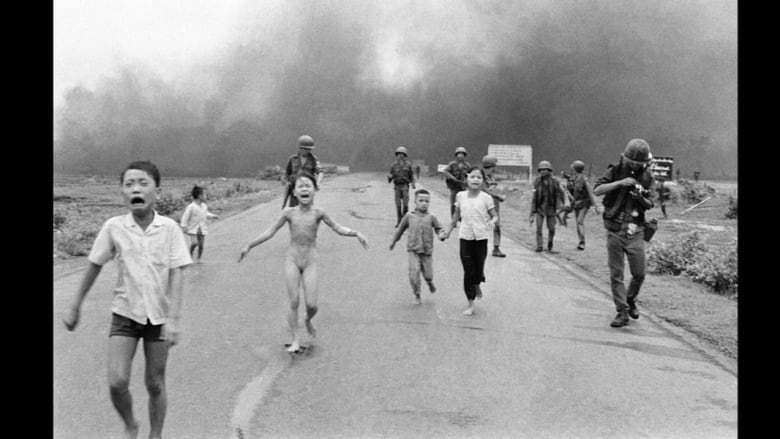
A well-known example is the photograph of Vietnamese children fleeing a napalm attack during the Vietnam War. Decades after its publication, the image still functions as a visual testimony to the violence of war and to the enduring documentary power of press photography.
Figure 1. Iconic Vietnam War photograph used in the article as a comparative example of war photography.
Source indicated in the submitted manuscript.
The world of war and crisis photography, which documents the conflicts endured by modern societies, has undergone significant transformation under the impact of technological change. Developments in journalism, photographic techniques, television news, the internet, and online publishing have enabled an unprecedented speed and scale of image circulation. Following the surge in image production during the Second World War, photographic news coverage expanded dramatically and became central to media accounts of conflict.
Media outlets continue to rely heavily on photojournalism, which has become a core component of editorial content. In a competitive media environment, photographs strengthen narrative authority by supplying a visible record of events. Scholars and political actors alike have therefore recognized the strategic power of imagery, to the point that some conflicts have been described as 'photographed wars' or 'wars fought through images' (Al-Labban & Yassin, 2015).
In the present study, photographic images are understood as visual documents that accompany journalistic coverage of events in Gaza and circulate through news sites or digital platforms. The analysis focuses specifically on images that represent the suffering, displacement, and precarious conditions of older adults.
2.4. Photojournalism as Psychological Exposure and Ethical Reflection
Visual shock is one of the most significant psychological and ethical effects generated by war photography, especially when the camera focuses on highly vulnerable groups such as women, children, older adults, or the injured. The image does not simply record suffering; it transmits it to the viewer as an affective event capable of provoking empathy, distress, guilt, or moral paralysis (Sontag, 2003, p. 57). In the Palestinian context, and more specifically in Gaza, photojournalism has also operated as a form of visual exposure that reveals the fragility of care structures under prolonged siege and bombardment.
In this regard, Linfield argues that violent images can never be neutral; they either condemn or justify, depending on the context in which they are presented and received. (Linfield, 2010) This underscores the importance of photojournalism in revealing the breakdown of care ethics in times of conflict, as older individuals in Gaza face compounded psychological trauma due to the loss of shelter, loved ones, or any sense of security and protection.
Similarly, Pinchevski notes that prolonged and intense exposure to traumatic imagery can produce psychological effects akin to post-traumatic stress disorder (PTSD) – not only among direct victims, but also among distant viewers consuming such images via media. Thus, the photojournalistic image becomes a powerful emotional medium that not only conveys information but also reshapes the viewer’s emotional and psychological experience. (Pinchevski, 2016)
In this context, Figley explains that exposure to distressing images may lead to what is known as secondary traumatization, a psychological condition affecting individuals who witness violent content without being directly involved. This impact intensifies when such images are encountered in personal or domestic settings (e.g., via smartphones or home screens), without critical framing or cognitive preparation. (Figley, 1995, p. 8)
Other researchers suggest that repeated consumption of violent imagery, particularly through social media, can lead to emotional desensitization – a gradual loss of the capacity for moral or emotional response, whereby shocking images become normalized and cease to provoke ethical concern (Moeller, 1999). However, Chouliaraki offers a contrasting view, proposing that certain images may evoke what she terms acute moral consciousness, prompting viewers to engage emotionally, express solidarity, or even participate in symbolic resistance. (Chouliaraki, 2006, p. 47)
This tension between emotional numbness and ethical engagement, between documentation and shock, is what makes the wartime photojournalistic image a double-edged instrument: it can provoke deep psychological impact, but it can also neutralize its own effect, depending on how it is framed and received.
2.5. Visual Shock and Moral Betrayal in Wartime
Visual shock, in this study, refers to the intense affective and cognitive impact produced by images of exposed vulnerability. It is especially marked in press photographs that bring the viewer into proximity with civilian suffering under conditions of war, displacement, and institutional breakdown.
In the case of Gaza, such shock does not emerge from violence alone, but from the visual conjunction of age, fragility, ruins, forced movement, and public exposure. The image becomes a site where the viewer confronts not only destruction, but also the inadequacy of humanitarian response and the uneven visibility accorded to different lives.
Visual shock refers to the deep psychological and emotional impact produced by a violent photograph that suddenly penetrates the viewer’s awareness without prior interpretive mediation. Such an image does not go unnoticed; rather, it embeds itself in memory and reshapes perception and emotion (Sontag, 2003). The contributions of thinkers such as Susan Sontag, Roland Barthes, and Walter Benjamin have helped clarify this analytical dimension. Sontag, in Regarding the Pain of Others, argues that painful images compel the viewer to react, even if that reaction manifests as numbness or denial. Barthes, in Camera Lucida, distinguishes between studium (general cultural meaning) and punctum (the emotional spark that pierces the viewer’s consciousness), while Benjamin describes shocking images as moments of “visual inflammation” in which painful pasts intersect with perceived presents. (Benjamin, 2016)
Linfield maintains that violent images can never be neutral; depending on the context of their display and reception, they either condemn or justify violence. This emphasizes the press image’s role in revealing the collapse of ethics of care in wartime, especially as elderly civilians in Gaza face repeated traumas resulting from the loss of shelter, loved ones, and basic safety. (Linfield, 2010)
Pinchevski argues that repeated exposure to violent images can produce PTSD-like symptoms not only among direct victims but also among distant viewers. Thus, press photography becomes an emotionally charged medium that reshapes the viewer’s psychological experience. (Pinchevski, 2016) Figley describes this as secondary traumatization, especially when images are consumed in private spaces without critical or educational framing.(Figley, 1995, p. 8)
On the other hand, researchers like Moeller warn of desensitization – the gradual loss of ethical and emotional responsiveness due to overexposure. (Moeller, 1999) However, Chouliaraki offers a different perspective, arguing that some images may stimulate what she calls acute moral awareness, potentially leading to symbolic solidarity or even real action. (Chouliaraki, 2006, p. 47)
Shocking images often display recurrent features: visible destruction, embodied helplessness, disrupted domestic environments, and details that condense vulnerability into a memorable sign. In Barthesian terms, the punctum may reside in a hand, a garment, a look, or an object that unexpectedly pierces the viewer’s defenses and transforms observation into ethical unease.
In photographs of older adults in Gaza after 7 October 2023, visual shock is generated by the juxtaposition of bodily fragility and devastated space: wrinkled faces, trembling hands, canes, watches, rubble, broken paths, exposed wires, and exhausted gestures. Such details intensify the image’s emotional charge while also opening a field of interpretation concerning abandonment, endurance, and recognition.
Yet visual shock also reveals a second and more silent dimension: moral betrayal. Here, the term refers to the perceived failure of political, humanitarian, and media orders to respond adequately to visible suffering, or to the reduction of such suffering to content that circulates without proportionate action or accountability.
Judith Butler, in Frames of War, argues that some lives are deemed more “grievable” than others, and that the media reproduce this unethical hierarchy of victimhood, resulting in a double betrayal: the betrayal of those who die and those who witness without action (Butler, 2009). She warns that images may become tools of solidarity – but they may also serve as instruments of symbolic dehumanization, especially when produced or circulated in contexts that deny moral equality between lives (Butler, 2009, p. 38).
Sontag, on the other hand, reminds us that the display of suffering does not necessarily prompt action; it may instead result in moral fatigue and silence, reducing even the most painful images to consumable visuals that fail to provoke real response (Sontag, 2003). In this sense, the repeated circulation of images of elderly Palestinians suffering in Gaza – without their plight becoming a matter of global conscience – represents a form of collective ethical abandonment.
The images circulated after 7 October 2023, make this tension particularly visible: older adults appear homeless, displaced, injured, or surrounded by ruins, while the surrounding structures of protection remain uncertain, insufficient, or absent. The photograph thus exposes both violence itself and the crisis of response to violence.
This leads to a fundamental ethical question: do such images mobilize recognition and responsibility, or do they risk being absorbed into a repetitive economy of distant spectatorship? Moral betrayal, in this sense, is not located only in the act of violence, but also in the failure to restore context, dignity, and equal grievability to those whose suffering is shown.
Thus, image analysis must go beyond visual techniques to question the ethical discourse they produce: how were these bodies portrayed? What was included, and what was excluded? Who speaks – and who is silenced? (Azoulay, 2008).
3. Semiotic Analysis of a Sample of Images of Older Palestinians
3.1. Semiotic Analysis of the First Image
3.1.1. Denotative Level
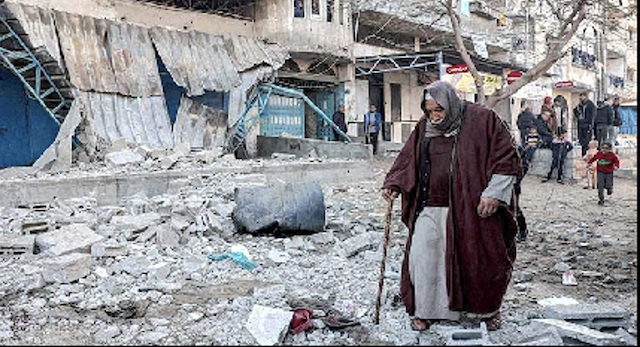
At the denotative level, the photograph foregrounds an older man with a white mustache walking carefully through a street filled with rubble. He wears layered traditional clothing in brown and grey tones, a white skullcap, a scarf wrapped around his neck, and open sandals. Leaning on a cane, he crosses a landscape of shattered concrete, broken poles, fragments of sheet metal, scattered fabric, and damaged urban surfaces. In the background, children and young men stand or sit amid the debris, while a tree stripped of much of its foliage remains visible.
His downward gaze suggests caution and concentration as he advances across unstable ground. Within the visual logic of the image, the act of moving through rubble may be read as an attempt to navigate a devastated environment, to search for traces of everyday life, or simply to continue walking in a space transformed by destruction.
By placing the older man prominently in the foreground, the photograph emphasizes the specific exposure of older adults to the material consequences of war. The damaged street, the broken infrastructures, and the human figures dispersed in the background situate his body within a broader scene of civilian precarity and spatial dislocation.
The image therefore functions not only as a record of destruction, but also as a visual condensation of vulnerability, endurance, and abandonment. Its analytical force lies in the contrast between the frailty of the central figure and the violence inscribed in the surrounding environment.
3.1.2. Connotative Level
At the connotative level, the image organizes a network of signs that exceed literal description. The older man’s slow movement, traditional clothing, and reliance on the cane transform him into a figure through which age, memory, and persistence become legible. The photograph thus resonates with the article’s central concern: the representation of older adults in Gaza under conditions of war.
The man’s deliberate steps among the ruins suggest both physical frailty and continued agency. His clothing does not signify ornament or display; rather, it points to protection, habit, and the ordinary material culture of everyday life disrupted by violence. In Barthesian terms, the ensemble resists any logic of aestheticization and instead anchors the image in necessity, seasonality, and embodied survival.
Figure 2. Older man walking among rubble and destroyed buildings
Source: Al-Quds Al-Arabi, as indicated in the submitted manuscript.
The presence of rubble, damaged buildings, scattered fabric, and a nearly leafless tree contributes to a visual atmosphere of coldness, exposure, and interruption. The spatial disorder surrounding the central figure intensifies the sense that domestic continuity has been broken and that ordinary urban life has been suspended.
The older man’s bent posture and solitary progression convey loneliness, but also a form of persistence. His wrinkles, measured pace, and bodily strain materialize the cumulative weight of age within a war-torn environment, while the ruined setting suggests the collapse of the protective world to which older adults are ordinarily attached.
The image also points to the heightened care needs of older adults in situations of conflict. Medication, food, water, rest, emotional support, and stable shelter become difficult to secure when bombardment, displacement, and bereavement disrupt the infrastructures on which daily life depends.
In this sense, the figure may be read as an elder moving through the remains of a lost domestic world. The cane becomes more than a walking aid: within the image, it condenses support, vulnerability, and the minimal material means by which movement remains possible in a devastated space.
The cane also carries a longer anthropological history. Beyond its immediate practical function, it evokes older forms of bodily assistance, protection, and survival. Such associations deepen the symbolic density of the image without displacing its documentary force.
Across historical contexts, simple objects such as sticks, stones, cloth, and tools have often mediated survival in conditions of exposure. In the present photograph, however, these objects appear less as emblems of heroism than as signs of precarious continuity amid ruin.
The scene thus raises broader questions about humanitarian responsibility, institutional adequacy, and the uneven translation of visible suffering into effective response. The photograph invites such questions without resolving them; its ethical force lies precisely in this tension.
What it ultimately confronts the viewer with is the persistence of vulnerable life in a devastated environment. The image does not merely show destruction; it asks how such destruction is seen, interpreted, and responded to when the exposed body is that of an older civilian.
3.2. Semiotic Analysis of the Second Image
3.2.1. Denotative Level
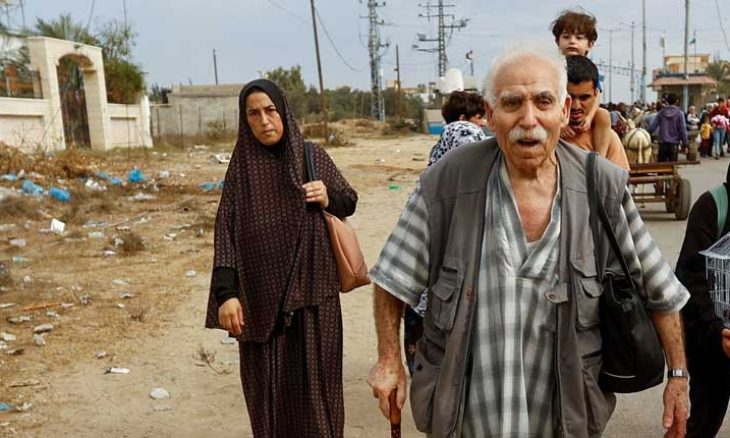
At the denotative level, the second image depicts a group of displaced people walking along a road. At the front of the group is an older man leaning on a cane. He has white hair and a white mustache and wears a striped robe in white and grey tones with a grey vest. A black bag hangs from his right shoulder, and a silver watch is visible on his wrist. Slightly behind him walks a woman in a prayer hijab carrying a handbag. Behind them, a young man carries a child on his shoulders, while other women, children, and passers-by occupy the depth of the frame. A horse-drawn cart, utility poles, plastic bags, dry grass, and scattered debris complete the background.
The image is structured around movement, crowding, and forced transit. Multiple generations appear within the same frame, and the material environment suggests displacement under precarious conditions rather than ordinary circulation.
Figure 3. Older Palestinian man on a displacement route
Source: Al-Quds Al-Arabi, as indicated in the submitted manuscript.
3.2.2. Connotative Level
Within the ecology of digital circulation, this photograph acquires a strong documentary and accusatory force. It visualizes the social reality of forced movement while simultaneously exposing the fragility of those who must endure it. Rather than treating displacement as an abstract category, the image gives it a face, a pace, and a bodily rhythm.
The older man leading the group condenses several layers of meaning. His cane and worn appearance register the difficulty of movement in old age, while his position at the front of the procession suggests both exposure and dignity. The figures behind him extend the scene from individual vulnerability to collective trauma shared across generations.
The photograph’s suggestive power lies in the way it links personal detail to a broader political condition. The child carried on the young man’s shoulders, the women walking behind, the cart, and the sparse landscape all point to a disrupted social world in which basic stability has been suspended. The image thus invites a distinction between ordinary mobility and forced displacement.
Displacement here should be understood as coerced movement produced by war, bombardment, and the destruction of living space. Unlike voluntary migration, it is marked by urgency, constraint, loss, and the absence of meaningful choice. This distinction is crucial to the interpretation of the scene.
The central figure appears to carry with him a small cluster of personal signs: the cane, the watch, the mustache, and the shoulder bag. The cane signifies support and fragility; the watch introduces the temporal dimension of departure, waiting, and uncertainty; the bag suggests the attempt to preserve a minimum of personal continuity while leaving one’s place of residence.
The mustache, in many Arab cultural contexts, may evoke dignity, adulthood, masculinity, and self-presentation. In the photograph, however, it functions less as a sign of assertion than as one element within a face marked by fatigue, age, and endurance.
More broadly, the image underscores the anthropological violence of forced removal from one’s place of origin. For older adults in particular, leaving home is not only a spatial displacement but also a rupture in memory, habit, identity, and social rootedness.
-
Loss of identity and belonging: land and home are deeply tied to personal and collective identity; forced displacement weakens these attachments and can generate estrangement and disorientation.
-
Loss and grief: leaving one’s place of life also means losing routines, memories, possessions, and the social bonds embedded in that environment.
-
Injustice and asymmetry: forced displacement reflects an unequal relation of power in which vulnerable populations are compelled to move under threat and without protection.
-
Exile and instability: those who leave under duress must seek precarious shelter while adapting to unfamiliar, often insecure environments.
-
Resistance and resilience: displacement may also become a site of persistence, as attachment to return, memory, and survival remains symbolically active despite loss.
-
Collective memory: abandoned places continue to inhabit familial and national memory, becoming part of a shared archive of dispossession and hoped-for return.
The photograph suggests that displaced families carry only what their bodies can bear while leaving behind homes transformed into ruins. What remains of domestic space is reduced to fragments, debris, and the uncertain possibility that essential belongings – or even loved ones – may still be trapped beneath collapsed structures.
In this context, the image of the older man condenses the violence of displacement as lived through age. The visual accumulation of bodily strain, sparse possessions, and forced movement points to a civilian condition in which survival takes precedence over continuity, comfort, and ordinary social life.
Framed from the front, the older man appears exposed to the viewer and to the road ahead. This frontal visibility intensifies the ethical charge of the image: the question is no longer whether displacement is occurring, but how an aging body can endure its pace, uncertainty, and consequences.
For older adults, such displacement is also a psychological ordeal. It interrupts care routines, weakens social support, and magnifies chronic vulnerability. The photograph makes this condition visible without reducing the subject to passivity.
3.3. Semiotic Analysis of the Third Image
3.3.1. Denotative Level
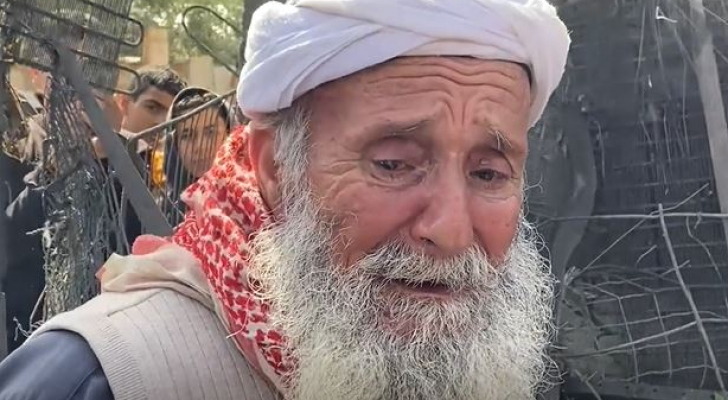
The third photograph is organized as a close portrait of an older man whose face occupies the foreground. His thick white beard, deeply lined forehead, and wrinkled eye area give visual prominence to age, experience, and suffering. He is crying intensely. Around his neck is a red keffiyeh patterned with white dots, and he wears grey clothing. His head is wrapped in a traditional white cloth. Behind him appear damaged wires, signs of grey destruction, and, further back, two adolescent boys looking toward the photographer. In the far background, a green landscape remains faintly visible.
The composition juxtaposes proximate grief and distant continuity: the crying face dominates the frame, while the boys and the green background open the image toward futurity, survival, and the persistence of life beyond immediate devastation.
3.3.2. Connotative Level
At the connotative level, the portrait activates a dense historical and emotional narrative. The photographer isolates a moment of grief that becomes readable as both singular and collective. According to the journalistic context accompanying the image, the man is Sarshehda Taha, aged 85, who had already lived through the Nakba of 1948 and was again displaced in 2024 after airstrikes destroyed his home and rendered his family homeless.
Figure 4. Portrait of an older Palestinian man mourning the destruction of his home
Source: Roya News, as indicated in the submitted manuscript.
He is associated with Beit Lahia in northern Gaza, a place marked by repeated displacement and by the longer history of Palestinian dispossession. Within the photograph, this historical depth is not directly narrated, but it is condensed in the face, the tears, and the symbolic density of the portrait.
The turban and the keffiyeh intensify this symbolic density. In Arab and Muslim contexts, the turban is at once a practical garment and a cultural sign, while the Palestinian keffiyeh has long functioned as an emblem of belonging, struggle, and historical memory. Their presence in the image places the grieving body within a wider political and cultural horizon.
Journalistic and historical accounts frequently associate the Palestinian keffiyeh with anti-colonial resistance and with the material culture of rural and popular life. In the portrait, however, the scarf does not operate as a slogan; it functions as a sign of inherited identity worn on a body marked by loss.
The motifs commonly associated with the keffiyeh – olive branches, nets, lines, and geometric crossings – have often been interpreted as visual condensations of land, labor, movement, and attachment. Whether or not the spectator recognizes each code, the garment contributes to the image’s articulation of memory and belonging.
The historical depth of the keffiyeh further reinforces this articulation. As a regional head covering with long Near Eastern genealogies, it exceeds the immediate event while remaining fully implicated in it. In the photograph, the fabric carries both inheritance and present grief.
By contrast, the wires and grey destruction in the background suggest entrapment, interruption, siege, and damaged connection. Yet the two boys and the distant green landscape introduce another register: futurity, transmission, and the possibility of renewal. The image thus stages a tension between devastation and continuity.
The older man and the boys may therefore be read as figures of generational passage. The elder condenses memory, pain, and experience; the younger figures suggest beginning, transmission, and the deferred horizon of life beyond catastrophe. The portrait does not dissolve suffering into hope, but it places them in unresolved relation.
The trees in the distance reinforce this relation. They signify rootedness, endurance, renewal, and the persistence of life even in a damaged environment. As visual counterpoints to the wires and ruins, they keep the image from closing entirely in despair.
Conclusion
The photographs examined in this article expose a central contradiction of contemporary humanitarian discourse: orders that claim to uphold human rights, freedom, and justice often remain incapable of protecting older civilians from destruction, displacement, deprivation, and loss. The aim of the analysis has not been to substitute indignation for method, but to show how the image renders this contradiction visible at the level of bodies, spaces, and signs.
In Gaza, the humanitarian crisis has been intensified by bombardment, repeated displacement, restrictions on water, electricity, food, and medical supplies, and the disruption of institutions essential to civilian survival. Older adults experience this crisis through the specific vulnerabilities of age: chronic illness, reduced mobility, dependence on family networks, psychological exposure, and heightened risk when care infrastructures collapse.
At a stage of life usually associated with increased need for medical, emotional, and relational support, older adults in Gaza are frequently deprived of even the most basic conditions required for continuity of care, safety, and dignity.
The three photographs reconstruct an integrated visual narrative of Palestinian suffering by foregrounding older adults, a category often marginalized within media coverage of war. In doing so, they restore analytical visibility to subjects who appear not merely as victims, but also as witnesses to successive catastrophes and bearers of historical memory.
The first image shows an older man moving through a destroyed neighborhood with the support of his cane. The contrast between bodily frailty and environmental devastation makes visible both exposure and persistence, while the ruined street situates the aging body within a broader scene of civilian precarity.
The second image captures an older displaced man leading a group in motion. His cane, wristwatch, shoulder bag, and facial features function as small but powerful signs of time, identity, and endurance, while the surrounding figures extend the scene from individual hardship to collective forced displacement.
The third image builds its force through the close-up of a grieving elder set against wires, ruins, children, and distant greenery. It articulates memory, mourning, generational transmission, and the unresolved relation between devastation and hope.
Taken together, the three photographs organize a symbolic triad of land, body, and time. Land appears as the place lost, damaged, or forcibly left behind; the body appears as vulnerable yet still agentive; and time is inscribed in wrinkles, watches, inherited clothing, and the juxtaposition of older adults with children.
These images also reactivate the article’s two central concepts: visual shock and moral betrayal. They do not simply document pain; they reveal the exposure of vulnerable lives and the instability of the ethical, political, and humanitarian frameworks that should respond to such exposure.
Ultimately, each photograph functions both as testimony and as an ethical demand. Together, they call for a mode of viewing that resists the normalization of suffering, restores context and dignity to the represented subjects, and takes seriously the unequal conditions under which some lives are seen, recognized, and protected.