
This article examines the contribution of e-learning to learner motivation and academic achievement among Algerian university students of English in the post-pandemic higher-education landscape. Drawing on Self-Determination Theory, it analyses the extent to which online learning environments support three psychological needs that are decisive for sustained academic engagement: autonomy, competence, and relatedness. The study is based on an online questionnaire completed by 200 students at the University of Laghouat. The analysis is descriptive and focuses on students’ perceptions of accessibility, flexibility, self-directed learning, teacher-student communication, and perceived academic performance. The findings indicate that e-learning is valued primarily for anytime/anywhere access to course materials (84.8%), the possibility of maintaining instruction under constraining circumstances (88.1%), the expansion of study opportunities beyond geographical limitations (87%), and continuous communication with instructors (81%). These results suggest that e-learning can strengthen motivation when it is pedagogically designed rather than merely technically deployed. The article argues that the effectiveness of digital learning in Algerian universities depends on the articulation of technological accessibility, teacher presence, interactive resources, formative feedback, and institutional support. It concludes with recommendations for more inclusive, motivating, and academically robust e-learning environments.
Introduction
In the twenty-first century, the digital transformation of higher education has altered not only the means through which knowledge is delivered but also the conditions under which learners engage with academic content, teachers, peers, and institutions. E-learning is therefore no longer a marginal or compensatory mode of instruction. In many systems, especially those affected by demographic pressure, uneven access to resources, and territorial disparities, it has become a strategic component of educational continuity and pedagogical modernization. Algerian universities are concerned about these issues in a particularly visible way. Overcrowded classrooms, limited physical resources, uneven internet access, and the distance separating many learners from university centres have made the question of digitally mediated learning both urgent and structurally significant.
The COVID-19 pandemic intensified these challenges and revealed the vulnerability of conventional models of instruction. Like many countries, Algeria adopted emergency measures to maintain teaching and learning during periods of physical distancing. Yet the pedagogical significance of e-learning cannot be reduced to the exceptional moment of the pandemic. The accelerated adoption of online platforms has sparked a broader debate about the role of digital education in promoting access, flexibility, continuity, and learner autonomy. The decisive question is not whether e-learning can replace face-to-face education, but under what pedagogical, technological, and institutional conditions it can strengthen motivation to learn and academic achievement.
This question is especially important for students of English as a foreign language. Language learning depends on exposure, interaction, feedback, and sustained practice. It also requires learners to develop communicative confidence, critical thinking, and the capacity to use language in varied academic and social contexts. If e-learning environments are limited to the passive distribution of course materials, they are unlikely to support these needs. If, however, they provide structured interaction, flexible access, formative feedback, and opportunities for self-directed learning, they may become powerful spaces for motivation and academic development.
The present article examines the perceived impact of e-learning on motivation and academic achievement among Algerian university students of English. It adopts Self-Determination Theory as its main interpretive framework because this theory allows motivation to be analysed through three interrelated psychological needs: autonomy, competence, and relatedness. The study argues that e-learning supports academic motivation when students feel that they can regulate their learning process, master learning tasks progressively, and maintain meaningful relationships with instructors and peers. Conversely, e-learning risks weakening engagement when access is unstable, communication is poor, feedback is delayed, or online materials remain pedagogically underdesigned.
The contribution of this article is twofold. First, it provides empirical indications, drawn from student responses, concerning the features of e-learning most strongly associated with motivation and perceived academic performance. Second, it situates these findings within a theoretically coherent discussion of digital learning in the Algerian higher-education context. The article thus moves beyond a purely technological view of e-learning and considers it as a pedagogical ecosystem in which infrastructure, teacher presence, learner autonomy, and instructional design interact.
For reasons of methodological clarity, the problem statement, research objectives, research questions, and significance of the study are presented in the methodology section, where they are directly connected to the research design, the instrument, and the analytical procedure.
1. Literature Review and Theoretical Framework
The literature on e-learning has expanded substantially over the last two decades, especially since the global shift toward emergency remote teaching during the COVID-19 pandemic. A recurrent conclusion of this literature is that online learning cannot be evaluated solely on the basis of access to platforms. Its effectiveness depends on learner readiness, instructional design, teacher presence, interaction, feedback, institutional support, and the perceived relevance of learning tasks. For this reason, a theoretically grounded approach is needed to examine the relationship between e-learning and motivation and academic performance.
1.1. Evolution and Global Perspectives on E-Learning
Historically, e-learning belongs to a longer genealogy of distance education, which began with correspondence courses and progressively evolved through radio, television, computer-assisted instruction, learning management systems, and interactive digital platforms. What distinguishes contemporary e-learning is not only the use of digital devices, but also the possibility of combining asynchronous access to resources with synchronous interaction, formative assessment, collaborative activities, and learner analytics. This combination makes e-learning a flexible environment in which learning can be individualized, monitored, and extended beyond the physical classroom.
In higher education, the value of e-learning is commonly associated with flexibility, cost reduction, lifelong learning, and expanded access. Students who cannot attend traditional classes due to distance, work, family responsibilities, or institutional constraints may benefit from digital access to course materials and recorded sessions. However, the literature also warns that e-learning success is conditional. It requires technological reliability, accessible content, clear course organization, timely feedback, and teachers who can design online activities rather than simply upload documents. Without these conditions, online learning may increase cognitive overload, isolation, and disengagement.
The global experience of the pandemic confirmed both the potential and the limits of digital education. It demonstrated that universities could maintain instruction through online tools, but it also revealed inequalities in access, insufficient teacher preparation, and uneven quality of course design. The transition from emergency remote teaching to sustainable e-learning, therefore, requires a change in perspective: digital learning must be treated as pedagogy supported by technology, not as technology substituted for pedagogy.
1.2. E-Learning in the Algerian Higher-Education Context
In Algeria, the expansion of e-learning has taken place within a higher-education system characterized by strong student demand, geographical disparities, and uneven institutional capacities. The adoption of digital platforms has been encouraged by the need to maintain academic continuity, facilitate access to resources, and modernize teaching practices. For students living far from university centres or facing mobility constraints, online access can reduce barriers and extend learning opportunities.
Nevertheless, the Algerian context also illustrates the limits of a purely infrastructural approach. Access to stable internet remains uneven, especially in rural or underserved areas; some learners depend mainly on smartphones rather than computers; and teachers may not always have the training required to create interactive online materials. Moreover, the use of e-learning for language education requires more than the distribution of lecture notes. It requires spaces for discussion, oral practice, writing feedback, peer collaboration, and continuous guidance. The success of e-learning in Algeria therefore depends on the articulation of technical, pedagogical, and relational conditions.
For English-language learning, these conditions are especially decisive. Learners need repeated exposure to the language, opportunities for communicative interaction, and feedback that helps them refine their comprehension, expression, and academic writing. E-learning can support these needs by providing multimedia resources, recorded lectures, forums, quizzes, collaborative tasks, and teacher feedback. It can also fail to meet them if courses are unstructured, interaction is weak, or students are left alone with materials that do not guide their learning process.
1.3. Self-Determination Theory as an Interpretive Framework
Self-Determination Theory provides a coherent framework for analysing motivation in educational environments. According to Deci and Ryan, motivation becomes more autonomous and sustainable when three basic psychological needs are supported: autonomy, competence, and relatedness. Autonomy refers to the learner’s experience of agency and meaningful choice. Competence refers to the learner’s sense of being able to master tasks and progress. Relatedness refers to the learner’s feeling of belonging and connection with others in the learning environment.
Applied to e-learning, autonomy is supported when students can access materials at convenient times, regulate their pace, review recorded content, and select learning pathways appropriate to their needs. Competence is supported when platforms include clear objectives, progressive tasks, quizzes, feedback, and opportunities to practise. Relatedness is supported when instructors communicate regularly, respond to questions, organise discussions, and create a sense of a learning community. These three dimensions are not optional additions to digital learning; they are motivational conditions that influence whether students perceive e-learning as empowering or isolating.
This theoretical perspective is particularly useful for avoiding technological determinism. E-learning does not automatically motivate students because it is digital. It motivates them when it provides conditions that satisfy psychological needs. A platform without feedback may increase access while weakening competence. A flexible course without interaction may support autonomy while undermining relatedness. Conversely, a well-designed online environment can combine flexibility, structured progression, and meaningful teacher presence.
1.4. Mechanisms Affecting Motivation in E-Learning
Three mechanisms are especially relevant for understanding how e-learning affects motivation. The first is personalized learning. Digital environments can allow course content, pace, activities, and feedback to be adjusted to learners’ needs. Even when full adaptive systems are not available, teachers can personalize learning through optional resources, differentiated tasks, and feedback that helps students identify strengths and weaknesses. Personalization supports motivation because students perceive the content as relevant and attainable.
The second mechanism is self-directed learning. E-learning can encourage learners to assume greater responsibility for their progress by choosing when to study, revisiting difficult materials, and managing their own learning schedule. This does not mean that students should be left without guidance. Self-directed learning is most effective when autonomy is structured by clear expectations, deadlines, assessment criteria, and teacher support. In this sense, online autonomy is not absence of direction; it is guided agency.
The third mechanism is gamification and interactive design. Quizzes, badges, progress indicators, simulations, and collaborative challenges can increase engagement by making learning more active and visible. However, gamification should not be reduced to superficial reward systems. Its educational value lies in feedback, progression, challenge, and the possibility for learners to monitor their own improvement. In language learning, interactive tasks can also transform passive exposure into active use of the target language.
1.5. Empirical Evidence on E-Learning, Motivation, and Achievement
Empirical research generally indicates that e-learning can support motivation when students perceive online environments as flexible, usable, interactive, and pedagogically meaningful. Studies on e-learning systems success emphasize the role of system quality, learner satisfaction, instructor support, and perceived usefulness. Research on blended and online learning similarly suggests that student success depends on access, engagement, teacher presence, and the perceived quality of instructional design.
Studies focusing on motivation often converge on the importance of interaction and feedback. Students are more likely to remain engaged when they can communicate with teachers, receive timely responses, and participate in structured learning activities. Conversely, weak interaction can turn e-learning into a solitary experience and reduce persistence. This is why teacher-student communication occupies a central place in the present study. It is not treated as an accessory variable but as a condition of relatedness and academic confidence.
The literature also shows that e-learning has practical advantages for academic performance. The ability to review recorded lessons, access materials outside class time, and repeat exercises can help students prepare for examinations and consolidate their knowledge. Yet these advantages depend on course organization. Digital access alone does not guarantee learning; it becomes academically effective when materials are sequenced, tasks are meaningful, and students receive feedback on their progress.
1.6. Analytical Model
The analytical model adopted in this study links e-learning practices to motivation and perceived academic achievement through the mediating logic of Self-Determination Theory. Flexible access and self-paced learning are interpreted as autonomy-supportive features. Interactive resources, quizzes, progress tracking, and feedback are interpreted as competence-supportive features. Teacher-student communication and peer interaction are interpreted as features that support relatedness. The model, therefore, assumes that e-learning becomes motivating when students experience it as accessible, structured, interactive, and relationally supported.
The article does not claim that e-learning automatically improves academic achievement in a causal sense. Because the data are based on students’ self-reported perceptions, the findings should be understood as evidence of perceived contribution rather than as measured performance gains. This distinction strengthens the interpretation by preventing overstatement and situating the results within the study’s methodological limits.
2. Methodology
This section presents the methodological architecture of the study. It clarifies the research problem, objectives, questions, and significance because these elements determine the empirical design and justify the use of a perception-based questionnaire. It then describes the research context, participants, instrument, data-collection procedure, analytical approach, and ethical and methodological considerations. The organization of the section is intended to make explicit the connection between the conceptual framework of Self-Determination Theory and the empirical indicators used to analyse e-learning, motivation, teacher-student communication, and perceived academic performance.
2.1. Conceptual and Methodological Framing of the Study
This first subsection establishes the conceptual and methodological foundation of the inquiry. It defines the problem addressed by the study, specifies its objectives, formulates the research questions, and clarifies its academic and institutional significance. These elements are placed together because they constitute the logical basis upon which the empirical design is built. In other words, the questionnaire, participant selection, and analytical dimensions derive from the need to understand how Algerian university students of English perceive e-learning as a motivational, relational, and academically useful environment.
2.1.1. Methodological Problem and Rationale
Although e-learning was widely adopted in Algerian universities during and after the pandemic, its pedagogical effects remain insufficiently documented in terms of learner experience. Institutional discourse often highlights continuity, modernization, and accessibility; however, these institutional objectives cannot be taken as direct evidence of effective learning. The central methodological problem is therefore to determine whether students perceive e-learning as a motivating and academically useful environment, and to identify which dimensions of online learning contribute most directly to that perception.
This problem is complex because e-learning produces ambivalent effects. On the one hand, it increases flexibility, reduces certain spatial constraints, facilitates access to digital resources, and allows students to work at their own pace. On the other hand, it may reduce interpersonal contact, reinforce inequalities in access to devices and internet connectivity, and expose learners to poorly structured online courses. Students of English are particularly affected by this ambivalence because their learning requires interaction, oral and written practice, feedback, and communicative engagement. The study therefore addresses the following overarching question: to what extent do e-learning practices support motivation, teacher-student communication, and academic performance among Algerian university students of English?
2.1.2. Research Objectives
The study pursues four complementary objectives. First, it seeks to assess students’ perceptions of the accessibility and usability of e-learning systems in the Algerian university context. Second, it examines the extent to which e-learning contributes to intrinsic and autonomous forms of motivation in English-language learning. Third, it analyses how specific e-learning practices – including flexible access to materials, self-directed learning, multimedia resources, gamified activities, and teacher interaction – are perceived in relation to academic performance. Fourth, it explores the role of teacher-student communication as a relational condition of motivation in online learning environments.
These objectives are not treated as isolated dimensions. They are understood as parts of a single pedagogical configuration: access to materials supports autonomy; structured activities and feedback support competence; and interaction with instructors and peers supports relatedness. The article therefore approaches e-learning as a system of motivational affordances rather than as a simple mode of content delivery.
2.1.3. Research Questions
The research is guided by three questions. The first asks how the diversity of e-learning methods affects the motivation of Algerian university students learning English. The second examines how e-learning influences students’ perceived academic achievement and their ability to follow, review, and complete learning tasks. The third investigates how teacher-student communication operates in e-learning environments and its effects on students’ motivation, confidence, and sense of educational presence.
The questions are intentionally formulated around student perceptions because motivation is partly subjective and experiential. Perceived flexibility, accessibility, communication, and usefulness are not secondary indicators; they are central to learners’ decisions about whether to engage with online learning and persist. For this reason, the questionnaire-based design does not attempt to measure achievement causally through grades; rather, it examines how students evaluate the motivational and academic usefulness of e-learning in their own learning experience.
2.1.4. Significance and Scope of the Study
The study is significant for several reasons. At the pedagogical level, it identifies dimensions of e-learning that students associate with motivation and academic progress. These findings can help teachers move from emergency remote instruction to more deliberately designed online or blended learning practices. At the institutional level, the study offers indications for improving digital platforms, expanding access, strengthening student support, and integrating e-learning into regular university policy. At the theoretical level, it shows the relevance of Self-Determination Theory for interpreting digital learning in a context marked by infrastructural constraints and strong demand for educational flexibility.
The Algerian context gives this inquiry particular importance. E-learning is often presented as a solution to overcrowding, geographical distance, and resource limitations. Yet such a solution remains fragile if it is implemented without teacher training, student support, stable infrastructure, and pedagogical design. The study therefore contributes to a more balanced understanding: e-learning can support motivation and success, but only when it is embedded in a coherent educational strategy.
2.2. Empirical Design, Data Collection, and Analytical Procedure
This second subsection presents the empirical implementation of the study. It moves from the conceptual justification of the research to the concrete methodological choices through which the investigation was conducted. It specifies the research design, the institutional context, the participant profile, the questionnaire dimensions, the analytical procedure, and the ethical and methodological precautions required for a scientifically cautious interpretation of the findings.
2.2.1. Research Design
The study adopts a quantitative descriptive design based on an online questionnaire administered to Algerian university students of English. This design is appropriate because the research seeks to identify tendencies in students’ perceptions rather than to establish experimental causality. The emphasis is placed on how students evaluate accessibility, usability, motivational support, teacher-student communication, and perceived academic performance within e-learning environments.
A descriptive survey design also corresponds to the post-pandemic institutional context in which e-learning became widespread before being systematically evaluated. Since the study investigates learners’ experiences, perception is treated as a legitimate object of analysis: students’ judgments regarding flexibility, interaction, usefulness, and academic support are central indicators of whether e-learning is likely to sustain engagement.
2.2.2. Research Context and Participants
The participants were 200 students enrolled in English studies at the University of Laghouat. The choice of this population is justified because English-language learning requires regular exposure, interactive practice, teacher feedback, and sustained engagement. These pedagogical requirements make English students an appropriate group for examining the motivational and academic value of e-learning.
The sample was accessed through an online questionnaire. Since the available data do not provide a complete breakdown by gender, year of study, socio-economic background, connectivity conditions, or device ownership, the revised analysis avoids unsupported claims about subgroup differences. For final publication, the authors should add a short table specifying the participants’ demographic and academic profile if the information is available.
2.2.3. Instrument and Analytical Dimensions
The questionnaire explored three principal dimensions. The first concerned the impact of diverse e-learning approaches on motivation, including access to materials anytime, anywhere; opportunities for self-directed learning, exploration, and skill development; and the use of varied teaching methods. The second dimension examined the e-learning environment and teacher-student communication, including acceptance of e-learning’s advantages, ongoing communication with instructors, teachers’ competence in implementing online content, and students’ sense of presence. The third dimension focused on perceived academic performance, including ease of following lessons, access to specializations regardless of location, ease of use, access to information, and financial economy.
The instrument thus combines pedagogical, relational, and performance-oriented indicators. Its structure is consistent with the theoretical model because it allows autonomy, competence, and relatedness to be operationalized through observable student perceptions: autonomy through flexible access and self-paced learning; competence through usability, feedback, and ability to follow lessons; and relatedness through communication with teachers and participation in the online learning environment.
2.2.4. Data Collection and Analysis
Data were collected through the online questionnaire and analysed descriptively. The results are presented mainly as percentages of respondents who positively identified each factor as relevant to their motivation, engagement, or perceived academic performance. This form of analysis is suited to the study’s exploratory and descriptive aims. It allows the article to determine which dimensions of e-learning are most salient for students without making unsupported causal claims.
The use of descriptive analysis is nevertheless informative. In contexts where e-learning policy often develops faster than empirical evaluation, students’ perceptions offer valuable evidence about what works, what remains fragile, and which pedagogical conditions require institutional attention. The analysis therefore interprets the percentages in relation to Self-Determination Theory and to the broader literature on online learning, motivation, and student engagement.
2.2.5. Ethical and Methodological Considerations
The revised version treats the survey as an anonymous educational questionnaire and excludes personal identifiers from the analysis. For final publication, the authors should confirm the precise conditions under which students were informed about the purpose of the study, the voluntary nature of participation, and the confidentiality of responses.
The principal methodological limitation is the reliance on self-reported perception. Students may perceive that e-learning improves performance without direct evidence from grades, test scores, or longitudinal achievement indicators. The study, therefore, speaks of perceived academic performance and perceived usefulness, not of experimentally measured academic gain. This limitation does not invalidate the study, but it requires a cautious interpretation of the findings.
3. Findings
The findings are organized around the three research dimensions: e-learning strategies and motivation, teacher-student communication, and perceived academic performance. Across the three dimensions, students generally reported favourable perceptions of e-learning. The strongest results relate to flexibility, accessibility, continuity of instruction, and communication with instructors. These dimensions correspond closely to the autonomy and relatedness components of Self-Determination Theory.
3.1. Diverse E-Learning Approaches and Student Motivation
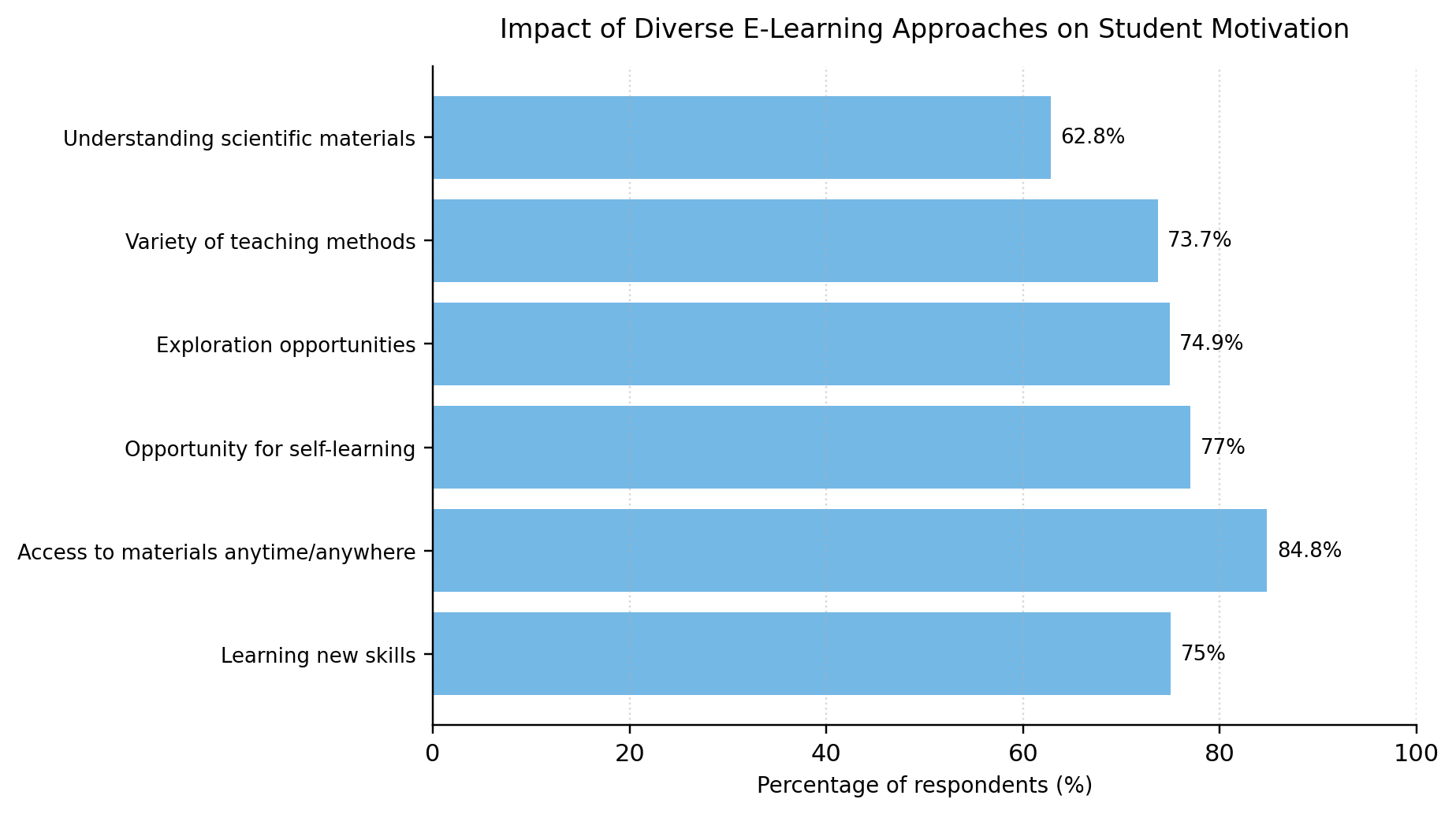
The first set of results concerns the motivational effect of diverse e-learning approaches. The most frequently cited factor was the ability to access learning materials at any time and from any location, identified by 84.8% of respondents. This result is central because it shows that students associate motivation with temporal and spatial flexibility. In SDT terms, this is an autonomy-supportive feature: learners value e-learning because it allows them to regulate the time, pace, and conditions of their study.
The opportunity for self-learning was identified by 77% of respondents, while learning new skills was identified by 75%. Exploration opportunities were reported by 74.9%, and the variety of teaching methods by 73.7%. These results suggest that students are motivated not only by access but also by the opportunity to engage in different forms of learning. The relatively lower percentage for understanding scientific materials (62.8%) is instructive. It indicates that access to digital resources does not necessarily guarantee comprehension. Understanding requires pedagogical mediation, explanation, interaction, and feedback.
Figure 1. Impact of Diverse E-Learning Approaches on Student Motivation
Source: Authors’ questionnaire data.
3.2. E-Learning Environment and Teacher-Student Communication
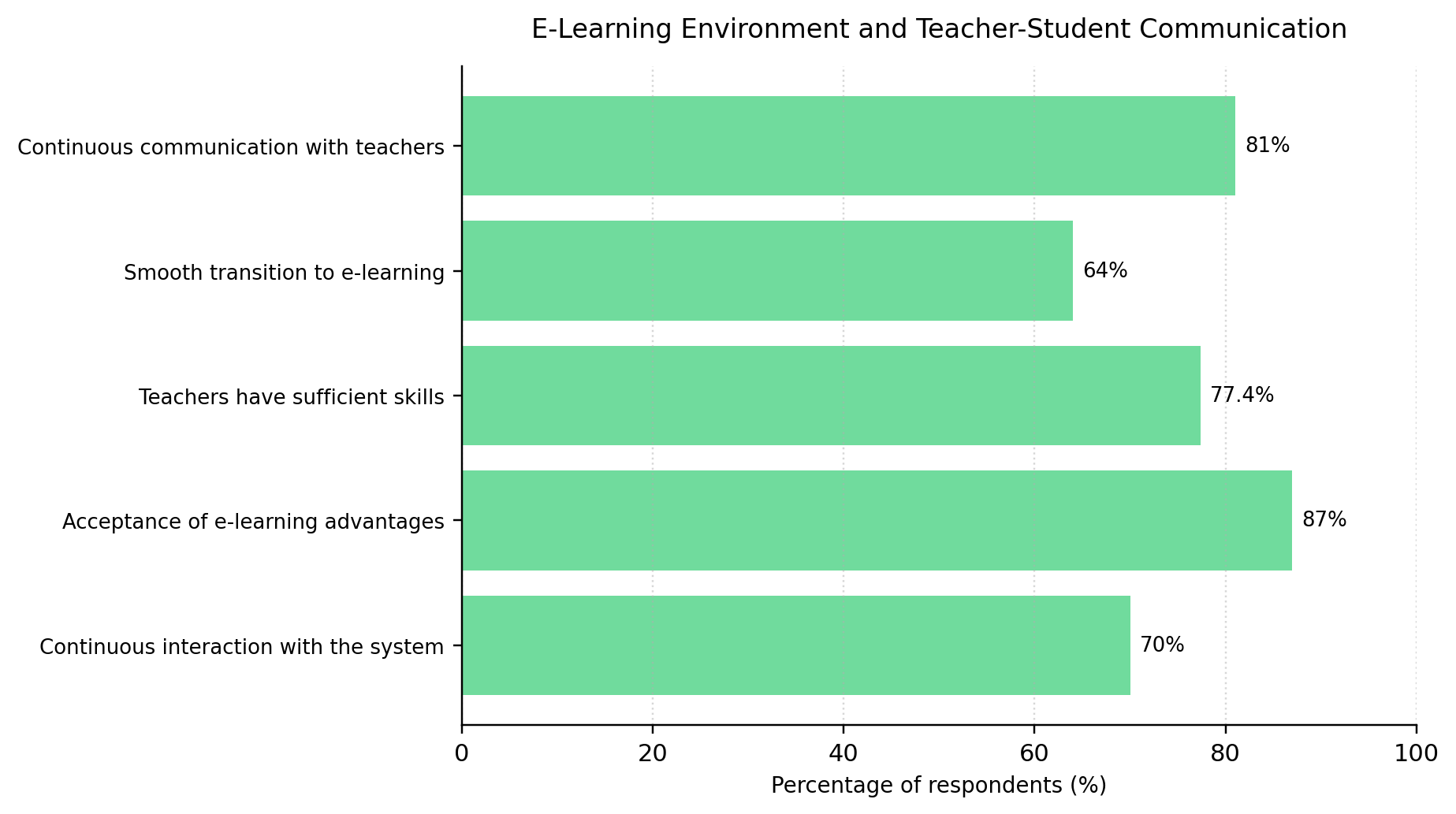
The second set of results concerns the learning environment and teacher-student communication. A high proportion of students (87%) accepted the advantages of e-learning, and 81% identified continuous communication with teachers as an important motivational factor. These findings demonstrate that e-learning is not experienced merely as an individual technological activity. Students continue to require teacher presence, guidance, and feedback. Communication is therefore a decisive component of relatedness.
The importance of teacher competence in online environments is also visible: 77.4% of respondents considered that teachers possessed sufficient skills to implement educational content effectively. Continuous interaction with the platform was identified by 70% of respondents, while a smooth transition to e-learning was reported by 64%. This last percentage is lower than the others and should be interpreted carefully. It suggests that the adoption of e-learning was not uniformly experienced as easy. Institutional and pedagogical support remains necessary to reduce the gap between technical availability and educational usability.
The reported mean score of 3.104 for the communication dimension further confirms the importance of relational support in e-learning. When students can ask questions, receive feedback, and perceive the instructor as present, the online environment becomes less isolating and more academically sustainable. In language learning, this point is particularly significant because communication is not only a means of support; it is itself part of the learning process.
Figure 2. E-Learning Environment and Teacher-Student Communication
Source: Authors’ questionnaire data.
4.3. E-Learning and Perceived Academic Performance
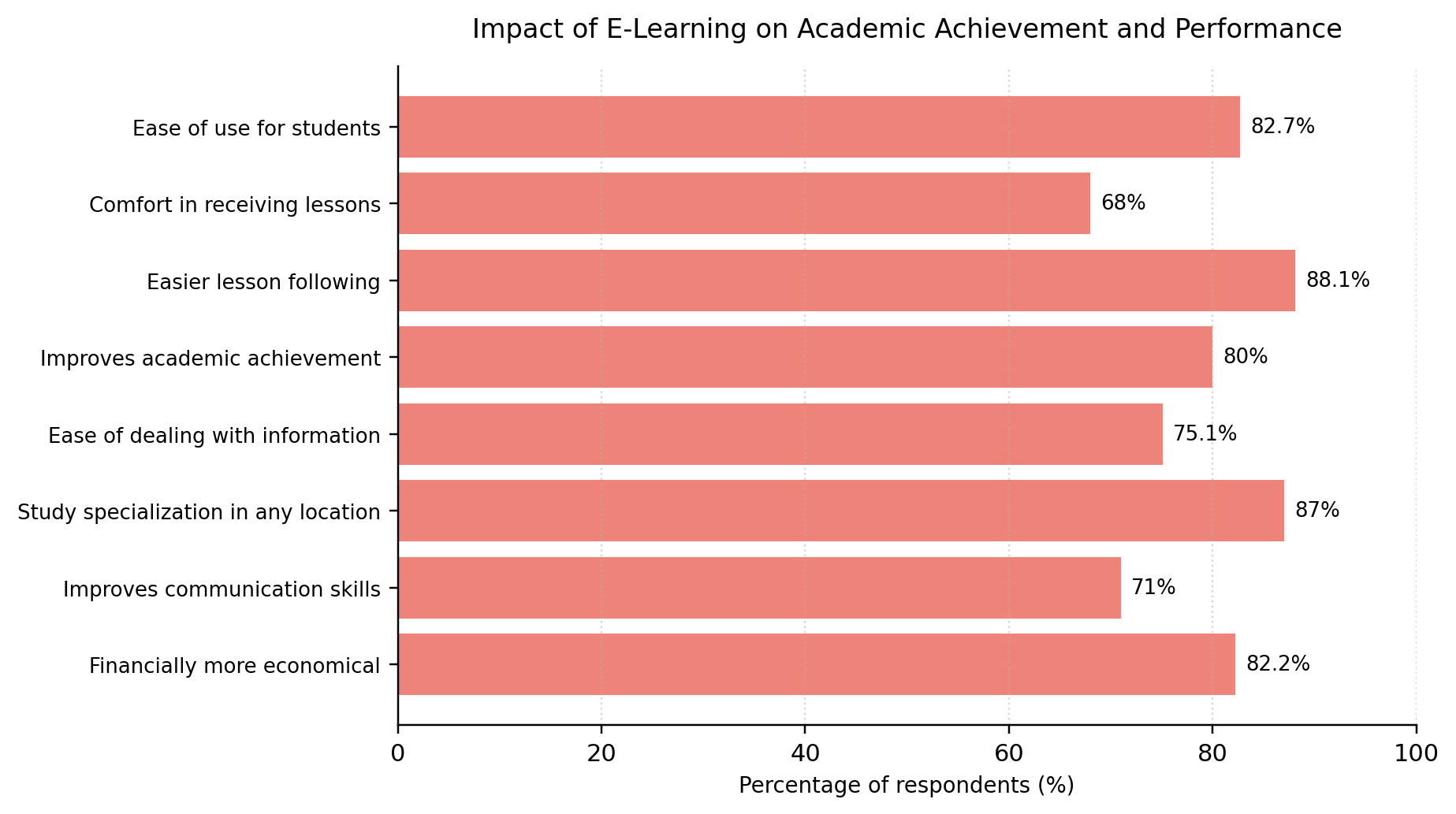
The third set of results concerns students’ perceived academic achievement and performance. The highest percentage in this dimension is the ease of following lessons, reported by 88.1% of respondents. This result suggests that students value e-learning because it helps maintain instructional continuity, including in difficult circumstances such as poor weather, distance, or other external constraints. The ability to pursue a specialization regardless of location was also reported by 87%, indicating that students perceive e-learning as a way of overcoming geographical limitations.
Ease of use was identified by 82.7% of respondents, and financial economy by 82.2%. These indicators show that students connect academic performance to practical access conditions. If learning is easier to organize, less costly, and less dependent on physical mobility, students may be more able to persist in their studies. Improved academic achievement was reported by 80%, and ease of obtaining information by 75.1%. Communication skills were reported by 71%, while comfort in receiving lessons was the lowest item in this dimension at 68%. This distribution indicates that students perceive e-learning as academically useful, but not without limitations regarding comfort, interaction, or learning experience.
The results, therefore, point to a nuanced conclusion. E-learning is perceived as facilitating academic performance because it increases continuity, flexibility, access, and opportunities for review. However, its effectiveness is not automatic. Lower scores on comfort and understanding indicate that online learning must be pedagogically accompanied if it is to produce deep learning rather than mere access to information.
Figure 3. Impact of E-Learning on Students’ Academic Achievement and Performance
Source: Authors’ questionnaire data.
4. Discussion
The results show a broadly positive perception of e-learning among the surveyed students. Nevertheless, their interpretation requires caution. The data support the view that e-learning can enhance motivation and perceived academic achievement, but they also show that motivation depends on a combination of design factors. Flexibility alone is not enough. Teacher presence, interactive content, feedback, and platform usability are equally necessary. The findings thus support a pedagogical rather than technological interpretation of digital learning.
4.1. Diversity of E-Learning Methods and Motivation
The first research question concerned the effect of diverse e-learning methods on student motivation. The findings indicate that students are motivated by varied forms of online learning, especially when these forms increase access, self-learning, exploration, and pedagogical diversity. The result aligns with the autonomy dimension of Self-Determination Theory. When students can choose when to access materials, revisit content, and organize their own study, they experience a greater sense of control over their learning process.
However, the findings also suggest that diversity must be pedagogically meaningful. A platform may contain videos, quizzes, forums, and documents, but these tools become motivating only when they are integrated into a coherent learning sequence. Variety without structure can increase confusion. Structure without variety can produce passivity. The challenge for Algerian universities is therefore to design e-learning environments that combine clarity and diversity: clear objectives, organized materials, interactive activities, and tasks that guide students toward measurable progress.
The relatively low result in understanding scientific materials also warrants attention. It shows that e-learning should not be evaluated only through access indicators. Students may access materials easily while still needing explanation, scaffolding, and feedback. Teachers, therefore, remain essential. Their role shifts from being the sole source of content to serving as designers of learning pathways, mediators of comprehension, and facilitators of autonomous learning.
4.2. Teacher-Student Communication as a Condition of Relatedness
The second research question concerned teacher-student communication. The finding that 81% of respondents value continuous communication with teachers confirms that interaction is a central motivational factor in e-learning. Within the framework of Self-Determination Theory, this result corresponds to the relatedness component. Students are more likely to remain engaged when they feel that instructors are present, responsive, and supportive. Online learning is, therefore, not a purely individual experience; it is a relational environment that must be actively maintained.
Teacher-student communication performs several functions. It clarifies expectations, reduces uncertainty, provides feedback, supports confidence, and helps students interpret learning tasks. In language learning, it also creates opportunities for authentic use of English and for corrective feedback. The absence of communication may transform e-learning into a repository of documents, whereas sustained communication transforms it into a learning community. This distinction is decisive for academic motivation.
The results also indicate that teacher digital competence matters. Students’ perception that teachers can execute educational content correctly is part of their confidence in the online environment. Institutions must therefore invest in teacher training, not only in platform management but also in online pedagogy: designing activities, moderating discussions, giving formative feedback, creating accessible resources, and maintaining a rhythm of interaction.
4.3. E-Learning and Academic Performance
The third research question concerned academic performance. The results show that students perceive e-learning as beneficial for the following: accessing specialisation opportunities, accessing materials easily, and improving academic achievement. These benefits are closely linked to flexibility and continuity. When students can access recorded sessions, revisit materials, and obtain information more easily, they may prepare better for assessments and consolidate learning at their own pace.
At the same time, the study should not overstate the relationship between e-learning and performance. The data are perceptual and do not include actual grades or longitudinal measures. The safest conclusion is that students perceive e-learning as supportive of academic performance. This perception is important because it influences motivation and persistence, but it should be complemented by objective indicators in future research. A stronger design would compare pre- and post-intervention results, platform engagement data, attendance, assessment scores, and qualitative interviews.
The findings also suggest that e-learning can reduce some structural barriers to academic participation. Financial economy, reduced mobility constraints, access to information, and the possibility of studying from any location are all significant in a country where students may face distance and resource limitations. E-learning can therefore contribute to educational inclusion, provided that the digital divide itself is addressed.
4.4. Theoretical Implications
The study confirms the usefulness of Self-Determination Theory for interpreting e-learning in higher education. Autonomy is evident in the value students place on flexible access and self-paced learning. Competence appears in their emphasis on understanding materials, following lessons, using the platform easily, and improving academic achievement. Relatedness appears in the central role of teacher-student communication. These three dimensions explain why some e-learning environments motivate students while others fail to sustain engagement.
The theoretical implication is that e-learning should be designed as a motivational ecology. Each element of the platform must be examined in terms of the psychological need it supports. A resource library supports autonomy only if it is organized. A quiz supports competence only if it provides feedback. A forum supports relatedness only if it is moderated and pedagogically meaningful. This approach allows institutions to move from digital provision to digital quality.
4.5. Practical Implications
Practically, the results suggest that Algerian universities should prioritize four areas. The first is accessibility: platforms should be mobile-responsive, easy to navigate, and capable of supporting students with unstable connectivity. Offline access to key materials and recorded lectures would help reduce inequalities. The second is pedagogical design: online courses should include clear objectives, progressive activities, multimedia resources, quizzes, and formative feedback. The third is teacher presence: teachers should communicate regularly, provide feedback, and maintain virtual office hours or discussion spaces. The fourth is institutional support: students and teachers need training, technical assistance, and clear norms for online learning.
These implications are not merely technical. They concern the quality of academic experience. E-learning can become inclusive and motivating only when students feel that they are not abandoned to a platform but accompanied through a structured learning process.
5. Recommendations, Pedagogical Implications, and Future Directions
The findings of the study call for a set of recommendations that concern not only the technical improvement of e-learning platforms, but also the pedagogical, institutional, and ethical conditions under which digital learning can effectively support motivation and academic success. The results show that students value e-learning when it provides flexibility, access to resources, continuity of instruction, teacher feedback, and opportunities for autonomous learning. However, these advantages cannot be dissociated from the quality of course design, the stability of infrastructure, the availability of teacher support, and the degree to which online learning environments remain communicative and pedagogically structured.
Several recommendations follow from the findings. First, universities should diversify e-learning approaches by combining videos, readings, quizzes, simulations, collaborative tasks, and discussion forums. Second, platforms should be designed for accessibility, including mobile use, low-bandwidth conditions, and offline availability of essential materials. Third, teacher-student communication should be strengthened through regular feedback, virtual office hours, discussion spaces, and clear response protocols. Fourth, personalized learning strategies should be developed through diagnostic activities, adaptive tasks, and progress tracking. Fifth, teachers should receive continuous professional training in online pedagogy, not only in the use of technical platforms.
The implications for practice are considerable. E-learning can reduce dependence on printed materials, extend learning beyond the classroom, support autonomous study, and help students maintain progress despite external constraints. It can also strengthen academic performance when students can review lessons, access resources repeatedly, and receive timely feedback. For policymakers, the study highlights the need to invest simultaneously in infrastructure, teacher training, student support, and quality assurance. For researchers, it opens the way to longitudinal and mixed-methods studies that combine perception data, interviews, platform analytics, and academic findings.
5.1. From Emergency Digitalization to Pedagogical Institutionalization
A central implication of the study is the need to distinguish emergency digitalization from pedagogical institutionalization. During the pandemic, online platforms were frequently mobilized to maintain pedagogical continuity under conditions of constraint. This emergency use was necessary, yet it cannot by itself constitute a durable model of digital higher education. Institutionalization requires stable course design, clearly defined teacher presence, reliable technical assistance, accessibility standards, and continuous evaluation of the learner experience. Without these conditions, e-learning remains dependent on individual initiative and cannot guarantee comparable quality across departments, cohorts, or geographical situations.
For Algerian universities, this distinction has concrete consequences. A platform should not be treated as a simple repository for lecture notes, slides, or PDF files. It should function as a structured learning environment in which students understand what they are expected to do, why each activity matters, how their progress will be assessed, and where they can obtain help. Course pages should therefore be organized by weeks, units, or competencies; each sequence should contain learning objectives, core resources, tasks, expected outputs, feedback channels, and a clear calendar. Such organization reduces uncertainty and strengthens perceived competence, especially for students whose digital study habits remain uneven.
The institutional dimension also involves equity. The findings show that students value access, flexibility, and the potential to reduce material and geographical constraints. These dimensions suggest that e-learning can reduce some barriers to participation. However, digital learning may also reproduce inequalities when connectivity, devices, digital literacy, and quiet study spaces are unevenly distributed. A responsible e-learning policy should therefore include low-bandwidth resources, downloadable materials, mobile compatibility, campus-based digital spaces, technical help desks, and explicit support for learners who cannot rely on stable home internet. Inclusion must be considered a criterion of academic quality rather than an optional social supplement.
5.2. Implications for English-Language Pedagogy
Because the study concerns students of English, its implications extend beyond general digital education. English as a foreign language requires not only access to content but also repeated practice, interaction, correction, and exposure to varied linguistic input. In this respect, e-learning can provide opportunities that are difficult to maintain in overcrowded face-to-face classrooms: recorded pronunciation models, listening tasks, online writing feedback, peer-review activities, vocabulary quizzes, asynchronous discussion forums, and short oral recordings. These tools can enrich the learning environment when they are integrated into a coherent progression and aligned with precise linguistic objectives.
Online English learning should nevertheless avoid two risks. The first is passive consumption. If students only download lessons or watch videos, they may be exposed to English without actually using the language. The second is fragmented activity. If digital tasks are not connected to a progression, students may complete them mechanically without developing communicative competence. A stronger pedagogical model would connect each online task to a language outcome: understanding an academic text, producing an argumentative paragraph, reformulating a concept, participating in a forum discussion, giving peer feedback, or recording a short oral presentation. In this model, e-learning becomes a space of language practice rather than a mere channel of information delivery.
Teacher feedback is especially important in English-language learning. The motivational value of teacher-student communication reported in the findings should therefore be interpreted not only as emotional support but also as linguistic mediation. Students need feedback on grammar, vocabulary, coherence, pronunciation, register, and pragmatic appropriateness. Digital platforms can facilitate this mediation through annotated documents, audio comments, rubrics, model answers, iterative submission, and recorded explanations of recurrent errors. Such practices support competence by enabling learners to identify what needs improvement and how to achieve it.
5.3. Limits of the Present Study
The study provides a useful descriptive account of students’ perceptions, but its limits must be explicitly acknowledged. First, the data are based on self-reported responses. This is appropriate for analysing motivation, since motivation is partly experiential, but it does not allow the article to claim direct causal improvement in academic achievement. The finding that students perceive e-learning as improving performance should therefore be read as an indicator of perceived usefulness, learning confidence, and academic continuity. Future research should compare these perceptions with actual grades, attendance records, platform analytics, course completion rates, and language proficiency measures.
Second, the available data do not provide sufficiently detailed demographic and infrastructural variables. It would be scientifically valuable to know whether perceptions differ by gender, year of study, residence, internet access, device ownership, socioeconomic conditions, or prior experience with online learning. Such variables could reveal inequalities that remain invisible in aggregate percentages. Students with personal laptops and stable connectivity may experience autonomy, whereas students relying on mobile data may experience stress, interruption, and academic vulnerability. Future studies should therefore integrate demographic, technological, and contextual variables into the analysis.
Third, the study is descriptive and should be extended through mixed methods. Quantitative questionnaires can identify tendencies, but interviews, focus groups, and learning diaries would explain why students value certain aspects of e-learning more than others. Qualitative data could clarify what learners mean by “communication”, “comfort”, “ease of use”, or “academic improvement”. They could also show how students negotiate motivation when they face technical difficulty, isolation, poor feedback, or overload. A mixed-method design would thus deepen interpretation and strengthen the article’s contribution.
5.4. Future Research Directions
Future research should examine the relationship between e-learning and measurable academic outcomes through longitudinal designs. Such studies could compare cohorts exposed to different levels of online interaction, feedback frequency, platform organization, or blended-learning design. They could also examine whether the motivational dimensions identified in this article predict persistence, achievement, participation, or language proficiency over time. Longitudinal evidence would help distinguish short-term satisfaction from sustained learning effects.
Another promising direction concerns teachers’ perspectives. The present study focuses on learners, but the quality of e-learning depends strongly on teachers’ digital competence, workload, institutional support, beliefs about online pedagogy, and ability to maintain presence in virtual spaces. A parallel study of instructors could identify training needs, obstacles to interactive course design, and conditions that enable effective online teaching. Bringing student and teacher perspectives together would provide a more complete understanding of e-learning as a shared pedagogical environment.
Finally, future research should examine the ethical and pedagogical use of emerging technologies, including artificial intelligence, learning analytics, and automated feedback systems. These tools may support personalization and formative guidance, but they also raise questions of transparency, privacy, bias, dependency, and academic integrity. In language education, AI-based tools should be evaluated not only for efficiency but also for their capacity to support learner autonomy, critical judgment, and meaningful interaction.
5.5. Toward a Pedagogical Ecology of E-Learning
The revised article, therefore, argues that the motivational value of e-learning cannot be separated from the quality of its pedagogical design. When online learning provides structured autonomy, visible progress, teacher presence, opportunities for collaboration, and accessible resources, it can become a powerful means of supporting students’ engagement. When it is reduced to a technical platform without guidance, feedback, or interaction, it risks becoming a source of disengagement. The Algerian higher-education context makes this distinction particularly important because digital education is simultaneously a response to structural constraints and an opportunity to redesign learning environments.
The contribution of this study lies in its contextualized reading of e-learning through Self-Determination Theory. Rather than presenting digital education as inherently beneficial, it identifies the conditions under which students are likely to find it motivating: flexibility must support autonomy; interactive tasks must support competence; and teacher-student communication must support relatedness. This theoretical articulation gives the article a clearer scientific orientation and allows its recommendations to move beyond general calls for modernization. E-learning becomes effective when it is conceived as a pedagogical ecology organized around learner needs, institutional responsibility, and academic quality.
Conclusion
This study examined the perceived contribution of e-learning to motivation, teacher-student communication, and academic achievement among Algerian university students of English. The findings indicate that students value e-learning primarily for flexibility, access to materials, continuity of instruction, and communication with instructors. These results support the idea that e-learning can contribute to motivation and perceived academic success when it satisfies the psychological needs identified by Self-Determination Theory: autonomy, competence, and relatedness.
The article also shows that e-learning should not be romanticized. Its value depends on quality of design, accessibility, interaction, and institutional support. Students may appreciate online learning yet still experience difficulties with comfort, comprehension, transition, or connectivity. The most important conclusion is therefore not that e-learning is superior to face-to-face education, but that it can become a strong component of Algerian higher education if it is integrated within a coherent pedagogical model.
Ultimately, the future of e-learning in Algerian universities should be understood not as a temporary response to crisis but as an opportunity to rethink the conditions of inclusive, flexible, and motivating higher education. The challenge is to ensure that digital learning environments remain humanly and pedagogically inhabited: accessible to students, structured by teachers, supported by institutions, and oriented toward genuine academic development.