
Introduction
The comic may be analyzed as a logical, semantic, and structural construction. However, the discursive dimension can prove to be equally exploitable through the adoption of a modular framework.
“A modular approach is, in a general sense, an approach that relies on a theoretical model comprising a certain number of autonomous subsystems called modules, where each module is responsible for processing a specific and limited issue” (Nølke & Adam, 1999, p. 18).
The various modules are not treated in isolation, but may be interconnected through a system of overarching rules.
The comic dramatic discourse of Aïssa Khelladi can be described with greater precision along the axis of discourse by opening the way to an explanatory level that can be revealed through the systematic analysis of discursive manifestations. We posit that discourse, as a trans-sentential construction, pertains to language in use, that is, to speech.
Indeed, The Paradise of False Hopes by Aïssa Khelladi does not constitute an ideal discourse in which words and utterances strictly conform to the constraints imposed by language alone. In fact, several currents within the social sciences emphasize the modularity of the mind and, correlatively, that of discourse. We will therefore seek to highlight this complexity in order to situate the comic, a notion that remains particularly complex and resistant to analysis, at the core of a complex discursive organization.
To this end, we adopt Eddy Roulet’s modular framework, which accounts for the complexity of the organization of comic dramatic discourse.
1. Theoretical Concepts of Modularity
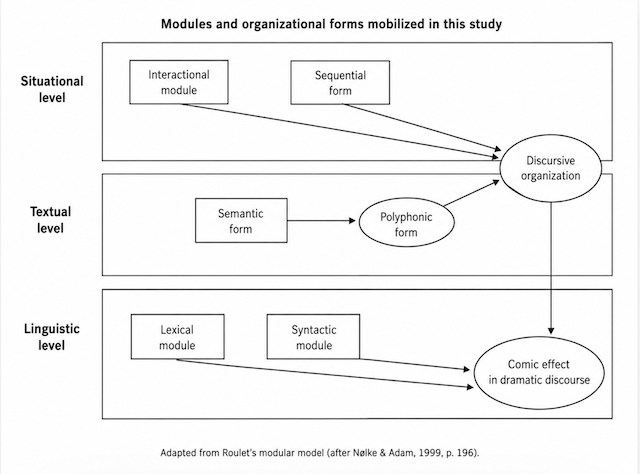
The architecture of Eddy Roulet’s model is heterarchical, insofar as it allows for the coupling of different organizational levels. Thus, it can be broadly observed that the complexity of comic dramatic discourse may be approached from multiple perspectives: enunciation, theme, lexicon, syntax, intonation, argumentation, and so forth. These components are classified by Roulet according to a modular schema (Nølke & Adam, 1999, p. 196).
This schema seeks to account for the complexity of discourse, which is distributed across three levels of analysis: the linguistic level, the textual level, and the situational level. Each module is thus defined as a complex structure of interrelations between elementary organizational forms, represented by rectangles, and complex organizational forms, represented by ellipses.
In the present study, we do not aim to examine the entirety of this model in relation to our corpus, Le paradis des fausses espérances by Aïssa Khelladi. Rather, we confine our analysis to the components responsible for generating a comic effect in dramatic discourse, namely the lexical, syntactic, and interactional modules, in addition to two elementary organizational forms, semantic and sequential. Finally, we consider the complex organizational form of polyphony.
Figure 1. Adapted schematic rendering of Roulet’s modular framework for the analysis of dramatic discourse (after Nølke & Adam, 1999, p. 196).
2. Discursive Features of Comedy in Le paradis des fausses espérances
2.1. The interactional dimension
The interactional module holds evident significance in Le paradis des fausses espérances by Aïssa Khelladi. Dialogic exchange constitutes the substance of dramatic discourse. It is relatively more significant than the entirety of stage directions, as these merely provide metalinguistic clarification of the dialogue.
Dialogic exchange defines the properties of the material dimension of verbal interaction in comic dramatic discourse.
At the outset, we observe the phenomenon of embedding that governs all dialogic exchanges in dramatic discourse. The interactional framework of the protagonists is embedded within a higher-level interaction between the author and the audience, conceived as a unilateral interaction in which the author occupies the position of an “agent” subject of speech, while the audience assumes the position of a “patient” subject.
It can also be noted that the embedded dialogic structure is explicitly marked, whereas the embedding dialogic structure remains implicit, except in the following utterances:
“Salam: …to humiliate, have we already said that? No? Well then: humiliate, crush, tear apart, erase, devastate, defeat, overcome, eradicate… ah, I see that you all know that one. E-ra-di-cate. And terrorize? You all know that one as well, of course.” (Khelladi, 2000, p. 264).
“Mabrouk: …I have killed Omar Zantag! I have killed Omar Zantag! (he looks again:) You, are you not applauding? (he waits), I am sure you are crypto-terrorists, reconciliators.” (Khelladi, 2000, p. 316).
“Salam: …I will not tell you where we live. For reasons you will infer.” (Khelladi, 2000, p. 333).
In Aïssa Khelladi’s comic dramatic discourse, indirect address to the audience is predominant, while direct address is rare and limited to only three instances. These moments of direct audience involvement are strategically placed at the beginning and end of the play, emphasizing the embedded structure of the discourse.
The dialogic exchange is understood as a multi-layered interaction involving multiple communication channels, particularly the verbal-auditory channel (speech and voice) and the visual channel (gestures, posture, and movement).
For the verbal channel, let us consider the following set of adjacency pairs. As Bange defines it, an adjacency pair consists of two turns produced by two different speakers in immediate succession (Bange, 1992, p. 42):
(1) “Salama : I do not know… He does not tell me ‘I love you’ the way you know how to.
Salam: (shouting) He does not tell you: ‘I love you’!
Salama : No… why are you shouting?
Salam: But what does that bastard say, then?
Salama : Soldiers do not speak easily.
Salam: He is a soldier!
Salama : And you think that soldiers do not know how to say ‘I love you’?
Salam: (exclaiming) Of course no!
Salama : Really! They are not like other men?
Salam: No!
Salama : Better?
Salam: No!
Salama : Different?
Salam: No! ” (Khelladi, 2000, p. 275).
(2) “Salam: So you do not feel well protected?
Mabrouk: I am the one who asks the… do not be afraid, I am always armed. If you make the slightest attempt against me, I will shoot you like a dog!
Salam: But I have no intention of making any attempt against you. You seem paranoid. Did Salama not explain to you that I was the one seeking your protection?
…
Salam: Listen, let us stop here. Let us shake hands and…
Mabrouk: No sudden movements or I will crush you like a cockroach!
Salam: Oh!
Mabrouk: I hope you are now convinced that I am in control of the situation. Let us begin at the beginning… so you claim that the sons of Zarkis are going to massacre you?
Salam: I did not say anything of the sort… which sons of Zarkis? They have done nothing to me, those people.
Mabrouk: Why? Are you with them? ...” (Khelladi, 2000, p. 295).
It is evident that several elements lend themselves to analysis, given the richness of verbal interaction in dramatic discourse; however, we will focus exclusively on the factors that generate a comic effect.
The text shows how language creates meaning and humor in dialogue. Informal address between Salama and Salam reflects equality, while Salama’s ironic, rhetorical questions and Salam’s blunt replies produce a comic effect.
In contrast, formal address between Salam and Mabrouk signals distance and power imbalance. Mabrouk adopts an accusatory, confrontational, or eristic style, while Salam responds defensively with logical, or dialectical, arguments.
A misunderstanding over the expression “sons of Zarkis,” interpreted differently by each character, creates dramatic irony, as the audience understands the confusion while the characters do not.
2.2. The Syntactic Dimension
Several observations can be made regarding the organization of the syntactic module. First, it is necessary to define the syntactic categories that generate the structures of all “maximal propositions” of the language (Roulet, 1995, p. 215). Roulet introduces this notion in place of that of the “sentence,” which may contain several maximal propositions and thus correspond more to a textual structure than to purely syntactic structures. This is the case, for example, with sentences containing appositions, that is, a detached use of the noun opposed to the appositive adjective (Dubois et al., 2002, p. 46).
Accordingly, the maximal proposition must be defined in terms of grammatical acceptability. The comic dramatic discourse of Aïssa Khelladi appears to conform to the rules of semantic and syntactic acceptability, except in the particular case of the utterances produced by Omar. In the extracts below, the asterisk signals deliberate ungrammaticality:
Salam: Bonjour.
Omar : *Jour bon1.
Salam: Why do you speak like that?
Omar : *Speak how I? (Khelladi, 2000, p. 268).
The bearded man: *Here, I am.
Salam: *I thought that hung up you had… (Khelladi, 2000, p. 283).
The bearded man: *Infallible is the judgment of the moudjahidin. Without appeal, the Front has condemned you. *Friday at the time of the great Prayer, you are executed (Khelladi, 2000, p. 283).
Omar (sighing) : *Reflect let me…
Salam: *Your time, take especially.
Omar : *Why like me you speak? The trap, I sense. (Khelladi, 2000, p. 314).
It is noteworthy that syntactic norms are not respected in Omar’s speech. This is due to exaggerated government: “Government refers to the property of a verb to be accompanied by a complement whose mode of introduction is determined” (Dubois et al., 2002, p. 399).
From a linguistic perspective, Omar’s maximal propositions are defined as grammatically unacceptable and thus constitute a deviation from the norms of linguistic acceptability. Omar’s linguistic performance becomes an object of ridicule for Salam, who resorts to imitation in order to intensify the mockery. Consequently, Omar’s recursive production of incorrect sentences becomes a comic device that suggests the inferiority of the object of the comic, namely his linguistic performance, by exposing its deficiencies.
2.3. The Lexical Dimension
The lexical module examines how vocabulary contributes to comic effects in Aïssa Khelladi’s dramatic discourse. Words in their literal, denotative meaning do not inherently produce humor; rather, comedy arises from the audience’s interpretation of the utterance as a whole.
For this reason, the focus here is on vocabulary, linked to speech in use, rather than on lexicon understood as part of the language system. In The Paradise of False Hopes, two types of lexical usage are identified as contributing to comic effects to varying degrees.
2.3.1. Exaggerated lexical recurrence
This first procedure involves the successive use of a large number of words belonging to the same lexical field. Consider, for example, the following utterance:
“Salam: I rack my brain to find words to invent life for you while you spend yours taking it away from yourselves. ‘To take it away from yourselves’… that sounds strange… Remove. A synonym for take away. (He rushes to his machine.) Words are my profession… remove, massacre, kill, slaughter, assassinate, stab, hack, put to death, disfigure, maim, damage… devastate, sabotage, cripple, alter, make ugly… denature, spoil, distort… do you know any others, words like that? Crush, very good! And what else? Yes, grind, chop, trample, etc. Damage? No, we have already said that. Annihilate, very good. Strike down, demolish, ruin, overthrow, undermine, raze, undo, abolish, annihilate, suppress, dismantle, extinguish, smother, neutralize, break, abrogate, shatter, exterminate, that is it, exterminate! Well, that will do. What? Humiliate, we have already said that. No? Well then: humiliate, squash, tear to pieces, erase, dilapidate, defeat, undo, eradicate… Ah, I see you all know that one. Eradicate. And terrorize?” (Khelladi, 2000, p. 268).
The procedure employed by Salam consists here in arranging a substantial number of verbal roots that can be organized into a lexical field. The fifty-two verbal roots are structured through a synonymic relationship justified by Salam. This chain of synonyms may be considered the first comic feature attributed to Salam.
It follows the principle of the “jack-in-the-box” developed by Henri Bergson. Salam’s mechanical attitude and his insistence on generating words in order to demonstrate his competence as a writer constitute the basis for the production of a comic effect.
2.3.2. Lexical borrowing from Arabic
The author’s recourse to words from his native language, namely dialectal Arabic, undoubtedly exerts a significant effect on the discourse. Consider, for example, the following utterances:
a. “Salam: May God protect me! Allah yastour!” (Khelladi, 2000, p. 282).
b. “Salam: Yes. We are Muslims; we say Inch’Allah when we intend to do something. See you tomorrow, inch’Allah. I am going to sleep, inch’Allah. I will try to be there, inch’Allah. The Front will execute me, not executes me, on Friday, at prayer time, inch’Allah! Dust you are, dust you shall become.” (Khelladi, 2000, p. 283).
c. “(The call of the muezzin is heard: Allah Akbar...)” (Khelladi, 2000, p. 315).
d. “Mabrouk: (He belches): Ham’dou llah.” (Khelladi, 2000, p. 295).
e. “One being alone is missing and everything is depopulated… What am I saying? Din errab! (To the audience:) it is the equivalent of ‘Damn!’ Excuse me. It rather means ‘Oh dear’ or ‘Good God’.” (Khelladi, 2000, p. 281).
The insertion of Arabic words into dramatic discourse constitutes a sociolinguistic case of language contact that produces borrowing: “There is linguistic borrowing when a speech variety A uses and ultimately integrates a unit or a linguistic feature that previously existed in a speech variety B, referred to as the source language, and which A did not possess” (Dubois et al., 2002, p. 177).
The use of borrowing may give rise to a comic effect, since the speaker who employs it intensifies his utterances by adopting an informal register stemming from a sense of linguistic insecurity, as is the case in the first example.
In the second, third, and fourth examples, the inserted Arabic expressions, inch’Allah, Allah Akbar, and Ham’dou llah, are idiomatic expressions specific to Arabic. They acquire their full meaning only when integrated as such, without translation into the foreign language, as they belong to the Arab-Muslim doxographic system.
In the fifth example, Salam becomes agitated and resorts to an insult in Arabic to express his anger. The comic effect arises from his attempt to euphemize his coarse expression, Din errab, by reverting to the normative usage of the foreign language, namely “Oh dear” or “Good God.” Thus, Salam’s self-correction functions as a mitigated strategy to soften the crudity of the insult and, consequently, to initiate the audience into the absurdity of his pseudo self-correction.
2.3.3. Elementary organizational forms
2.3.3.1. The semantic organizational form
The global semantic dimension of Aïssa Khelladi’s comic dramatic discourse is represented by the macrosemantic structure, or the overall topic of the discourse. The overarching theme of the play is the life quest of a failed writer who is doubly threatened. The fictional nature of comic dramatic discourse is governed by a specific logic that alternates between reality and fiction.
It is noteworthy that the author does not establish any distancing. On the contrary, he deploys enunciative devices, which will be examined within the polyphonic organizational form, by using the personal pronoun “I,” and fictional devices aimed at rendering his discourse plausible. In this respect, the metaphorical use of the title *Le paradis des fausses espérances* may serve to suspend the truth conditions that determine the universe of reference.
In this case, we will analyze isotopy, which functions as a site of mediation between the specific logic of dramatic discourse and the referential logic of the world. Defined as a form of linguistic iteration, semantic isotopy is “the syntagmatic recurrence of the same seme or group of semes” (Dubois et al., 2002, p. 259).
Isotopic ambiguities are extensively manifested in literary texts as deviations, and they govern the semantic cohesion of the utterance. Two levels of semantic isotopy may be identified: the sentential level, corresponding to sentential cohesion; and the textual level, corresponding to the coherence and semantic cohesion of worlds.
Consider, for example, the following utterance:
“Salam (aside, philosophically): One is always afraid of encountering life; that is normal! ” (Khelladi, 2000, p. 267).
We have previously analyzed this utterance as a witticism. It clearly differs from an isotopic utterance such as “One is always afraid of encountering death.” In this case, the two lexemes life and death appear heterogeneous with respect to the isotopic context of encounter, hence producing the effect of a metaphorical figure. This rupture may be mitigated by brief explanations indicating that life and death constitute the two extremities of the existential trajectory of human beings.
The concept of isotopy is related to the trajectory of meaning that the reader analyzes and understands while experiencing a sense of unity. In the comic dramatic discourse of Aïssa Khelladi, the rupture at the sentential level is complemented by the logic of the semantic world of the play. For this reason, the juxtaposition of contradictory lexemes in a witticism creates a comic effect by marking a rupture at the level of sentential isotopy, aligned with the absurd logic of the textual isotopy of comic dramatic discourse: “Semantic cohesion is a fact of co-textuality, which the notion of isotopy makes it possible to theorize” (Adam, 2001, p. 26).
In light of the foregoing, it may be stated that the comic consists in exploiting the internal properties of the text in order to sustain the absurd logic of the dramatic narrative universe.
2.3.3.2. The form of sequential organization
Dramatic discourse is a heterogeneous form of discourse. Its primary substance, namely dialogue, consists of the arrangement of multiple fragments of sequences: while engaging in dialogue, the protagonist may recount an event, explain a notion, or defend an idea. Sequential organization seeks to identify these different types of sequences within comic dramatic discourse and subsequently relate them to the comic.
3. The narrative sequence or the suspension of the comic
3.1. The narrative sequence and the suspension of the comic
We will focus exclusively on the narrative sequence, although other sequences, such as argumentative and explanatory ones, also exist and are considered less conducive to our analysis of the comic.
Theatrical discourse has always raised a fundamental question: does theatre pertain to mimesis or to diegesis? It is evident that both the narrative and the dramatic modes converge to form the substance of theatrical discourse. *Le paradis des fausses espérances* is a play that tells a story addressed to an audience. Narrativization serves as a device for representing elements that cannot be directly enacted.
By contrast, the narrative is embedded within conversation according to Adam’s prototypical model (Adam, 2001, p. 171):
[Conversation + [narrative] + conversation]
In The Paradise of False Hopes by Aïssa Khelladi, several instances of narrative embedding within dialogue are established:
A. “Salam: Salama arranged the meeting with Mabrouk. She told me that he would come to my house at four in the afternoon…” (Khelladi, 2000, p. 293).
a. “Salama : Say nothing… I am going to make a confession. While you were talking with Mabrouk, I was reflecting. I knew that he would offer you his help if you renounced me. He had told me so. And I played on that… oh forgive me, forgive me! (She weeps, wipes her tears, resumes:) Now what am I to do? You must know something else, and it is the most terrible: I am going to leave you. Do not cry out. Do not protest. Say nothing… Farewell! I have done enough harm as it is” (Khelladi, 2000, pp. 307–308).
B. “Salam: Hello… Yes… Mabrouk? It is Mabrouk… Why is he calling me? Why are you calling me? He wants to speak to Salama. We had the same idea at the same moment. Great minds think alike… He does not understand. What? He says that he is inhabited by no spirit at all. That is exactly what I thought! I said that is exactly what I thought! Is he deaf or what? He thinks Salama is with me. Do you think Salama is with me? Calm down, calm down. Really now! He calms down. He does not calm down. Ah, these military men… I hesitate to tell him that she is with me, just to provoke him. Listen, Mr. Mabrouk, Salama has gone to her sister’s in the countryside. Which sister? I have no idea, she told me nothing. What are you saying? A name, a district, an initial, a clue… There he goes again. Conduct your investigation… What? He still thinks Salama is with me. Do you think I am making fun of you? He thinks I am making fun of him. Fine, yes, I am listening, I am listening… Very well. Goodbye, sir. Or rather farewell, once again. (He hangs up.) He is giving me until Friday, one o’clock, to tell him where Salama is. After that deadline, he will come to kill me. Three bullets to the head, he specified. Why three? He is completely insane…” (Khelladi, 2000, pp. 309–310).
b. “The woman: I had a husband and four children whom I loved very much. My husband said to me, we must divide ourselves… the masks have fallen” (Khelladi, 2000, pp. 324–326).
Adam (2001) proposes a study of the embedding of the narrative monologue within dramatic discourse. Narrative can thus be integrated into dialogue in a variety of ways. For example, in the first case, the narrative instance is enveloped by the discursive instance. The justification lies in the verbal tense. Two occurrences are combined: “Salama arranged / told” and “It is half past four…”
Here, the passé composé, whose aspect is non-accomplished, does not intrinsically belong to narrative but rather to discourse, or more precisely to narrative rendered as discourse, which should be analyzed as reported speech. In this case, Salam’s unilateral dialogue with the audience constitutes a quoting discourse that remains anchored in its enunciative instance while incorporating a quoted discourse endowed with its own markers of subjectivity (Charaudeau & Maingueneau, 2002).
In the second case, the situation involves a unilateral dialogue in which Salama is the acting subject and Salam the patient subject. This dialogue may therefore be likened to a conventional narrative monologue, with one variation: the addressee is present but does not participate in the interaction. His presence is marked by the use of the imperative “say nothing.” This scene may be schematized as follows:
Unilateral Dialogue
(Salama’s Narrative Monologue)
[Discourse + (Narrative)]
In the fourth example, we are dealing with the same type of embedding, though it appears more substantial insofar as two entire scenes are embedded within the dialogue between the veiled woman and Salam. These two scenes fulfill two essential functions (Adam, 2001). First, they provide information about previously unknown subjects, namely the husband, and they also ensure textual coherence by narrativizing events that cannot be enacted directly.
It should be noted, however, that the narrative instance is introduced only through an opening, “I had a husband…,” which functions as an initial situation marked by the use of the imperfect tense. Here, the imperfect serves as an indicator of temporal distancing, separating the action from the present moment of enunciation. Its value in this utterance is to frame the narrative, to envelop it as a background whose boundaries are not clearly delineated, as in having a husband or loving the four children. In this case, the background encompasses the foreground, represented by the present perfect “my husband told me…,” or by the introduction of a disruptive element.
The embedded narrative is presented in the form of dialogue, thereby actualizing the narrative. It may be argued that the dialogue between the woman and her husband fulfills an emotional pragmatic function. One may thus speak of a double embedding structured hierarchically as follows:
Table 1. The embedding of narrative within dramatic dialogic exchange.
|
Scene |
Structure |
Participants |
|
I |
Dialogue + [narrative] |
S + F |
|
II |
Dialogue [narrative] |
(dialogue: F + M) |
|
III |
Dialogue |
S + F |
|
IV |
[narrative] |
(dialogue: F + M) |
|
V |
Dialogue |
S + F |
This constitutes a strategy aimed at foregrounding dialogue, which serves as a direct representation of action. A significant emotional charge may emerge from the narrative sequences inserted within the dialogue, functioning as intermediate narratives endowed with emotional value.
In the first, second, and fourth examples, the embedding of narrative sequences does not produce any comic effect. Rather, it disrupts the audience’s horizon of expectations. One may even argue that these narrative sequences represent seriousness, in contrast to the discursive sequences that embody non-seriousness, or the comic. Thus, the insertion of the narrative component may function as a pause that ultimately enhances the comic effect.
In the third example, we encounter a particular case of embedding related to the enunciative instance. Salam engages in double enunciation: he speaks to Mabrouk on the telephone while simultaneously reporting what Mabrouk says to an abstract addressee, namely the audience. A double dialogue is thus established within this utterance, which may be represented as follows (the lines attributed to Mabrouk are reconstructed for analytic clarity):
“Salam: Hello… yes.
Mabrouk: This is Mabrouk.
Salam: Why are you calling me?
Mabrouk: I want to speak to Salama.
Salam: We had the same idea at the same moment. Great minds think alike.
Mabrouk: I do not understand. I am not inhabited by any mind.
Salam: That is exactly what I thought! I said that is exactly what I thought.
Mabrouk: I believe Salama is with you…”
At the same time, this dialogue is directly reported to the audience: “Calm down, calm down. Really! He is calming down. He is not calming down. Ah, these military men… I hesitate to tell him that she is with me, just to annoy him.”
It is evident that Salam resorts to reported speech with an informative function. The transformation of the dialogue between Salam and Mabrouk into a narrative through reported discourse presupposes the presence of a listener who becomes the object of tacit complicity, insofar as the misunderstandings are narrated in such a way that they can be detected by the audience, which alone possesses their underlying key.
3.2. The polyphonic form or enunciative simulacrum
This form makes it possible to analyze the functioning of comic dramatic discourse by moving from dialogue to dialogism. Theatrical dialogue has consistently raised questions of an enunciative nature. Dramatic discourse may be conceived as a set of speech acts in interaction. This results in a dynamic progression that unfolds along the temporal axis of the present of verbal and actantial interaction.
Consider, for example, the following utterances:
(1) “Salam: What? My book, did you say? Do you wish to know the story that I will recount in the book that I will write?”
(2) “Salam: A woman’s voice! Is that possible? But who could it be! (There is another knock at the door.) Who is it?
Salama : It is me.
Salam (imitating a parrot): Who is it? ... ‘It is me’ who?”
The use of the deictic variant “me” constitutes a source of comic effect, insofar as it highlights its variation according to the enunciative instance.
It is noteworthy that dramatic discourse is saturated with deictic elements, which signal its performative and expressive character. For this reason, dramatic dialogue fulfills a communicative function that pertains to discourse rather than narrative. The dominant tense in Aïssa Khelladi’s comic dramatic discourse is the present indicative.
The use of the present tense in theatrical dialogue performs an actualizing function: “the use of the present results in representing the corresponding object as contemporaneous with the speaker’s now” (Haillet, 2007, p. 69). This usage may be analyzed in both components of theatrical discourse, namely dialogue and stage directions. In the first of the two examples above, the use of the present in “do you wish” corresponds to what is termed a performative present, in which temporal boundaries are not clearly marked. In the second example, the stage direction reflects the use of a historical present, interchangeable with the simple past of narration, since stage directions may serve to narrativize actions that cannot be integrated into the dialogue.
It may thus be concluded that the use of the present tense and deictics ensures a complete enunciative anchoring, endowing comic dramatic discourse with an enunciative tone rooted in the present time of staging and discourse production. This enunciative anchoring corresponds to a current act of enunciation whose reference frame is defined as I, here, now. This current enunciation is represented as a particular form of verbal interaction, not only between the protagonists but also between the author and the audience. Consequently, enunciative instances are doubled, creating instability in the source of speech.
Consider, for example, the following utterance:
“Salam: But I have no intention of making any attempt against you. It would seem that you are paranoid. Has Salama not explained to you that it was I who was seeking your protection?” (Khelladi, 2000, p. 294).
In this utterance, the use of the present conditional introduces ambiguity and a certain distancing, as it is combined with an indefinite enunciative instance, namely the hypocritical “one.” This corresponds to what Haillet terms the conditional of enunciative alterity, which produces a splitting of the speaker (Haillet, 2007, p. 115). In effect, Salam attributes his own point of view to another indefinite instance in order to evade enunciative responsibility, in this case, the insult.
Let us examine a brief fragment from one of Salam’s speeches, marking with S the utterances produced by Salam and with X those attributed to an undefined voice:
“S (I know. You are thinking about the list of the 130 writers that was posted on mosques. I will tell you), X (it is a publicity stunt), S (believe me)! X (favoritism). S (As for me, it is more serious…)” (Khelladi, 2000, p. 268).
We observe that Salam’s utterances are easily attributable to him. By contrast, the utterances labeled X are of unknown origin: these viewpoints may be attributed to Salam, to the author Aïssa Khelladi, or even to another protagonist. This phenomenon is referred to as polyphony. The theory of polyphony developed by Oswald Ducrot draws on Bakhtinian dialogism, which presupposes that discursive viewpoints may be conveyed by multiple sources or voices.
Thus, Ducrot’s major contribution lies in delineating the sources of speech within the utterance of the speaking subject by distinguishing between locutor and enunciator:
“The locutor is the one who, according to the utterance, is responsible for the act of enunciation. The locutor leaves traces in the utterance, such as first-person pronouns. The locutor is capable of staging enunciators who present different points of view. The locutor may align with certain enunciators while distancing himself from others” (Charaudeau & Maingueneau, 2002, p. 445).
This distinction is fundamental to the functioning of dramatic discourse in general and of comic dramatic discourse in particular.
Consider, for example, the following utterance:
“Salama : Soldiers do not speak easily” (Khelladi, 2000, p. 275).
In this utterance, a point of view is conveyed through the use of the present indicative, which carries the value of a general truth. This point of view may be attributed either to the enunciator, Aïssa Khelladi, or to the locutor, Salama, since it contains no explicit markers of subjectivity attributable to a specific instance.
Consequently, in theatrical communication, the integration of psychological and cultural components is essential in determining the source of the utterance. For Kerbrat-Orecchioni (2002, p. 22), language constitutes a cluster of subjective markers that can be analyzed at the enunciative level.
In order to simulate his point of view, the speaker frequently resorts to implicitness. Implicit statements are generally attributed to the enunciator. Within the framework of a unilateral conversational logic between the speaker, Aïssa Khelladi, and the addressee, namely the audience, the former produces inferential statements:
“We shall call ‘inference’ any implicit proposition that can be extracted from an utterance and deduced from its literal status by combining information of varying status, whether internal or external” (Kerbrat-Orecchioni, 1986, p. 24).
Consider, for example, the following utterances:
“Salama :… Mabrouk is older than I am; he is a friend of my late parents. Well, if one wishes. Somewhat older, yet still handsome, and wealthy thanks to the positions he holds” (Khelladi, 2000, p. 274).
“Mabrouk: I no longer go to those places since they have become disreputable!” (Khelladi, 2000, p. 297).
In these two utterances, the polyphonic dimension emerges alongside the inferential aspect. In the first, this involves an implicature encompassing all the information that an utterance is capable of conveying, but whose actualization remains dependent on certain features of the enunciative context (Kerbrat-Orecchioni, 1986, p. 39). In this utterance, an interpretive process must be mobilized by the addressee in order to determine the fluctuating semantic value of the term “positions.” This lexeme introduces a dual axiological interpretation: Mabrouk’s prestigious position may be understood either as the reward for the irreproachable exercise of his military duties or, conversely, as the result of questionable practices.
By contrast, the second example involves a presupposition, that is, information that, without being overtly asserted, is nevertheless automatically entailed by the formulation of the utterance in which it is inscribed (Kerbrat-Orecchioni, 1986, p. 25). Here, the temporal marker “since” conveys a lexical presupposition upon which two presupposed inferences are constructed, namely that mosques were not previously frequented by undesirable individuals and that they are now attended by so-called undesirable worshippers.
From the foregoing, it may be concluded that polyphonic organization does not merely aim to identify segments of discourse that are produced and represented, along with their sources, as enunciative organization does, but rather to describe their function within the overall organization of discourse. The polyphonic simulacrum enables a redistribution of enunciative responsibility: Aïssa Khelladi attributes to Salam points of view that are not his own under the pretext of generating a general comic effect.
Conclusion
It may be concluded that the modular approach enables an increasingly in-depth understanding of dramatic discourse and, consequently, a more effective analysis of the comic as a phenomenon grounded in discursive structure.
The comic may arise from the three levels that constitute the complexity of discourse. At the linguistic level, the comic emerges in relation to fundamental linguistic properties. At the textual level, semantic cohesion prevails by ensuring an isotopy aligned with the comic logic of the dramatic universe, while the insertion of narrative within dialogic exchange in The Paradise of False Hopes serves to reinforce the comic dimension. At the interactional level, polyphony functions as a subtle means of evading enunciative responsibility by creating ambiguity regarding the identity of the enunciative instance.