
Rethinking AI-Mediated Assessment and Feedback in EFL: Evidence, Learner Judgement, and Human Calibration

إعادة التفكير في التقويم والتغذية الراجعة بوساطة الذكاء الاصطناعي في تعلم الإنجليزية لغةً أجنبية: الأدلة، وحكم المتعلم، والمعايرة البشرية

Repenser l’évaluation et la rétroaction médiées par l’IA en anglais langue étrangère : preuves, jugement de l’apprenant et calibration humaine

Abderrahmen Tahri Mourad Touati

Abderrahmen Tahri Mourad Touati, « Rethinking AI-Mediated Assessment and Feedback in EFL: Evidence, Learner Judgement, and Human Calibration », Aleph [], 12 November 2026, 13 November 2026. URL : https://aleph.edinum.org/18340

Context. AI-mediated feedback is increasingly used in English as a foreign language (EFL) assessment, yet favourable user experience, assisted output and durable learning are often treated as equivalent outcomes. Objective. This critical review examines what current evidence can support about writing performance, motivation, engagement and feedback use, and develops a process-oriented framework linking machine feedback to learner judgement and independent performance. Method. A critical integrative synthesis not designed as a PRISMA systematic review draws on 36 publications: 27 topic-specific sources and nine theoretical anchors. The supporting appendices document the author-reported search queries, screening counts, corpus inventory and targeted source rechecks; historical execution of the search and individual retrieval assignments remain only partly documented. Results. Some guided instructional packages are associated with gains in assessed writing or revision, whereas affective findings frequently concern self-reported experience. Bundled interventions limit attribution to AI alone, and evidence for delayed unaided transfer remains insufficient. Learner judgement, explicit criteria and human calibration emerge as plausible mechanisms, but not as validated causal relations. Conclusion. AI can contribute to learning-oriented assessment when its outputs remain provisional, contestable and subject to human calibration. The proposed framework offers testable hypotheses and candidate indicators for future research while preserving a deliberately bounded interpretation of the evidence.

السياق. يتزايد استخدام التغذية الراجعة بوساطة الذكاء الاصطناعي في تقويم الإنجليزية لغةً أجنبية، مع استمرار الخلط أحيانًا بين التجربة الإيجابية، وجودة الإنتاج المدعوم، والتعلم المستدام. الهدف. تفحص هذه المراجعة النقدية ما تسمح الأدلة الحالية بإثباته بشأن الأداء الكتابي والدافعية والانخراط واستخدام التغذية الراجعة، وتقترح إطارًا إجرائيًا يربط بين مخرجات الآلة وحكم المتعلم والأداء المستقل. المنهج. تعتمد الدراسة مراجعة تكاملية نقدية غير مصممة بوصفها مراجعة منهجية وفق بروتوكول PRISMA، وتشمل 36 منشورًا: 27 مصدرًا موضوعيًا وتسعة مرتكزات نظرية. وتوثق الملاحق استعلامات البحث وأعداد مراحل الانتقاء وجرد مدونة المصادر والتحققات المصدرية المستهدفة كما أبلغ عنها المؤلفان، مع بقاء التنفيذ التاريخي للبحث وتوزيع بعض مهام الاسترجاع موثقين جزئيًا. النتائج. ترتبط بعض التدخلات المؤطرة بتحسن في الكتابة المقوّمة أو في المراجعة، في حين تعتمد النتائج الوجدانية كثيرًا على الخبرة المصرح بها ذاتيًا. كما تحد التصاميم المركبة من إمكان إسناد النتائج إلى الذكاء الاصطناعي وحده، وتظل الأدلة على الانتقال المؤجل من دون مساعدة غير كافية. ويظهر حكم المتعلم ووضوح المعايير والمعايرة البشرية بوصفها آليات محتملة لا علاقات سببية مثبتة. الخلاصة. يمكن للذكاء الاصطناعي أن يسهم في تقويم موجه نحو التعلم عندما تظل مخرجاته مؤقتة وقابلة للنقد وخاضعة للمعايرة البشرية. ويقدم الإطار المقترح فرضيات قابلة للاختبار ومؤشرات أولية لأبحاث لاحقة.

Contexte. La rétroaction médiée par l’intelligence artificielle se diffuse dans l’évaluation en anglais langue étrangère, alors que l’expérience favorable, la production assistée et l’apprentissage durable sont encore souvent confondus. Objectif. Cette revue critique examine ce que les travaux disponibles permettent d’établir sur la performance écrite, la motivation, l’engagement et l’usage de la rétroaction, puis propose un cadre processuel reliant la rétroaction machinique au jugement de l’apprenant et à la performance autonome. Méthode. La synthèse intégrative critique, qui n’est pas une revue systématique PRISMA, porte sur 36 publications : 27 sources thématiques et neuf ancrages théoriques. Les annexes documentent les requêtes, les décomptes de sélection, l’inventaire du corpus et les recontrôles ciblés déclarés par les auteurs ; l’exécution historique de la recherche et l’attribution individuelle de certaines opérations restent partiellement documentées. Résultats. Certaines interventions accompagnées sont associées à des gains en écriture évaluée ou en révision, tandis que les résultats affectifs reposent fréquemment sur des expériences autodéclarées. Les dispositifs composites empêchent d’isoler un effet propre de l’IA, et les preuves d’un transfert différé sans assistance demeurent insuffisantes. Le jugement de l’apprenant, l’explicitation des critères et la calibration humaine apparaissent comme des mécanismes plausibles, mais non comme des relations causales validées. Conclusion. L’IA peut contribuer à une évaluation orientée vers l’apprentissage si ses productions restent provisoires, discutables et soumises à une calibration humaine. Le cadre proposé fournit des hypothèses testables et des indicateurs candidats pour de futures recherches.

Introduction

AI now enters EFL assessment in several guises: automated writing evaluation, generative feedback, speech-recognition applications and conversational assistants. A system may correct language, identify a weakness, suggest a revision or attach a score. Assessment then stretches beyond the script or teacher conference to include prompts, machine replies, learner choices and institutional decisions. Whether the reply arrives quickly is a secondary matter. The more demanding question is whether learners become better able to recognise quality, defend a revision and perform without the same support on a later task.

Uncertainty makes that question harder to answer. A learner may doubt the accuracy or relevance of a machine response; a teacher may be unsure how much assistance the task permits; an institution may not yet have settled questions of access, privacy, authorship or responsibility. Abundant advice may still leave a learner with polished alternatives but no clear basis for choosing among them. Faster feedback may also conceal the decisions that produced the final text. When a scoring or detection system is adopted before its intended use has been validated, uncertainty moves from the classroom into institutional judgement. Such concerns are not an ethical appendix to assessment. They shape what the evidence means and where learners direct their effort.

The Algerian evidence brings this tension close to Aleph’s readership. Bessadat and Korichi (2025) surveyed 15 university teachers about AI-supported formative assessment in writing. Responses were broadly favourable, although accuracy, cost, limited training and the possible loss of human interaction remained prominent concerns. Four fifths of the respondents had not actually used the tools. The study depicts readiness and hesitation, not learner benefit: its small convenience sample and perception data cannot support an outcome claim. Institutional interest is visible; classroom impact is still an open question.

A comparable unevenness runs through the international literature. Reviews record rapid growth around ChatGPT and automated writing feedback, alongside short interventions, heterogeneous tools, narrow measures and few convincing transfer tests (AlTwijri & Alghizzi, 2024; Lo et al., 2024; Shi & Aryadoust, 2024; Teng, 2024). Positive findings are common, particularly for writing, speaking, motivation and engagement. They do not always survive closer separation of experience from performance. Biju et al. (2024), for example, reported narratives of lower anxiety and stronger motivation in the AI-assisted group, yet the groups did not differ significantly on the post-test measure of writing. A favourable experience does not establish a performance advantage; a non-significant difference also does not establish equivalence. The two outcomes deserve separate treatment.

This separation exposes the gap addressed here. Existing accounts organise the field around tools, advantages and risks, saying less about what learners do before a later task or how securely each link in that process is supported. Motivation, affect, self-regulation, engagement, feedback literacy and validity usually occupy neighbouring discussions rather than a shared explanatory account. Three questions guide the review: what can current studies support about motivation and engagement; where do counter-evidence and design limitations narrow those claims; and how might a process-oriented framework connect AI feedback with learner judgement, revision and independent transfer?

1. Conceptual Foundations

1.1 Assessment for Learning and Feedback Use

Learning-oriented assessment is defined by use, not by the delivery of information. Sadler (1989) located improvement in three learner accomplishments: grasping what quality entails, comparing present work with that standard and acting on the discrepancy. Hattie and Timperley (2007) described feedback in relation to goals, current progress and the next move. Nicol and Macfarlane-Dick (2006), meanwhile, tied formative assessment to learners’ ability to generate and use internal feedback. Boud and Molloy (2013) instead asked how environments enable learners to seek, interpret and apply information. Fluent machine prose becomes educational feedback only when it informs a decision that can be tested in subsequent work.

Generative systems make this distinction difficult to ignore. Their replies can sound assured even when they are wrong, irrelevant or based on criteria that differ from those of the task. A polished rewrite may quietly change stance, register or evidential force. Likewise, a pronunciation score may reward conformity to a narrow speech model although intelligibility and interaction are the intended constructs. Validity resides in the inference drawn from an output and the use made of it, not in the technical sophistication of the application (Aloisi, 2023; Gardner et al., 2021; Swiecki et al., 2022).

1.2 Motivation, Affect and Engagement

Self-determination theory offers one way of explaining why the same tool can encourage one learner and constrain another. Motivation is more likely to be sustained when autonomy, competence and relatedness are supported (Deci & Ryan, 2000). Timely feedback may strengthen competence by making a manageable problem and subsequent progress visible. Private practice can also give learners control over timing, although neither benefit is inherent in the technology. A dense inventory of errors can communicate deficiency, an unsolicited rewrite can remove meaningful choice, and prolonged solitary work can weaken the relational side of learning. Dörnyei’s (2009) L2 motivational self system adds a longer view: feedback may connect present effort with a credible future language self, whereas relentless scoring may intensify an externally imposed ought-to self.

Affect matters because it changes how feedback is approached and used. Control-value theory relates achievement emotions to perceived control and to the value assigned to an activity (Pekrun, 2006). Private rehearsal can reduce the social cost of making an error. Opaque automated judgement can do the reverse by making the basis of evaluation harder to contest. Fredricks et al. (2004) distinguish behavioural, emotional and cognitive engagement, which guards against treating frequent prompting as proof of learning. Prompt counts show activity, not whether a learner planned, monitored understanding or became more independent. The important issue is not simply whether effort increased, but where it moved.

1.3 Feedback Literacy and Learner Judgement

Feedback literacy supplies the process concept needed at this point. Carless and Boud (2018) describe learners who can appreciate feedback, make judgements, manage its emotional consequences and take action. AI expands the volume of advice without conferring these capacities. Learners must judge whether a suggestion is correct, suitable, faithful to their meaning and useful beyond the present text. Small language-learning studies indicate that comparison and reflection tasks can help learners develop more critical routines around automated feedback (Gozali et al., 2024; Li & Kim, 2024). Li and Kim’s study concerns international university students in Australia. These studies illuminate a plausible process, although their limited and context-specific samples do not permit a causal or population-level conclusion.

2. Method

2.1 Review Design and Source Selection

We adopted a critical integrative review because the problem cuts across intervention studies, qualitative accounts, systematic reviews and theoretical scholarship. Because these materials answer different questions, they cannot reasonably be collapsed into one effect estimate. This is not a PRISMA systematic review, but a problem-led synthesis that compares claims with their designs and with contrary evidence.

Searches are reported for Google Scholar and the Algerian Scientific Journal Platform (ASJP), supplemented by backward and forward citation tracing. The reported search window was 1 July–2 August 2026, with topic-specific coverage from 2019 to the closure date of 2 August 2026. Appendix D1–D3 provides the author-reported queries, fields, language and date limits, returned counts and citation-tracing procedure. D4 records 430 identified notices, 287 after deduplication, 89 full texts assessed and 31 publications included within that flow. D5 distinguishes these 31 from the complete 36-publication inventory: the flow represents 27 topic-specific publications and four theoretical anchors, while five further anchors are present in the inventory. The records do not identify which individual anchors belong to either subset. The log is available, but its contemporaneous creation, exact historical execution and source-level deduplication decisions cannot be independently established from the retained documentation. The counts are reported descriptively; they do not establish exhaustive coverage or PRISMA compliance.

The reference list and both panels of Appendix A1 identify the same 36 distinct publications under shared identifiers A01–A36. The corpus comprises nine theoretical anchors and 27 topic-specific publications: four field-specific reviews, three general assessment analyses and 20 primary investigations. The latter comprise 19 learner or teacher empirical studies and one computational detector audit. Fan et al. (2025), a non-EFL learning study, and Liang et al. (2023), a detector audit, inform contextual interpretation rather than direct estimates of EFL feedback effectiveness. Li and Kim (2024) likewise concern international students learning English in an Australian university, widening the language-learning context beyond EFL-only settings. Sources addressing assessment validity, learner engagement or informal learning were retained purposively for their analytical relevance. The reported exclusion label “not EFL/ESL” is not a universal eligibility rule for these contextual and theoretical sources; a complete historical allocation of exceptions is unavailable. Appendix A2 reports mutually exclusive analytical roles with explicit denominators. Secondary reviews do not contribute additional independent participants or replications of studies already represented in the inventory.

2.2 Extraction, Comparison and Evidential Judgement

Sources are compared by assessment function, outcome type, design, comparison condition and temporal reach where these features can be documented. Appendix A1 provides a complete bibliographic inventory and descriptive source characteristics; Appendix B supplies the extraction schema and worked examples. Appendix C records targeted source-verification checks and fields that remain undetermined. These materials support documentary transparency but do not constitute a contemporaneous record of the original extraction. The available documentation attributes verification collectively to the authors but does not record the original division of selection and extraction tasks, the number of readers at each stage or how disagreements were handled. Those procedures are therefore not reconstructed. The comparison is organised around learner outcomes, contrary findings and the theoretical accounts in Section 2.

The evidence map uses descriptive inferential categories, not a standardised confidence scale: assessed performance evidence, reported experience, process evidence and contextual assessment analysis. These categories identify the kind of claim a source can inform; they do not rank entire clusters as if a formal appraisal had been completed. Comparison conditions, human rating and delayed measures strengthen particular inferences, whereas self-report, bundled interventions and limited follow-up restrict them. No formal risk-of-bias instrument or second independent coding of this review was used. Author-led interpretation without a documented independent selection or extraction check leaves scope for selection and confirmation bias. The synthesis therefore offers bounded interpretations and research hypotheses rather than pooled effects, prevalence estimates or demonstrated causal mechanisms. Targeted source-verification checks are recorded separately in Appendix C; they do not validate the historical search as a whole.

Table 1. Evidence types and limits of inference

Evidence cluster

Representative evidence

Bounded claim

Main constraint

Inferential scope

Writing and revision

Mahapatra (2024); Sarı & Han (2024); Song & Song (2023); Tran (2025)

Some guided packages improve assessed writing; revision frequency is a separate outcome.

Samples are often small or intact; interventions are brief, training is bundled and transfer is rarely tested.

Assessed performance and revision

Motivation and affect

Alazemi (2024); Biju

et al. (2024); Mohammed & Khalid (2025); Wang

& Wen (2025)

Private and timely support may reduce anxiety and improve experience in some settings.

Self-report dominates; novelty and additional attention remain plausible explanations.

Reported affective experience

Engagement and self-regulation

Ma & Chen (2024); Teng & Huang (2025); Zhang (2024); Zhou & Hou (2024)

Reported engagement varies by dimension; cognitive gains are not consistent.

Activity and questionnaire scores cannot establish deeper learning or causation.

Reported engagement

Feedback literacy

Gozali et al. (2024); Li & Kim (2024); Shi & Aryadoust (2024)

Comparison and reflection may strengthen critical use of feedback.

Direct studies of the process are small and closely tied to their contexts.

Qualitative process evidence

Validity and fairness

Aloisi (2023); Gardner et al. (2021); Liang et al. (2023); Swiecki et al. (2022)

Automated output needs validation for its purpose and continued human review.

Part of the evidence concerns assessment broadly or AI detection rather than EFL feedback.

Contextual assessment analysis

Algerian context

Bessadat & Korichi (2025)

Teachers recognise formative possibilities but seek accuracy, training and human supervision.

n = 15; 80% were non-users, and perception data cannot establish learner outcomes.

Teacher perceptions only

Source: authors’ critical synthesis.

The final column describes inferential scope, not confidence grades or a validated appraisal instrument. Reviews provide synthesis context; overlapping primary studies are not independent replications. Normative safeguards are discussed separately in Sections 4.3 and 6.

3. What the Evidence Can—and Cannot—Support

3.1 Language Performance and Revision

Mahapatra (2024) provides evidence of assessed writing performance after a guided ChatGPT intervention: 35 intervention and 37 comparison participants were analysed from 134 initially consenting students. The six-hour intervention ran over one month, and a delayed test followed approximately two months after the post-test. Two human raters assessed writing. Although the article reports random assignment to class sections, it describes the study as quasi-experimental; the design and substantial exclusions constrain causal interpretation. Sarı and Han (2024) compared combined automated–teacher feedback with teacher-only feedback over 16 weeks. Benefits concerned writing performance and self-efficacy; between-condition differences in self-regulated strategies were not significant, and anxiety did not improve. Song and Song (2023) also reported assessed writing gains in a context-specific intervention. Tran (2025), by contrast, primarily examined revision frequencies in 14 Vietnamese undergraduates over a 15-week course. More revisions do not, by themselves, establish better writing or independent learning, and the two feedback sequences did not differ significantly. These studies support specific claims about instructional packages and outcomes, rather than a common causal effect of AI alone.

Biju et al. (2024) compared two groups of 35 learners over eight weeks. Narrative data favoured the AI-assisted experience, while the between-group post-test difference in writing was not statistically significant. That result does not demonstrate either superiority or equivalence. In Alazemi (2024), reading and affective outcomes followed a package combining Nearpod, formative activities and a different delivery format; an isolated AI effect cannot be inferred. Gozali et al. (2024) examined 18 Indonesian learners using ChatGPT alongside Grammarly and QuillBot in a qualitative case study. This illuminates feedback use, rather than estimating a population effect. An assisted revision, a human-rated test and an unaided transfer task must consequently remain separate outcomes.

3.2 Motivation, Affect and Engagement

Enjoyment, reduced anxiety, motivation and psychological ease recur in studies of AI-supported activity (Alazemi, 2024; Biju et al., 2024; Mohammed & Khalid, 2025; Sayed et al., 2024; Wang & Wen, 2025). These accounts credibly describe the settings studied, but their causal reach is narrower: many rely on self-report, intact classes and brief exposure. Novelty, additional attention, training and the privacy of rehearsal remain credible alternative explanations. Work on speaking suggests that low-risk practice can support confidence and involvement (Sayed et al., 2024; Wang & Wen, 2025; Zhang, 2024). Whether the benefit survives in another context or appears in unaided speaking is much less certain. Zhang (2024) reported no significant between-group difference in motivation despite favourable speaking results and interview accounts. Sayed et al. (2024) followed one intact class of 28 Ethiopian learners, with a delayed speaking test three weeks after the immediate post-test and no external control group. ChatGPT also scored the tests. These features limit causal attribution and independent validation of the speaking outcome; a delayed score is not, by itself, evidence of unaided transfer.

Ma and Chen (2024) studied 350 first-year students in ten intact classes, with 175 students per condition. The intervention combined a three-hour AI workshop with semester-long application, and questionnaires were administered after 16 weeks. Reported engagement gains concern this package and self-reported engagement, not an independently tested language-learning effect. Teng and Huang (2025) found differences in affective and behavioural writing engagement, but not a significant between-group difference in cognitive engagement. Zhou and Hou (2024) offer interview accounts from teachers and learners rather than a causal estimate. The models in Fan and Zhang (2024) and Liu et al. (2025) likewise concern associations and proposed pathways; statistical mediation in such models does not establish temporal or causal mediation by feedback. Durable motivation and independent performance require additional evidence.

3.3 Counter-evidence: Offloading, Validity and Fairness

Ease of use can move effort away from the very process an assessment is meant to develop. Fan et al. (2025) reported “metacognitive laziness” when generative AI took over parts of learning. Their study did not concern EFL assessment, so it should not be treated as direct language evidence. It does, however, identify a plausible failure route. When a system diagnoses, reformulates and evaluates before the learner has attempted those judgements, the visible product may improve while self-monitoring receives less practice. The study distinguished essay-score improvement from knowledge gain and transfer, for which group differences were not significant.

A second challenge comes from assessment scholarship. Technical novelty does not cancel the need to define a construct and validate an intended use (Gardner et al., 2021). Aloisi (2023) connects algorithmic opacity with questions of validity and trust in high-stakes scoring. Swiecki et al. (2022) argue for arrangements in which AI extends rather than replaces human interpretive responsibility. Human judgement is not unbiased, but automated output also carries decisions about training data, linguistic norms and target constructs.

For multilingual writers, fairness is particularly pressing. Liang et al. (2023) found that seven GPT detectors misclassified human-written TOEFL essays in a comparison with US school essays. This audit concerns the tested texts and detector versions, not every current detector or all multilingual populations. Detection is not formative feedback, yet it enters the same assessment environment when institutions use it to police work produced with AI assistance. Learners are placed in an untenable position if a policy invites them to learn with AI and then subjects their writing to an unreliable detector. A detector score cannot, on its own, support a high-stakes allegation.

4. A Process-Oriented Framework

The literature makes more sense when AI feedback is treated as one event in a sequence rather than as a direct cause of an outcome. A learner meets a task whose criteria, stakes and permitted assistance may be clear or ambiguous, and produces an initial attempt. The system returns provisional evidence. The learner then accepts, rejects or modifies that advice. Human calibration tests the choice against linguistic and disciplinary purposes; revision follows; and a later task shows whether anything has transferred. Uncertainty is present throughout. Learning depends on keeping judgement visible and consequential.

Figure 1. Proposed process framework for AI-mediated EFL feedback
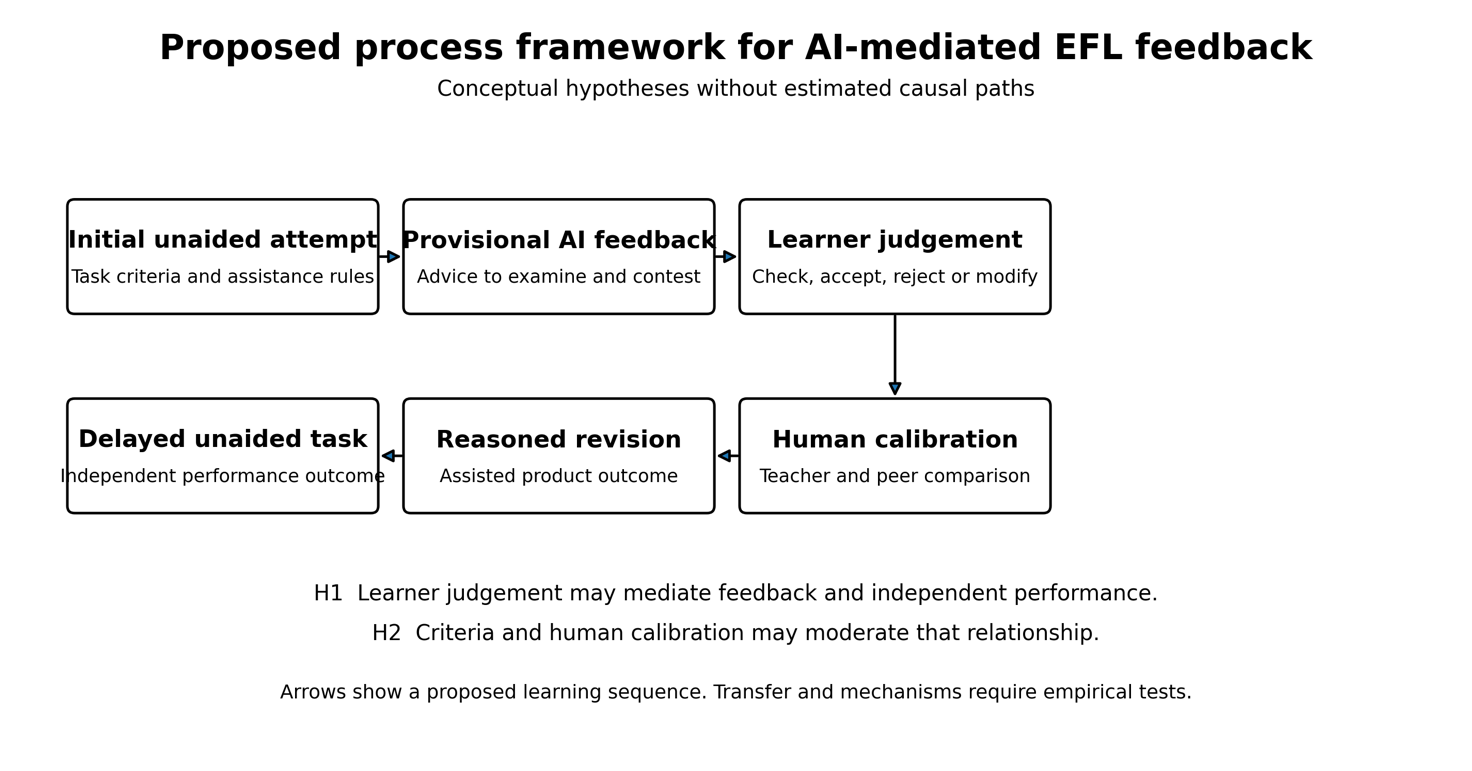
Figure 1. Proposed process framework for AI-mediated EFL feedback

Source: authors’ conceptual synthesis.

Arrows represent proposed instructional links, not estimated effects. H1 concerns learner judgement as a possible mediator; H2 concerns criteria and human calibration as possible moderators. Neither relationship has been validated by this review.

Five mechanisms sit inside this sequence. Competence calibration turns a diffuse difficulty into a manageable target, but only if progress as well as error can be recognised. Autonomy is supported when learners choose when to practise and which advice to take; it gives way to dependency when the system decides by default. Private work may regulate affect by lowering the interpersonal cost of error, whereas opaque scoring can heighten anxiety. Feedback literacy grows through comparison, disagreement and reasoned uptake. Engagement, finally, is redistributed rather than simply increased. Routine correction outside class might release time for discussion or outsource planning and monitoring. Task and feedback design determine which possibility prevails.

Table 2. Proposed observation indicators for future evaluation

Process mechanism

Learning possibility

Failure mode

Proposed observation indicator

Competence calibration

Feedback identifies a manageable gap and makes progress noticeable.

Dense correction conveys deficiency or creates an unwarranted sense of mastery.

Can the learner name the criterion and improve a fresh example?

Autonomy support

Learners decide when to practise and which advice merits use.

Routine acceptance transfers decisions to the machine.

Are accepted and rejected suggestions justified?

Affective regulation

Private rehearsal reduces the social cost of error.

Opaque scoring or authoritative prose encourages anxiety and deference.

Is the response explicitly provisional, with a route for discussion or appeal?

Feedback literacy

Comparison develops evaluative judgement and responsible uptake.

Fluent prose is mistaken for accuracy, appropriateness or authorship.

Do learners test the output against criteria, peers and trusted sources?

Engagement redistribution

Routine correction releases time for higher-order dialogue.

Prompting displaces planning, monitoring and productive struggle.

Does later unaided performance improve, rather than only the assisted draft?

Source: authors’ conceptual synthesis.

These are candidate observation prompts, not validated instruments. They require operational definitions, piloting, reliability checks and context-specific validity evidence. Independent transfer should be observed on a fresh comparable task after a pre-specified delay, without AI, teacher or peer assistance, under documented conditions, with blinded human rating where feasible.

Two research hypotheses follow. H1 proposes that reasoned learner judgement may mediate the relationship between access to machine feedback and subsequent independent performance. A test would measure judgement before a later unaided outcome, compare feedback access under matched conditions and assess the proposed indirect pathway while considering alternative explanations. H2 proposes that explicit criteria and human calibration may moderate that relationship. A factorial or well-matched design could vary those supports, keep tasks and exposure comparable, and test interaction effects on assisted revision and delayed unaided performance separately. These hypotheses are theoretically motivated; the reviewed studies do not jointly validate the proposed mediation or moderation.

5. Pedagogical and Institutional Implications

Teachers can keep judgement visible by asking for an initial unaided attempt, stating which criteria a system may address and presenting its response as one source of evidence rather than the answer. A brief revision memorandum can record accepted, rejected or altered suggestions and the reasons, while peer comparison exposes the difference between fluent wording and a suitable argument. Teacher attention is especially valuable for higher-order purposes, recurring misconceptions and cases in which machine advice conflicts with the learner’s intention. Such a sequence preserves productive struggle without withholding timely help.

Assessment design also needs a workable distinction between assistance and substitution. Broad tool use may be appropriate for brainstorming, low-stakes rehearsal and surface checking. A task intended to show independent performance requires a controlled stage or a later unaided component. Automated scores must be validated for the population, purpose and language construct at hand. One number cannot represent argument quality, pragmatic appropriateness and authorial

responsibility. For detection, the findings of Liang et al. (2023) make sole reliance on detector output indefensible in allegations involving EFL writers.

Institutional policy should be intelligible before learners submit their work. It needs to specify permitted assistance, treatment of data, routes of appeal and responsibility when a system is wrong. Access belongs in the same conversation because paid models, connectivity and digital confidence are unevenly distributed. Professional development must connect tool use with validity, multilingual fairness, privacy and feedback literacy, not stop at prompt demonstrations. In Algeria, the cautious interest recorded by Bessadat and Korichi (2025) favours training and supervised pilots over rapid adoption for consequential decisions.

6. Research Agenda

Future studies need to follow feedback through the work it is expected to change. Prompt records, revision histories, accepted and rejected suggestions, learner explanations and episodes of teacher calibration can reveal where judgement takes place. An independent transfer task is indispensable: an assisted draft is a product outcome, whereas a later unaided performance offers stronger evidence of learning. Delayed measures would help separate novelty from sustained motivation. Transfer protocols should pre-specify the delay and assistance rules, use a fresh task matched for construct and difficulty, and distinguish retention on similar tasks from generalisation across genres or contexts. Motivation should be followed over repeated occasions rather than inferred from an immediate post-intervention response.

More credible counterfactuals are equally important. A comparison between AI-supported instruction and ordinary teaching often alters time on task, feedback frequency, teacher attention and delivery mode at once. Factorial or carefully matched designs could separate tool access, feedback timing, explanation and human calibration. Motivation should be studied alongside behaviour and performance, not inferred from satisfaction. Qualitative accounts still have an essential place, particularly when they capture resistance, mistrust and identity. They should illuminate those experiences, not be made to bear causal conclusions.

The field also needs a wider geographic and linguistic range. Multi-site studies in Algeria and comparable multilingual settings could address local English norms, Arabic and French repertoires, unequal access, teacher workload and institutional policy. The present purposive inventory does not support prevalence estimates by region, learner level or language activity. Younger learners, oral assessment and lower-proficiency students warrant deliberate inclusion in future sampling. Reports should identify model versions, prompts, permitted revisions and data governance. An intervention described only as “AI” cannot be replicated or interpreted confidently.

Conclusion

The reviewed literature supports a bounded account of AI-mediated EFL assessment. Some guided instructional packages yield improvements in assisted revision or assessed writing, and some learners report a more favourable experience. These are different outcomes. The synthesis does not establish an isolated AI effect, durable motivational change or general independent transfer. The accompanying appendices now provide the reported search procedure, screening counts and a reconciled corpus inventory. The absence of source-level historical assignments and an independent extraction check nevertheless limits reproducibility and prevents exhaustive coverage claims.

A process-oriented account shows why tool-centred claims are insufficient. Machine output does not become development by itself. Criteria, learner judgement, emotion, feedback literacy, human calibration and institutional rules intervene. Where feedback can be questioned and learner action remains visible, AI may extend learning-oriented assessment. Where those conditions disappear, immediacy can hide dependency, invalid inference or inequity. AI therefore has a defensible but limited role: it can contribute evidence to a judgement; it should not be allowed to own that judgement.

References

Alazemi, A. F. T. (2024). Formative assessment in artificial integrated instruction: Delving into the effects on reading comprehension progress, online academic enjoyment, personal best goals, and academic mindfulness. Language Testing in Asia, 14, Article 44. https://doi.org/10.1186/s40468-024-00319-8

Aloisi, C. (2023). The future of standardised assessment: Validity and trust in algorithms for assessment and scoring. European Journal of Education, 58(1), 98–110. https://doi.org/10.1111/ejed.12542

AlTwijri, L., & Alghizzi, T. M. (2024). Investigating the integration of artificial intelligence in English as foreign language classes for enhancing learners’ affective factors: A systematic review. Heliyon, 10(10), Article e31053. https://doi.org/10.1016/j.heliyon.2024.e31053

Bessadat, A. I., & Korichi, S. (2025). Perceptions of AI-based assessment for formative writing in EFL: Evidence from Algerian teachers. Aleph, 12(3), 59–71. https://aleph.edinum.org/14943

Biju, N., Abdelrasheed, N. S. G., Bakiyeva, K., Prasad, K. D. V., & Jember, B. (2024). Which one? AI-assisted language assessment or paper format: An exploration of the impacts on foreign language anxiety, learning attitudes, motivation, and writing performance. Language Testing in Asia, 14, Article 45. https://doi.org/10.1186/s40468-024-00322-z

Boud, D., & Molloy, E. (2013). Rethinking models of feedback for learning: The challenge of design. Assessment & Evaluation in Higher Education, 38(6), 698–712. https://doi.org/10.1080/02602938.2012.691462

Carless, D., & Boud, D. (2018). The development of student feedback literacy: Enabling uptake of feedback. Assessment & Evaluation in Higher Education, 43(8), 1315–1325. https://doi.org/10.1080/02602938.2018.1463354

Deci, E. L., & Ryan, R. M. (2000). The “what” and “why” of goal pursuits: Human needs and the self-determination of behavior. Psychological Inquiry, 11(4), 227–268. https://doi.org/10.1207/S15327965PLI1104_01

Dörnyei, Z. (2009). The L2 motivational self system. In Z. Dörnyei & E. Ushioda (Eds.), Motivation, language identity and the L2 self (pp. 9–42). Multilingual Matters. https://doi.org/10.21832/9781847691293-003

Fan, J., & Zhang, Q. (2024). From literacy to learning: The sequential mediation of attitudes and enjoyment in AI-assisted EFL education. Heliyon, 10(17), Article e37158. https://doi.org/10.1016/j.heliyon.2024.e37158

Fan, Y., Tang, L., Le, H., Shen, K., Tan, S., Zhao, Y., Shen, Y., Li, X., & Gašević, D. (2025). Beware of metacognitive laziness: Effects of generative artificial intelligence on learning motivation, processes, and performance. British Journal of Educational Technology, 56(2), 489–530. https://doi.org/10.1111/bjet.13544

Fredricks, J. A., Blumenfeld, P. C., & Paris, A. H. (2004). School engagement: Potential of the concept, state of the evidence. Review of Educational Research, 74(1), 59–109. https://doi.org/10.3102/00346543074001059

Gardner, J., O’Leary, M., & Yuan, L. (2021). Artificial intelligence in educational assessment: “Breakthrough? Or buncombe and ballyhoo?” Journal of Computer Assisted Learning, 37(5), 1207–1216. https://doi.org/10.1111/jcal.12577

Gozali, I., Wijaya, A. R. T., Lie, A., Cahyono, B. Y., & Suryati, N. (2024). Leveraging the potential of ChatGPT as an automated writing evaluation (AWE) tool: Students’ feedback literacy development and AWE tools integration framework. The JALT CALL Journal, 20(1), 1–22. https://doi.org/10.29140/jaltcall.v20n1.1200

Hattie, J., & Timperley, H. (2007). The power of feedback. Review of Educational Research, 77(1), 81– 112. https://doi.org/10.3102/003465430298487

Li, L., & Kim, M. (2024). It is like a friend to me: Critical usage of automated feedback systems by self-regulating English learners in higher education. Australasian Journal of Educational Technology, 40(1), 1–18. https://doi.org/10.14742/ajet.8821

Liang, W., Yuksekgonul, M., Mao, Y., Wu, E., & Zou, J. (2023). GPT detectors are biased against non-native English writers. Patterns, 4(7), Article 100779. https://doi.org/10.1016/j.patter.2023.100779

Liu, G. L., Zou, M. M., Soyoof, A., & Chiu, M. M. (2025). Untangling the relationship between AI-mediated informal digital learning of English, foreign language enjoyment and the ideal L2 self: Evidence from Chinese university EFL students. European Journal of Education, 60(1), Article e12846. https://doi.org/10.1111/ejed.12846

Lo, C. K., Yu, P. L. H., Xu, S., Ng, D. T. K., & Jong, M. S.-Y. (2024). Exploring the application of ChatGPT in ESL/EFL education and related research issues: A systematic review of empirical studies. Smart Learning Environments, 11, Article 50. https://doi.org/10.1186/s40561-024-00342-5

Ma, Y., & Chen, M. (2024). AI-empowered applications effects on EFL learners’ engagement in the classroom and academic procrastination. BMC Psychology, 12, Article 739. https://doi.org/10.1186/s40359-024-02248-w

Mahapatra, S. (2024). Impact of ChatGPT on ESL students’ academic writing skills: A mixed methods intervention study. Smart Learning Environments, 11, Article 9. https://doi.org/10.1186/s40561-024-00295-9

Mohammed, S. J., & Khalid, M. W. (2025). Under the world of AI-generated feedback on writing: Mirroring motivation, foreign language peace of mind, trait emotional intelligence, and writing development. Language Testing in Asia, 15, Article 7. https://doi.org/10.1186/s40468-025-00343-2

Nicol, D. J., & Macfarlane-Dick, D. (2006). Formative assessment and self-regulated learning: A model and seven principles of good feedback practice. Studies in Higher Education, 31(2), 199–218. https://doi.org/10.1080/03075070600572090

Pekrun, R. (2006). The control-value theory of achievement emotions: Assumptions, corollaries, and implications for educational research and practice. Educational Psychology Review, 18(4), 315–341. https://doi.org/10.1007/s10648-006-9029-9

Sadler, D. R. (1989). Formative assessment and the design of instructional systems. Instructional Science, 18(2), 119–144. https://doi.org/10.1007/BF00117714

Sarı, E., & Han, T. (2024). The impact of automated writing evaluation on English as a foreign language learners’ writing self-efficacy, self-regulation, anxiety, and performance. Journal of Computer Assisted Learning, 40(5), 2065–2080. https://doi.org/10.1111/jcal.13004

Sayed, B. T., Bani Younes, Z. B., Alkhayyat, A., Adhamova, I., & Teferi, H. (2024). To be with artificial intelligence in oral test or not to be: A probe into the traces of success in speaking skill, psychological well-being, autonomy, and academic buoyancy. Language Testing in Asia, 14, Article 49. https://doi.org/10.1186/s40468-024-00321-0

Shi, H., & Aryadoust, V. (2024). A systematic review of AI-based automated written feedback research. ReCALL, 36(2), 187–209. https://doi.org/10.1017/S0958344023000265

Song, C., & Song, Y. (2023). Enhancing academic writing skills and motivation: Assessing the efficacy of ChatGPT in AI-assisted language learning for EFL students. Frontiers in Psychology, 14, Article 1260843. https://doi.org/10.3389/fpsyg.2023.1260843

Swiecki, Z., Khosravi, H., Chen, G., Martinez-Maldonado, R., Lodge, J. M., Milligan, S., Selwyn, N., & Gašević, D. (2022). Assessment in the age of artificial intelligence. Computers and Education: Artificial Intelligence, 3, Article 100075. https://doi.org/10.1016/j.caeai.2022.100075

Teng, M. F. (2024). A systematic review of ChatGPT for English as a foreign language writing: Opportunities, challenges, and recommendations. International Journal of TESOL Studies, 6(3), 36–57. https://doi.org/10.58304/ijts.20240304

Teng, M. F., & Huang, J. (2025). Incorporating ChatGPT for EFL writing and its effects on writing engagement. International Journal of Computer-Assisted Language Learning and Teaching, 15(1), 1–21. https://doi.org/10.4018/IJCALLT.367874

Tran, T. T. T. (2025). Enhancing EFL writing revision practices: The impact of AI- and teacher-generated feedback and their sequences. Education Sciences, 15(2), Article 232. https://doi.org/10.3390/educsci15020232

Wang, X., & Wen, Y. (2025). The role of artificial intelligence tools on Chinese EFL learners’ speaking skills, speaking anxiety, and motivation. Acta Psychologica, 261, Article 105957. https://doi.org/10.1016/j.actpsy.2025.105957

Zhang, M. (2024). Enhancing self-regulation and learner engagement in L2 speaking: Exploring the potential of intelligent personal assistants within a learning-oriented feedback framework. BMC Psychology, 12, Article 421. https://doi.org/10.1186/s40359-024-01917-0

Zhou, C., & Hou, F. (2024). Can AI empower L2 education? Exploring its influence on the behavioural, cognitive and emotional engagement of EFL teachers and language learners. European Journal of Education, 59(4), Article e12750. https://doi.org/10.1111/ejed.12750

APPENDICES

Appendix A: Corpus inventory

Table A1 — Complete inventory of 36 publications with shared bibliographic identifiers

The panels list the same 36 publications in manuscript bibliography order under shared identifiers A01–A36. The corpus comprises 27 topic-specific publications and nine theoretical anchors. The 20 primary investigations comprise 19 learner or teacher empirical studies and one detector audit. Non-EFL learning, English learning in an Australian university and detector evidence are labelled as contextual rather than direct EFL feedback effects. NR means not established in the present extraction; it does not mean absent from the original study. A delayed test is distinguished from demonstrated unaided transfer. Verification levels and dates are explained in Appendix C.

Table A1: Panel 1. Study characteristics

ID

Author (year)

Analytical role

Country/setting

Participants (N, level)

Tool/system

Assessment function

Design

A01

Alazemi (2024)

Primary empirical study

Kuwait

80 EFL learners

Nearpod + AI-integrated instruction

Formative

Quasi-experimental

A02

Aloisi (2023)

General assessment analysis

UK

—

Algorithmic scoring

Standardised assessment

Conceptual

A03

AlTwijri & Alghizzi (2024)

Secondary review

Saudi Arabia

—

Multiple

Affective factors

Systematic review

A04

Bessadat & Korichi (2025)

Primary empirical study

Algeria

15 university teachers

AI-based formative writing

Formative

Survey

A05

Biju et al. (2024)

Primary empirical study

Bangladesh

70 university learners; 35 per group

ChatGPT vs paper-based teacher feedback

Formative

Mixed-methods group comparison

A06

Boud & Molloy (2013)

Theoretical anchor

Conceptual framework

Not applicable

Not applicable

Feedback as a designed learning process

Theoretical / conceptual

A07

Carless & Boud (2018)

Theoretical anchor

Conceptual framework

Not applicable

Not applicable

Feedback literacy and uptake

Theoretical / conceptual

A08

Deci & Ryan (2000)

Theoretical anchor

Conceptual framework

Not applicable

Not applicable

Autonomy, competence and relatedness

Theoretical / conceptual

A09

Dörnyei (2009)

Theoretical anchor

Conceptual framework

Not applicable

Not applicable

L2 motivational self system

Theoretical / conceptual

A10

Fan & Zhang (2024)

Primary empirical study

China

University EFL

AI-assisted EFL

Mediating

Survey/model

A11

Fan et al. (2025)

Primary empirical study (not EFL)

Multiple

Learners

Generative AI

General learning; indirect relevance to EFL

Experimental

A12

Fredricks et al. (2004)

Theoretical anchor

Conceptual framework

Not applicable

Not applicable

Behavioural, emotional and cognitive engagement

Theoretical / conceptual

A13

Gardner et al. (2021)

General assessment analysis

General educational assessment

Not applicable

Automated scoring; adaptive testing

Validity and assessment use

Critical analysis

A14

Gozali et al. (2024)

Primary empirical study

Indonesia

18 EFL learners

ChatGPT as AWE

Formative

Qualitative

A15

Hattie & Timperley (2007)

Theoretical anchor

Conceptual framework

Not applicable

Not applicable

Goals, progress and next steps

Theoretical / conceptual

A16

Li & Kim (2024)

Primary empirical study

Australia; international university students

7 portfolio / interview participants; survey n = 32

Automated feedback systems, including ELSA and Grammarly

Formative

Mainly qualitative; supplementary survey

A17

Liang et al. (2023)

Primary investigation — detector audit

USA

—

GPT detectors

Detection and fairness; indirect relevance to feedback

Computational

A18

Liu et al. (2025)

Primary empirical study

China

299 survey participants; 12 interviews

AI-mediated informal learning

Motivational

Survey/model

A19

Lo et al. (2024)

Secondary review

Hong Kong

—

ChatGPT

Multiple

Systematic review

A20

Ma & Chen (2024)

Primary empirical study

China

350 EFL learners

AI-empowered applications

Engagement

Quasi-experimental

A21

Mahapatra (2024)

Primary empirical study

India

72 analysed: 35 intervention, 37 comparison

ChatGPT

Writing

Quasi-experimental; assignment to sections reported

A22

Mohammed & Khalid (2025)

Primary empirical study

Iraq

EFL learners

AI-generated feedback

Formative

Quasi-experimental

A23

Nicol & Macfarlane-Dick (2006)

Theoretical anchor

Conceptual framework

Not applicable

Not applicable

Self-regulation and internal feedback

Theoretical / conceptual

A24

Pekrun (2006)

Theoretical anchor

Conceptual framework

Not applicable

Not applicable

Control-value theory and achievement emotions

Theoretical / conceptual

A25

Sadler (1989)

Theoretical anchor

Conceptual framework

Not applicable

Not applicable

Standards, comparison and action

Theoretical / conceptual

A26

Sari & Han (2024)

Primary empirical study

Turkey

79 university learners: 45 intervention, 34 comparison

Criterion plus teacher feedback

Formative

Quasi-experimental; intact classes

A27

Sayed et al. (2024)

Primary empirical study

Ethiopia

28 university EFL learners

ChatGPT scoring and feedback

Speaking assessment

One-group mixed methods; repeated measures

A28

Shi & Aryadoust (2024)

Secondary review

Singapore

—

Automated written feedback

Formative

Systematic review

A29

Song & Song (2023)

Primary empirical study

China

50 EFL learners

ChatGPT

Writing

Mixed-methods

A30

Swiecki et al. (2022)

General assessment analysis

Multiple

—

AI assessment

Assessment design

Conceptual

A31

Teng (2024)

Secondary review

China

—

ChatGPT

Writing

Systematic review

A32

Teng & Huang (2025)

Primary empirical study

China

169 learners: 83 intervention, 86 comparison

ChatGPT

Writing engagement

Quasi-experimental

A33

Tran (2025)

Primary empirical study

Vietnam

14 Vietnamese undergraduates

Gemini and teacher feedback

Formative

Exploratory comparison of feedback sequences

A34

Wang & Wen (2025)

Primary empirical study

China

EFL learners

AI tools

Speaking

Quasi-experimental

A35

Zhang (2024)

Primary empirical study

China

54 Chinese university learners; 27 per group

Google Assistant with learning-oriented feedback

Formative

Mixed-methods group comparison

A36

Zhou & Hou (2024)

Primary empirical study

China

24 teachers and 38 college learners

AI-empowered L2

Engagement

Qualitative interviews; thematic analysis

Table A1: Panel 2. Measures and analytical classification

ID

Author (year)

Comparison condition

Outcome measure(s)

Duration

Transfer/delayed test?

Identifier check

Cluster

A01

Alazemi (2024)

Yes (bundled)

Reading comprehension; enjoyment; goals; mindfulness

Exact duration NR

Not established in extraction

Source check (C)

Motivation/affect

A02

Aloisi (2023)

—

Validity; trust

—

—

Source check (C)

Counter-evidence

A03

AlTwijri & Alghizzi (2024)

—

Anxiety; motivation

—

—

Source check (C)

Motivation/affect

A04

Bessadat & Korichi (2025)

No

Perceptions

—

Not established in extraction

Source check (C)

Algerian context

A05

Biju et al. (2024)

Paper-based teacher feedback

Narrative affective experience; writing test

8 weeks

No delayed transfer established

Rechecked 19 Oct 2026 (C3)

Motivation/affect

A06

Boud & Molloy (2013)

Not applicable

Feedback as a designed learning process

Not applicable

Not applicable

Yes (reported)

Theory

A07

Carless & Boud (2018)

Not applicable

Feedback literacy and uptake

Not applicable

Not applicable

Yes (reported)

Theory

A08

Deci & Ryan (2000)

Not applicable

Autonomy, competence and relatedness

Not applicable

Not applicable

Yes (reported)

Theory

A09

Dörnyei (2009)

Not applicable

L2 motivational self system

Not applicable

Not applicable

Yes (reported)

Theory

A10

Fan & Zhang (2024)

No

Attitudes; enjoyment

—

Not established in extraction

Source check (C)

Motivation/affect

A11

Fan et al. (2025)

Yes

Motivation; processes; performance

Exact duration NR

Transfer measured; significant advantage not established

Source check (C)

Counter-evidence

A12

Fredricks et al. (2004)

Not applicable

Behavioural, emotional and cognitive engagement

Not applicable

Not applicable

Yes (reported)

Theory

A13

Gardner et al. (2021)

Not applicable

Conceptual discussion of validity and assessment

Not applicable

Not applicable

Rechecked 19 Oct 2026 (C3)

Counter-evidence / contextual analysis

A14

Gozali et al. (2024)

No

Feedback literacy

Exact duration NR

Not established in extraction

Source check (C)

Feedback literacy

A15

Hattie & Timperley (2007)

Not applicable

Goals, progress and next steps

Not applicable

Not applicable

Yes (reported)

Theory

A16

Li & Kim (2024)

No causal comparison group

Critical feedback use; self-regulation; perceived progress

One term

Unaided transfer not established

Rechecked 19 Oct 2026 (C3)

Feedback literacy

A17

Liang et al. (2023)

Yes

Misclassification rates

—

—

Source check (C)

Counter-evidence

A18

Liu et al. (2025)

No

Enjoyment; ideal L2 self

—

Not established in extraction

Source check (C)

Motivation/affect

A19

Lo et al. (2024)

—

Multiple

—

—

Source check (C)

Review

A20

Ma & Chen (2024)

Yes (bundled workshop)

Engagement; procrastination

16 weeks plus 3-hour workshop

Not established in extraction

Source check (C)

Engagement

A21

Mahapatra (2024)

Comparison class

Writing; delayed post-test

6 hours over 1 month

Delayed test about 2 months later; general transfer not established

Rechecked 19 Oct 2026 (C3)

Writing

A22

Mohammed & Khalid (2025)

Yes

Motivation; peace of mind; EI; writing

Exact duration NR

Not established in extraction

Source check (C)

Motivation/affect

A23

Nicol & Macfarlane-Dick (2006)

Not applicable

Self-regulation and internal feedback

Not applicable

Not applicable

Yes (reported)

Theory

A24

Pekrun (2006)

Not applicable

Control-value theory and achievement emotions

Not applicable

Not applicable

Yes (reported)

Theory

A25

Sadler (1989)

Not applicable

Standards, comparison and action

Not applicable

Not applicable

Yes (reported)

Theory

A26

Sari & Han (2024)

Teacher-only feedback

Writing and self-efficacy gains; SRL difference not significant; anxiety not improved

16 weeks

Delayed transfer not established

Rechecked 19 Oct 2026 (C3)

Writing

A27

Sayed et al. (2024)

No external control

Speaking scores; narrative affective and autonomy accounts

Interventio n duration NR

Delayed test 3 weeks later; not an independent transfer test

Rechecked 19 Oct 2026 (C3)

Speaking

A28

Shi & Aryadoust (2024)

—

Multiple

—

—

Source check (C)

Review

A29

Song & Song (2023)

Yes

Writing; motivation

Exact duration NR

Not established in extraction

Source check (C)

Writing

A30

Swiecki et al. (2022)

—

Validity; responsibility

—

—

Source check (C)

Counter-evidence

A31

Teng (2024)

—

Multiple

—

—

Source check (C)

Review

A32

Teng & Huang (2025)

Yes

Engagement

One semester

Not established in extraction

Source check (C)

Engagement

A33

Tran (2025)

Feedback forms and orders compared

Local and global revision frequencies; not an independent quality test

15 weeks

Unaided transfer not established

Rechecked 19 Oct 2026 (C3)

Writing

A34

Wang & Wen (2025)

Yes

Speaking; anxiety; motivation

Exact duration NR

Not established in extraction

Source check (C)

Speaking

A35

Zhang (2024)

Traditional instruction

Speaking performance; motivation; self-regulation measures; interviews

Exact duration NR

Unaided transfer not established

Rechecked 19 Oct 2026 (C3)

Engagement

A36

Zhou & Hou (2024)

No causal comparison group

Interview accounts of three engagement dimensions

NR

Not a transfer study

Rechecked 19 Oct 2026 (C3)

Engagement

Table A2. Corpus distribution by analytical role

Population

Analytical role and identifiers

n

Percentage

Topic-specific (N = 27)

Learner / teacher empirical studies: A01, A04, A05, A10, A11, A14, A16, A18, A20, A21, A22, A26, A27, A29, A32, A33, A34, A35, A36

19

70.4% of 27

Topic-specific (N = 27)

Computational detector audit: A17

1

3.7% of 27

Topic-specific (N = 27)

Secondary reviews: A03, A19, A28, A31

4

14.8% of 27

Topic-specific (N = 27)

General assessment analyses: A02, A13, A30

3

11.1% of 27

Topic-specific subtotal

27 distinct publications; primary investigations = 19 empirical studies + 1 detector audit = 20

27

100.0% of 27

Full corpus (N = 36)

Topic-specific publications

27

75.0% of 36

Full corpus (N = 36)

Theoretical anchors: A06, A07, A08, A09, A12, A15, A23, A24, A25

9

25.0% of 36

Full corpus total

All bibliographic entries A01–A36, each counted once

36

100.0% of 36

Counting rule. Analytical roles are mutually exclusive within the 27 topic-specific publications. The detector audit belongs to the 20 primary investigations but is not a learner intervention. General assessment analyses and secondary reviews do not supply new learner samples. The nine theoretical anchors are counted only in the full-corpus denominator. Percentages are rounded to one decimal place.

Distribution scope. Table A2 reports only analytical roles with an auditable source-by-source allocation. No geographical, activity, learner-level or design prevalence percentages are inferred from this purposive corpus. The identifier column records documentary provenance, not a risk-of-bias score or assurance that every empirical assertion was independently re-extracted.

Appendix B: Extraction matrix

Extraction schema

Field

Description

ID

Shared bibliographic identifier A01–A36 from Table A1; match additionally by author and year.

Setting

Country, institution type, language context

Participants

N, level, sampling method

Tool

Named system and version if stated

Assessment function

Formative / summative / detection / mixed

Design

Experimental, quasi-experimental, survey, qualitative, review, conceptual

Comparison

Present / absent / bundled

Outcome

Construct(s) measured and instrument(s)

Duration

Exposure length

Transfer/delayed

Yes / No / Unclear

Limitations

As acknowledged by authors

Cluster

Writing / Motivation-affect / Engagement / Feedback literacy / Counter-evidence / Theory

Worked examples

Writing cluster — Mahapatra (2024)

A21 Mahapatra (2024). India; 72 analysed learners. The source describes a quasi-experimental study and reports assignment to class sections; the earlier blanket description “not randomised” is removed. Human-rated writing and a delayed test are distinguished from general unaided transfer. Selection exclusions constrain the result.

Source: original article, Methodology, Participants and data-collection procedure.

Motivation/affect cluster — Biju et al. (2024)

A05 Biju et al. (2024). Bangladesh; 70 learners in two classes. ChatGPT feedback and paper-based teacher feedback were compared over eight weeks. Narrative reports and assessed writing are separate outcomes; the post-test writing difference was not significant. Delivery mode and feedback timing varied together. Source: original article, Participants, Data collection procedures and Results.

Engagement cluster — Ma & Chen (2024)

Setting: China. Participants: 350 EFL learners. Tool: AI-empowered applications. Design: quasi-experimental. Comparison: yes, but experimental condition included an additional workshop. Outcome: engagement (behavioural, affective, cognitive); procrastination. Instrument: questionnaires. Limitation: bundled treatment; self-report.

Feedback literacy cluster — Gozali et al. (2024)

Setting: Indonesia. Participants: 18 EFL learners. Tool: ChatGPT as AWE. Design: qualitative. Comparison: none. Outcome: feedback literacy development. Limitation: small N, single context, no population inference.

Counter-evidence cluster — Liang et al. (2023)

Setting: computational study, USA. Tool: GPT detectors. Design: computational. Outcome: misclassification rates by writer L1. Key finding: disproportionate misclassification of non-native English writers. Note: detection is not formative feedback; relevance is to policy and fairness.

Appendix C: Verification log

Verification status. The bibliography contains 35 DOI-bearing references and one Aleph journal URL. Tables C1–C2 document the source basis and retained scope of key claims, while C3 records targeted source-verification checks. Identifier resolution is not treated as independent validation of all findings.

Table C1. Verification of load-bearing empirical claims

#

Claim in manuscript

Source

Verified?

Note

1

15 Algerian teachers surveyed; four fifths had not used the tools; perception data only

Bessadat & Korichi (2025)

Source check

Verified via Aleph stable page; 12(3), 59–71

2

Affective gains without significant post-test writing advantage

Biju et al. (2024)

Recheck ed C3

Language Testing in Asia, 14, Article 45

3

Intervention bundled Nearpod + formative activities + delivery mode

Alazemi (2024)

Source check

Language Testing in Asia, 14, Article 44

4

N = 18 Indonesian learners; qualitative

Gozali et al. (2024)

Source check

JALT CALL Journal, 20(1), 1–22

5

N = 350; additional workshop; questionnaire outcomes

Ma & Chen (2024)

Source check

BMC Psychology, 12, Article 739

6

GPT detectors disproportionately misclassify non-native English writers

Liang et al. (2023)

Source check

Patterns, 4(7), Article 100779

7

"Metacognitive laziness"; not EFL-specific

Fan et al. (2025)

Source check

BJET, 56(2), 489–530

8

Class sections; human-rated writing; delayed test; substantial exclusions; quasi-experimental description retained

Mahapatra (2024)

Recheck ed C3

Smart Learning Environments, 11, Article 9

9

Writing and self-efficacy gains; no significant between-group SRL difference; anxiety not improved

Sari & Han (2024)

Recheck ed C3

JCAL, 40(5), 2065–2080

10

Writing and motivation gains; brief, single-context

Song & Song (2023)

Source check

Frontiers in Psychology, 14, Article 1260843

11

Revision frequencies and feedback order; not independent writing quality or transfer

Tran (2025)

Recheck ed C3

Education Sciences, 15(2), Article 232

12

Validity resides in inference and use, not technical sophistication

Aloisi (2023); Gardner et al. (2021); Swiecki et al. (2022)

Source check

Verified against publisher records

Table C2. Claim–source concordance

#

Assertion in manuscript

Source

Location in source

Formulation retained

1

15 Algerian teachers; four fifths had not used the tools

Bessadat & Korichi (2025)

§Results, sample and frequency tables

Retained

2

Affective gains without significant post-test writing advantage

Biju et al. (2024)

§Findings, between-group comparisons

Retained

3

Intervention bundled Nearpod + formative activities + delivery mode

Alazemi (2024)

§Method, intervention description

Retained

4

N = 18 Indonesian learners; qualitative

Gozali et al. (2024)

§Participants

Retained

5

N = 350; additional workshop; questionnaire outcomes

Ma & Chen (2024)

§Method and §Results

Retained

6

GPT detectors disproportionately misclassify non-native English writers

Liang et al. (2023)

§Results, detector performance

Retained

7

"Metacognitive laziness"; not EFL-specific

Fan et al. (2025)

§Discussion

Retained with scope limitation

8

Class sections; human-rated writing; delayed test; substantial exclusions; quasi-experimental description retained

Mahapatra (2024)

§Method and §Limitations

Corrected design qualification

9

Writing and self-efficacy gains; no significant between-group SRL difference; anxiety not improved

Sari & Han (2024)

§Results

Differentiated outcomes retained

10

Writing and motivation gains; brief, single-context

Song & Song (2023)

§Results and §Limitations

Retained

11

Revision frequencies and feedback order; not independent writing quality or transfer

Tran (2025)

§Design

Revision frequency distinguished from quality

12

Validity resides in inference and use

Aloisi (2023); Gardner et al. (2021); Swiecki et al. (2022)

Conceptual arguments

Retained

Review procedure. The available documentation attributes verification collectively to the authors and reports no second independent coding of this review. The original allocation of selection and extraction tasks and the handling of disagreements were not documented and are not retrospectively inferred. Tables C1–C2 identify the documentary basis and retained scope of key claims; they do not constitute a formal risk-of-bias appraisal.

C3 Targeted source-verification checks

A05 Biju et al. Original Springer article; Participants, Data collection procedures and Results; Bangladesh setting and comparator. https://doi.org/10.1186/s40468-024-00322-z

A13 Gardner et al. Wiley article record and abstract; general assessment analysis and bibliographic identification. https://doi.org/10.1111/jcal.12577

A16 Li and Kim. Original journal PDF, pp. 1 and 7–8; Australian setting and qualitative / survey components. https://ajet.org.au/index.php/AJET/article/download/8821/2058/30483

A21 Mahapatra. Original Springer article; Participants and data-collection procedure; class-section assignment and delayed measure. https://doi.org/10.1186/s40561-024-00295-9

A26 Sarı and Han. Wiley article; abstract and Method; differentiated outcomes and combined-feedback comparison. https://doi.org/10.1111/jcal.13004

A27 Sayed et al. Original Springer article; Participants, Instruments and Treatment; one class and delayed measure. https://doi.org/10.1186/s40468-024-00321-0

A33 Tran. Published article PDF hosted by the author’s university; abstract and Methodology. MDPI page retrieval failed; the university-hosted published PDF was used. https://csdlkhoahoc.hueuni.edu.vn/data/2025/2/Enhancing_EFL_Writing_Revision_Practices_The_Impact_of_AIan d_Teacher-Generated_Feedback_and_Their_Sequences.pdf

A35 Zhang. Original Springer abstract and method description; speaking, motivation and comparison scope. https://doi.org/10.1186/s40359-024-01917-0

A36 Zhou and Hou. Wiley abstract; interview design and teacher / learner participants. https://doi.org/10.1111/ejed.12750

These targeted checks do not constitute a new systematic search, a second independent coding or a recheck of every field in all 36 publications. NR fields remain unknown in this extraction. Identifier checks and targeted source verification have different scopes.

Appendix D: Search documentation and corpus reconciliation

This appendix records the author-reported searches for the critical integrative review. D1–D2 provide the six queries, stated fields, language and date limits and returned counts. The reported search window is 1 July–2 August 2026, with closure on 2 August 2026. D3 records citation tracing; D4 reports screening counts and D5 reconciles them with the 36-publication inventory. The nine theoretical anchors are not restricted to the 2019–2026 date range used for topic searches. D6 states the limits of historical traceability. These appendices document the reported search process; no absence of the entire search log is claimed.

Documentation status. The presence of this log establishes the availability of an author-reported record, not independent authentication of its contemporaneous creation or exact execution. This review is purposive and non-exhaustive. The numerical reconciliation does not establish PRISMA compliance, source-level eligibility decisions or individual retrieval assignments for the anchors. The exclusion reason “not EFL/ESL” in D4 is not treated as a universal exclusion rule for contextual and theoretical sources in the final inventory.

D1 Google Scholar

Queries reported for 1 July–2 August 2026; reported closure 2 August 2026:

("artificial intelligence" OR "generative AI" OR ChatGPT OR "automated writing evaluation" OR "automated feedback" OR "intelligent personal assistant") AND (EFL OR ESL OR "English as a foreign language" OR "English as a second language")

("artificial intelligence" OR "generative AI" OR ChatGPT OR "automated writing evaluation" OR "automated feedback") AND (assessment OR feedback OR writing OR speaking OR motivation OR affect OR anxiety OR engagement OR "self-regulation" OR "feedback literacy")

("AI-mediated" OR "AI-assisted") AND (language learning OR language assessment) Fields searched: anywhere in the article.

Language filter: English, French or Arabic (applied where the interface allowed). Date filter: 2019–2026.

Records returned: query 1: 168; query 2: 142; query 3: 71.

D2 Algerian Scientific Journal Platform ASJP

Queries reported for the same window, 1 July–2 August 2026:

ESL) OR EFL OR الإنجليزية( AND الاصطناعي الذكاء

"intelligence artificielle" AND (évaluation OR rétroaction) AND anglais "AI" AND (assessment OR feedback) AND (EFL OR ESL)

Fields searched: full text.

Language filter: Arabic, French, English. Date filter: 2019–2026.

Records returned: query 1: 12; query 2: 11; query 3: 8.

D3 Citation tracing

The authors report backward reference checking of the four field-specific reviews (AlTwijri & Alghizzi, 2024; Lo et al., 2024; Shi & Aryadoust, 2024; Teng, 2024) and forward citation checking through Google Scholar’s “cited by” function. Separate dates and source-level retrieval assignments are not specified in the supplied log; no additional tracing dates are inferred here.

D4 Reported screening workflow by retrieval route

Stage

Google Scholar

ASJP

Citation tracing

Total

Records identified

381

31

18

430

After duplicate removal

251

22

14

287

Title/abstract screened

251

22

14

287

Title/abstract excluded

173

18

7

198

Full texts assessed

78

4

7

89

Full texts excluded

52

2

4

58

— no AI assessment function

22

0

2

24

— no learner process/outcome

18

1

0

19

— preprint / non-peer-reviewed

7

0

2

9

— not EFL/ESL

5

1

0

6

Included within the reported screening flow

26

2

3

31

— topic-specific publications within this flow

23

1

3

27

— theoretical anchors within this flow

3

1

0

4

This table retains the reported search and screening counts. Its endpoint is 31 publications within this flow; the complete bibliographic corpus of 36 publications is reconciled separately in D5. Platform subtotals are retrieval-route counts and do not describe the provenance of every theoretical anchor.

Arithmetic check. 381 + 31 + 18 = 430 records identified; 430 − 287 = 143 records removed through deduplication;

287 − 198 = 89 full texts assessed; 89 − 58 = 31 included. Within the endpoint, 27 topic-specific publications + 4 theoretical anchors = 31. The exclusion categories total 58. The theoretical-anchor row totals 3 + 1 + 0 = 4, rather than nine.

D5 Reconciliation with the complete corpus inventory

Corpus component

Count

Basis and treatment

Topic-specific publications

27

23 Google Scholar + 1 ASJP + 3 citation tracing in D4.

Theoretical anchors represented in D4

4

3 Google Scholar + 1 ASJP; included within the 31-publication flow.

Remaining theoretical anchors in the inventory

5

Nine anchors in A1 minus four represented in D4. These five are outside the reported platform subtotals; their individual retrieval routes are not documented.

Complete bibliographic corpus

36

27 topic-specific publications + 9 theoretical anchors; equivalently, 31 in the reported flow + 5 remaining anchors.

Identity and provenance. The nine theoretical anchors are A06 Boud and Molloy (2013), A07 Carless and Boud (2018), A08 Deci and Ryan (2000), A09 Dörnyei (2009), A12 Fredricks et al. (2004), A15 Hattie and Timperley (2007), A23 Nicol and Macfarlane-Dick (2006), A24 Pekrun (2006) and A25 Sadler (1989). The supplied records do not identify which four belong to D4 and which five fall outside it. D5 therefore reconciles aggregate counts without assigning individual sources to an undocumented route.

Scope of the reconciliation. The five-publication remainder is derived from the complete inventory, not from a reconstructed search history. It is not added to the 430 identified records, the 89 assessed full texts or their platform subtotals. The earlier statement that all nine anchors were retrieved separately has been replaced because D4 already represents four within its flow. No new search, additional screening decision or PRISMA reconstruction is claimed.

D6 Scope and limits of the reported method

The revised manuscript, its three abstracts and the data-availability statement recognise the search documentation supplied in D1–D5. The closure date is consistently reported as 2 August 2026. The review remains critical, integrative and non-exhaustive.

Historical traceability

D4 supplies an aggregate screening account. D5 reconciles its 31 inclusions with the 36-publication inventory, but the retained records cannot identify which four anchors were represented in the flow and which five were outside its platform counts. No source-level allocation, execution date or deduplication decision is reconstructed from arithmetic alone. The nine anchors are listed in D5; their theoretical role is documented independently of their original retrieval route.

Extraction and appraisal

A1 identifies all publications and their descriptive characteristics; Appendix B defines the extraction fields and gives worked examples. Original selector/extractor responsibilities, a contemporaneous complete extraction sheet and disagreement handling are not documented. The review did not use a formal risk-of-bias tool or independent second coding.

Interpretive scope

Reported experience, measured performance, revision frequency and delayed unaided transfer are distinct outcomes. No absent or undetermined follow-up is converted into a definitive claim that an original study lacked it. Contextual non-EFL evidence and detector audits do not estimate direct EFL feedback effects. Arithmetic consistency does not validate causal inference or exhaustive coverage.

Availability and provenance

The search queries and original screening counts are preserved as author-reported information. The inventory, arithmetic reconciliation and targeted source-verification checks provide supplementary documentary transparency. Their availability does not authenticate the original search executions. No new participant data or retrospective task allocations are introduced.

Appendix E: Ethical and transparency declarations

Ethics approval. Not applicable. This study is based exclusively on published literature and did not involve the collection of new data from human participants.

Data availability. No new empirical dataset was generated for this study. The publications included in the review are identified in the reference list, and Appendices A–D provide the corpus inventory, extraction framework, search information, verification record and documentary limitations relevant to the synthesis.

Funding. The authors received no specific funding for this research.

Competing interests. The authors declare no competing interests.

Generative AI use. Generative AI tools were used for language editing, structural revision and editorial support. All scientific claims were checked against the cited sources, and the authors remain fully responsible for the interpretation, accuracy and final content of the article.

Figure 1. Proposed process framework for AI-mediated EFL feedback

Figure 1. Proposed process framework for AI-mediated EFL feedback

Source: authors’ conceptual synthesis.

Abderrahmen Tahri

Laboratory of Theoretical and Applied Linguistic Studies · Mohamed Boudiaf University of M'Sila, Algeria
Pôle Universitaire, Route de Bordj Bou Arréridj (BBA), M'Sila 28000, Algérie
abderrahmane.tahri@univ-msila.dz
ORCID: https://orcid.org/0009-0004-0042-8899

Mourad Touati

Mohamed Boudiaf University of M'Sila
Pôle Universitaire, Route de Bordj Bou Arréridj (BBA), M'Sila 28000, Algérie
mourad.touati@univ-msila.dz
ORCID: 0009-0003-7999-1387

© Droits d’auteur réservés aux auteurs — Articles diffusés en accès ouvert sous licence CC BY 4.0, sauf mention contraire.