
Introduction
Sleep is a dynamic neurophysiological process rather than a passive interruption of wakefulness. Its architecture emerges from coordinated changes in cortical activity, ocular movements, muscle tone, autonomic regulation, respiration, and circadian timing. Because disturbances in these systems can affect cognition, mood, cardiovascular health, metabolism, safety, and quality of life, the assessment of sleep is both a clinical and a public-health concern. Contemporary sleep medicine therefore combines subjective information, standardized questionnaires, longitudinal diaries, physical examination, and physiological recordings. Polysomnography remains the reference method for many diagnostic questions because it records multiple signals simultaneously and permits expert identification of sleep stages, respiratory events, arousals, and movement-related phenomena (American Academy of Sleep Medicine [AASM], 2014; Iber et al., 2007).
The expansion of digital health has altered this diagnostic landscape. Large quantities of electroencephalographic, electrooculographic, electromyographic, electrocardiographic, respiratory, oximetric, actigraphic, and behavioral data can now be collected in laboratories, clinics, and homes. Artificial intelligence provides methods for extracting patterns from these heterogeneous data, estimating probabilities, identifying temporal dependencies, and generating classifications. Machine-learning methods can operate on engineered variables such as age, body mass index, blood pressure, heart rate, sleep duration, or questionnaire scores; deep-learning models can learn representations directly from raw or minimally processed physiological signals. Wearable, nearable, and smartphone-based devices further increase the frequency and ecological reach of sleep monitoring (Cay et al., 2022; Lee et al., 2023).
This technical progress has generated an optimistic discourse in which algorithmic accuracy is sometimes treated as synonymous with diagnostic reliability. Such an equation is scientifically inadequate. A model may perform well on a benchmark dataset yet fail when transferred to another laboratory, another device, a different age group, or a population with comorbidities. A high overall accuracy may conceal poor recognition of a minority class such as N1 sleep or central apnea. A system may also be statistically discriminative but poorly calibrated, meaning that its probability estimates do not correspond to real risk. Finally, a model that cannot communicate uncertainty or reveal the variables driving its decision may be difficult to integrate into high-stakes clinical practice.
The studies examined in the submitted manuscript are valuable because they represent several major directions of current research: automated sleep staging, classification of insomnia and sleep apnea from lifestyle and health variables, detection of apnea using wearable AI, and digitally delivered cognitive-behavioral support. However, the evidence is heterogeneous. Some publications use large physiological repositories, whereas others reuse a small public table of approximately 400 observations. Some evaluate diagnostic discrimination against a clinical reference, while others present a software prototype without testing therapeutic effectiveness. A scientifically rigorous synthesis must therefore compare not only reported scores but also data provenance, validation design, target definition, reference standards, interpretability, and the intended clinical use.
The objective of this article is to provide a critical narrative review of international evidence on AI-assisted sleep assessment. It asks three related questions: What types of data and algorithms are currently used to classify sleep stages and sleep disorders? How robust are the reported results when examined in relation to sample size, validation strategy, and clinical reference standards? Under what methodological and ethical conditions can AI become a reliable component of diagnosis, monitoring, or treatment pathways? The central argument is that AI has already demonstrated substantial analytical potential, but its clinical value depends on disciplined validation and on a human-supervised model of care.
1. Clinical and Historical Foundations of Sleep Assessment
1.1. From electrophysiological observation to standardized sleep staging
Modern sleep science emerged through the convergence of electrophysiology and systematic behavioral observation. Loomis, Harvey, and Hobart (1937) documented characteristic electroencephalographic patterns associated with different depths of sleep. Aserinsky and Kleitman (1953) subsequently described regularly occurring periods of rapid eye movement and associated physiological phenomena. Dement and Kleitman (1957) established the cyclical organization of nocturnal sleep and clarified the relation between rapid eye movements, dreaming, and electroencephalographic changes. These discoveries displaced the earlier conception of sleep as a homogeneous state of reduced cerebral activity.
The Rechtschaffen and Kales (1968) manual provided a common vocabulary and formal rules for scoring sleep from polysomnographic recordings. Later revisions issued through the AASM consolidated stages 3 and 4 into N3 and standardized the classification of arousals, respiratory events, limb movements, and recording epochs (Iber et al., 2007). Current conventional staging distinguishes wakefulness, N1, N2, N3, and rapid eye movement (REM) sleep. N1 is a transitional and often difficult-to-score stage; N2 is characterized by phenomena such as sleep spindles and K-complexes; N3 reflects high-amplitude slow-wave activity; REM combines activated cortical patterns with rapid eye movements and reduced skeletal muscle tone. The stages recur in temporally structured cycles rather than appearing as isolated labels.
This temporal organization is crucial for algorithm design. A classifier that treats every 30-second epoch independently may ignore the biological likelihood of transitions between stages. Models such as convolutional neural networks (CNNs) can extract local signal features, whereas recurrent networks, long short-term memory units, and attention mechanisms can represent the sequence in which epochs occur. The move from manual rules to learned representations therefore does not eliminate physiological knowledge; it re-encodes part of that knowledge in statistical architectures and training data.
Figure 1. Selected milestones in the development of sleep research and monitoring
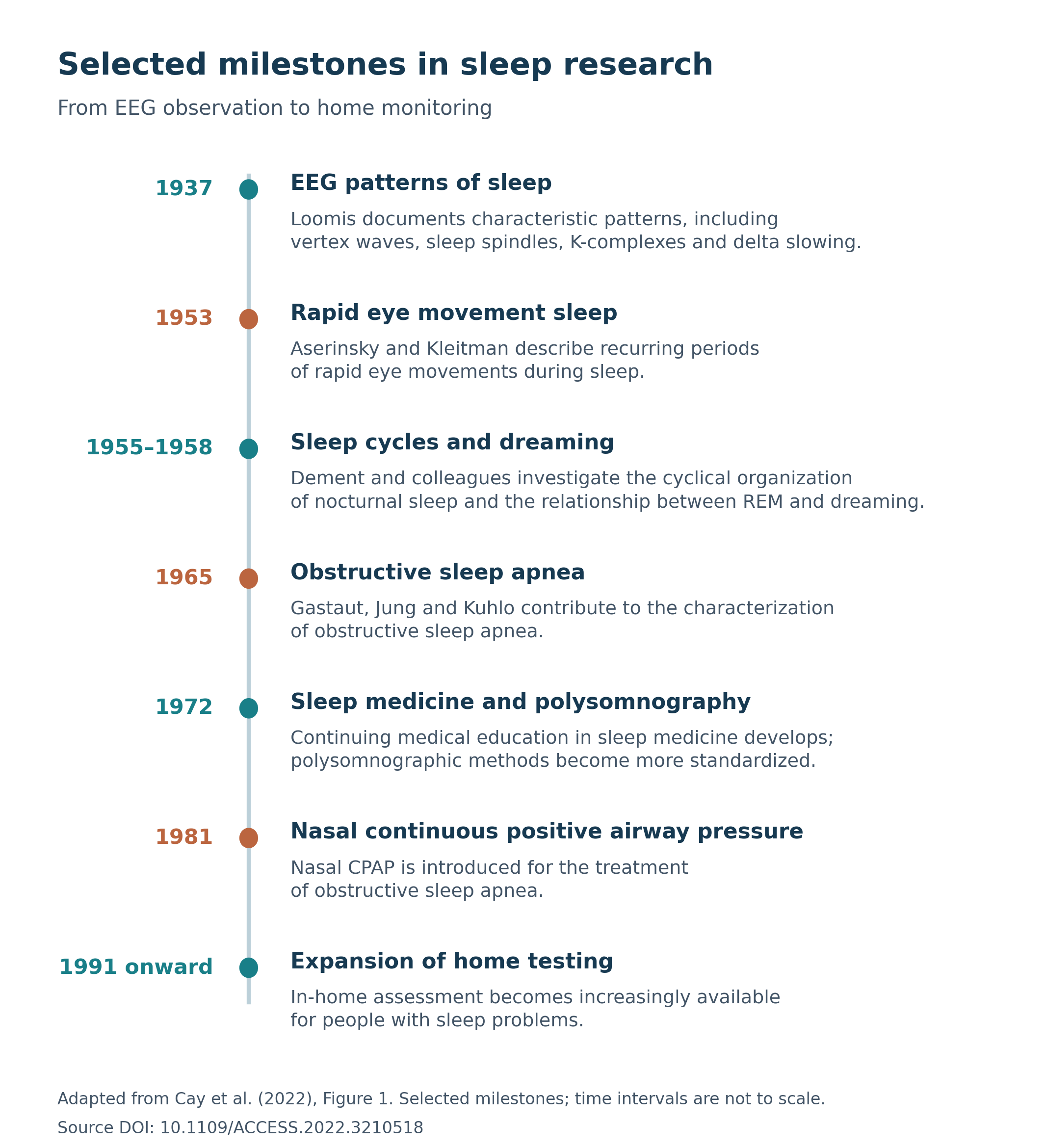
Source: Reproduced from Cay et al. (2022), with bibliographic attribution. The historical labels should be read as a synthetic timeline rather than as an exhaustive history.
1.2. Standard diagnostic methods and their respective functions
The clinical diagnosis of a sleep disorder cannot be reduced to a single signal or score. It begins with a structured history addressing the principal complaint, symptom chronology, sleep schedule, medication and substance use, occupational constraints, psychiatric and medical comorbidities, and the observations of a bed partner when available. The International Classification of Sleep Disorders provides diagnostic categories and criteria, but their application requires clinical judgment (AASM, 2014).
Sleep diaries add a longitudinal dimension by recording bedtime, attempted sleep time, sleep-onset latency, awakenings, final awakening, rising time, naps, medication, and perceived sleep quality. The consensus sleep diary standardizes these variables and supports both clinical assessment and intervention monitoring (Carney et al., 2012). Questionnaires answer narrower questions. The Pittsburgh Sleep Quality Index evaluates several domains of sleep quality over the preceding month, while the Epworth Sleepiness Scale estimates the propensity to doze in common daytime situations (Buysse et al., 1989; Johns, 1991). These tools are informative but do not directly measure neurophysiological sleep stages.
Polysomnography records multiple physiological channels and remains central when sleep-disordered breathing, parasomnias, nocturnal seizures, complex movement disorders, or unexplained hypersomnolence are suspected. Multiple sleep latency testing assesses the speed of daytime sleep onset under standardized conditions and contributes to the evaluation of narcolepsy and other hypersomnolence disorders. Actigraphy estimates rest-activity patterns over extended periods and is useful for circadian and insomnia-related questions, although immobility can be misclassified as sleep. Each instrument therefore addresses a different level of the diagnostic problem.
AI can support these methods in at least four ways. It can automate repetitive scoring tasks; detect patterns too complex for simple thresholds; combine information across modalities; and quantify uncertainty or risk over time. Yet AI should not collapse distinct clinical constructs. Sleep-stage classification is not equivalent to disorder diagnosis; detection of apnea events is not equivalent to etiological characterization; prediction from lifestyle variables is not equivalent to confirmation by physiological recording; and digital symptom improvement is not proof that an automated system can safely prescribe treatment. Maintaining these distinctions is essential for interpreting the evidence.
2. Review Design and Analytical Framework
This article adopts a critical narrative-review design. The purpose is not to claim exhaustive coverage of every AI application in sleep medicine, but to evaluate the main evidentiary patterns represented in the submitted corpus and to verify them against peer-reviewed international literature. A targeted search and bibliographic verification were conducted using PubMed, IEEE Xplore, journal platforms, and DOI records. The search focused principally on publications from 2017 to 2025 and used combinations of the terms artificial intelligence, machine learning, deep learning, sleep staging, sleep disorder classification, sleep apnea, wearable, polysomnography, digital CBT-I, and insomnia. Foundational publications on staging standards and diagnostic instruments were retained irrespective of date.
Studies were included when they addressed at least one of the following: automated classification of standard sleep stages from physiological signals; detection or classification of sleep disorders using clinical, lifestyle, respiratory, cardiac, or wearable data; validation of consumer sleep technologies against polysomnography; or digital and AI-supported behavioral interventions for insomnia. Duplicate citations, references with incorrect publication years, non-identifiable sources, and publications unrelated to sleep outcomes were excluded or corrected. Technical prototypes were not discarded, but they were assigned a lower evidentiary status when they lacked prospective clinical validation.
The studies were compared along six dimensions: data source and sample size; target task and label definition; algorithmic family; reference standard; validation strategy; and clinical transferability. Performance metrics were interpreted in context. Accuracy was not considered sufficient when class distributions were unequal. Sensitivity, specificity, precision, recall, macro F1 score, area under the receiver-operating-characteristic curve, agreement coefficients, calibration, and external validation were examined when available. The review also considered explainability, subgroup performance, privacy, and the degree of human oversight.
Because the review is narrative and the underlying studies are heterogeneous, no new meta-analysis was performed. The quantitative results reported below are those of the cited publications. They are synthesized critically rather than pooled across incompatible tasks. This methodological choice prevents the misleading comparison of, for example, five-stage EEG scoring with three-class lifestyle-based diagnosis or binary apnea-event detection.
3. AI Applications in Sleep Assessment and Insomnia Care
3.1. Artificial Intelligence for Automated Sleep-Stage Classification
3.1.1. Signals, representation learning, and temporal context
Manual sleep staging requires trained scorers to inspect successive epochs and apply standardized rules. The process is labor-intensive and is affected by inter-scorer disagreement, especially at boundaries such as wake/N1, N1/N2, and N2/N3. Automated staging attempts to reduce this burden while preserving clinically meaningful distinctions. Earlier systems relied on hand-crafted spectral, temporal, nonlinear, and morphological features. Deep learning shifts part of the feature-engineering process into the model itself.
DeepSleepNet illustrates this transition. The architecture combines CNN components that learn time-invariant representations from raw single-channel EEG with bidirectional long short-term memory layers that model transition rules across epochs. On the MASS and Sleep-EDF datasets, the model achieved overall accuracy and macro F1 scores comparable to contemporary state-of-the-art methods, while using different EEG derivations without redesigning the core architecture (Supratak et al., 2017). The result was methodologically important because it showed that raw-signal learning and temporal modeling could be integrated in a single pipeline.
Subsequent approaches have explored attention mechanisms and lighter architectures. AttnSleep uses multi-resolution feature extraction and attention to emphasize informative temporal components in single-channel EEG (Eldele et al., 2021). DeepSleepNet-Lite reduces computational demands and estimates predictive uncertainty through Monte Carlo dropout, demonstrating that a model can be designed not only to classify but also to identify uncertain epochs (Fiorillo et al., 2021). Uncertainty estimation is particularly relevant in clinical deployment: an algorithm should be able to defer ambiguous epochs to a human scorer rather than forcing a confident label.
Multimodal systems can integrate EEG with EOG, EMG, ECG, respiration, or movement. The potential advantage is biological complementarity. Eye movements contribute directly to REM identification; chin muscle tone helps distinguish REM from wakefulness; respiratory signals are necessary for apnea detection; and cardiac dynamics may capture autonomic changes. The disadvantage is increased sensor burden, missing-channel risk, and reduced transferability between laboratories with different montages. A clinically useful model must therefore specify the minimum signal set required for its intended task and demonstrate robustness to realistic recording variation.
Temporal context is another decisive factor. Sleep architecture constrains plausible transitions, but excessive reliance on sequence patterns can also become a source of error in atypical sleep. Patients with fragmented sleep, neurological disease, medication effects, or severe apnea may exhibit transitions underrepresented in benchmark datasets. A model trained on healthy or narrowly selected participants may learn a normative architecture and misclassify clinically important deviations. Performance should therefore be reported separately for healthy participants and diagnostic groups whenever possible.
3.1.2. Why benchmark performance does not equal clinical equivalence
Benchmark datasets permit reproducible comparison, but they also encourage optimization to a fixed distribution. If recordings from the same participant appear in both training and testing sets, performance can be inflated because subject-specific signal characteristics leak across the split. Patient-level separation is therefore indispensable. Cross-validation should preserve independence at the participant level, and final performance should be tested on an untouched external cohort collected at another site or with another device.
Class imbalance is a second problem. N2 often occupies a large proportion of the night, whereas N1 is relatively infrequent and intrinsically ambiguous. A model can attain high overall accuracy by performing well on dominant stages while failing on N1 or wake after sleep onset. Macro-averaged F1 scores, stage-specific sensitivity and precision, and confusion matrices are consequently more informative than accuracy alone. Agreement with a consensus of expert scorers may also be preferable to agreement with a single scorer when establishing a reference label.
The final issue is clinical workflow. Automated staging can save time, but the relevant outcome is not simply whether the algorithm reproduces labels. It should also preserve the identification of respiratory events, arousals, REM without atonia, periodic limb movements, and other clinically significant patterns. A staged deployment model is therefore preferable: automatic preprocessing and preliminary scoring; presentation of confidence scores and flagged segments; expert review of uncertain or abnormal epochs; and audit of final modifications. Under this model, automation increases efficiency without erasing professional accountability.
3.2. AI-Based Detection and Classification of Sleep Disorders
3.2.1. Classification from lifestyle and routine clinical variables
A growing group of studies classifies sleep status from tabular variables such as age, sex, occupation, sleep duration, self-rated sleep quality, physical activity, stress, body mass index, blood pressure, heart rate, and daily steps. These studies are attractive because they require fewer sensors than polysomnography and can be implemented in screening interfaces. Alshammari (2024) compared k-nearest neighbors, support vector machines, decision trees, random forests, and an artificial neural network after genetic-algorithm optimization on a public dataset of approximately 400 records and 13 variables. The reported accuracies ranged from 83.19% to 92.92%, with the neural network producing the highest value.
Airlangga (2024) examined the same broad type of dataset and compared logistic regression, decision trees, ensemble methods, support vector machines, and neural networks. Random Forest and XGBoost reached performance values approaching 0.93 on the reported metrics. Rahman et al. (2025) extended feature selection and classifier comparison and reported accuracies up to 97.33% for several ensemble methods, with gradient boosting showing favorable computational efficiency. These results indicate that the labels contained in the dataset are highly predictable from the selected variables.
The interpretation must nevertheless remain cautious. First, several studies draw on the same small publicly available dataset. Their results are therefore not independent clinical replications; they are alternative analyses of a common data source. Second, the provenance and label-construction process of the dataset must be documented. If the diagnostic labels were derived from variables that are also used as predictors, the model may learn a circular rule rather than a clinically generalizable relation. Third, random train-test splits can place near-duplicate or highly similar observations in both subsets, especially in small tabular datasets.
Fourth, a three-class output—no disorder, insomnia, or sleep apnea—simplifies a much more complex nosology. Insomnia is clinically defined through symptoms, frequency, duration, daytime consequences, and exclusion or consideration of other conditions. Sleep apnea requires assessment of respiratory events and severity, generally using objective measures. A lifestyle classifier may estimate a screening probability, but it cannot establish these diagnoses on its own. The appropriate claim is therefore risk stratification or preliminary classification, not definitive diagnosis.
Feature engineering remains useful, but it should be clinically motivated and externally evaluated. Reducing the number of variables can improve speed and reduce burden, yet an apparently stable performance after aggressive feature selection may indicate redundancy, leakage, or an overly easy label structure. Transparent reporting should include the exact data dictionary, missing-data handling, preprocessing fitted only on the training set, class distributions, patient-level splitting, hyperparameter selection, confidence intervals, calibration curves, and independent validation.
3.2.2. Sleep-apnea detection from physiological and wearable data
Obstructive sleep apnea is a particularly active domain for AI because respiratory, oximetric, cardiac, acoustic, and movement signals contain recurrent event-related patterns. Models have been developed from single-lead ECG, photoplethysmography, oxygen saturation, airflow, thoracoabdominal movement, snoring, and combinations of these signals. CNNs can identify local morphology, recurrent networks can model event sequences, and ensemble methods can integrate clinical risk factors with physiological features.
The systematic review and meta-analysis by Abd-alrazaq et al. (2024) provides an important synthesis of wearable AI. Thirty-eight studies met the eligibility criteria. For detecting apnea versus non-apnea respiratory events, the pooled mean accuracy, sensitivity, and specificity were 0.893, 0.793, and 0.947. For identifying sleep apnea at the participant level, the corresponding pooled means were 0.869, 0.938, and 0.752. The pooled accuracy for distinguishing event types was 0.815, while accuracy for identifying severity categories was lower at 0.651. The pattern is clinically revealing: wearable AI may be effective for broad detection, but severity grading and fine-grained classification remain more difficult.
Sensitivity and specificity must be interpreted according to intended use. A screening device may prioritize sensitivity in order to miss fewer possible cases, accepting more false positives that require confirmatory testing. A system intended to support treatment decisions needs stronger specificity, calibration, and severity estimation. The meta-analysis therefore concluded that wearable AI remains suboptimal for routine autonomous clinical use and should be used concurrently with traditional assessment until stronger evidence is available (Abd-alrazaq et al., 2024).
Generalization is complicated by device placement, sensor quality, skin contact, motion artifacts, age, body mass index, cardiovascular comorbidity, and apnea phenotype. Algorithms developed on one device or recording protocol may not transfer directly to another. Event-level evaluation can also overstate participant-level utility if many correlated epochs from the same individual are treated as independent observations. Prospective validation should report both event-level and person-level performance and should include clinically relevant thresholds of the apnea-hypopnea index.
AI may nonetheless improve access when embedded in a carefully designed pathway. Home monitoring can identify individuals who need full polysomnography, prioritize referrals, repeat measurements across several nights, and support longitudinal follow-up. The safest use is not to replace the sleep laboratory universally, but to allocate its resources more intelligently and to reduce the delay between symptom recognition and specialist assessment.
3.2.3. Consumer sleep technologies: accessibility and measurement limits
Consumer sleep technologies can be grouped into wearables worn on the body, nearables placed close to the sleeper, and airables that use smartphone or environmental sensors. Wearables commonly combine accelerometry and photoplethysmography; nearables may use radar or mattress pressure; and airables can analyze sound, motion, or reflected signals. This variety expands access but creates a heterogeneous measurement ecosystem (Cay et al., 2022).
A prospective multicenter validation of 11 consumer sleep trackers against polysomnography showed substantial variation. Among 75 participants and more than 349,000 compared epochs, macro F1 scores ranged from 0.26 to 0.69. Device types also showed different biases: wearables tended to overestimate sleep by classifying quiet wakefulness as sleep, while nearables struggled with sleep latency and deep-sleep discrimination (Lee et al., 2023). These findings demonstrate why a wellness device should not automatically be treated as a diagnostic instrument.
EEG-based wearables may offer richer sleep-stage information than movement-only devices, but their usability, electrode contact, artifact resistance, and validation remain variable. The systematic review by de Gans et al. (2024) found promising systems but emphasized the need for standardized validation and reporting. From a clinical perspective, the most useful distinction is not whether a device contains AI, but whether it has been validated for a defined population, task, and reference standard.
Continuous home data can complement a single laboratory night by revealing variability and context. At the same time, repeated low-validity measurements do not become clinically reliable merely because they are numerous. Data quantity must be accompanied by signal quality, transparent algorithms, and a clear rule for escalation to professional assessment.
Figure 2. Main technological families used in sleep monitoring
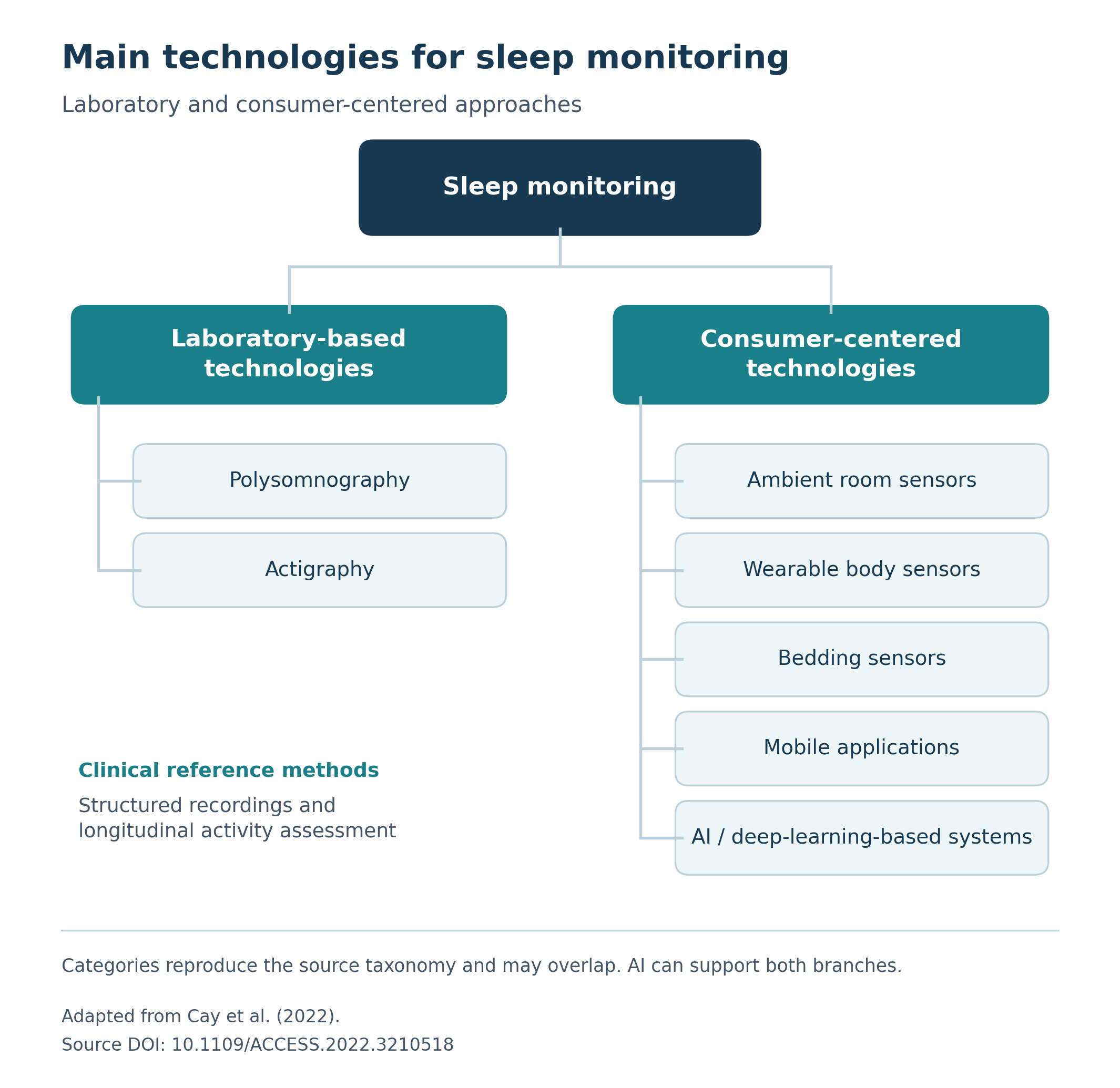
Source: Cay et al. (2022). Laboratory-based and consumer-centered systems may overlap when validated wearable or nearable devices are integrated into clinical pathways.
3.3. AI-Supported Behavioral Interventions for Insomnia
Cognitive behavioral therapy for insomnia (CBT-I) is a multicomponent intervention that typically addresses maladaptive sleep schedules, conditioned arousal, unhelpful beliefs, and behaviors that perpetuate insomnia. Digital delivery can increase access and scalability. However, the term AI-enhanced intervention must be used precisely. A web program that follows fixed rules is digital but not necessarily AI-based; a chatbot can provide adaptive interaction without proving therapeutic efficacy; and a classifier that assigns a user to a category is not equivalent to a validated treatment engine.
Randomized evidence supports the effectiveness of digitally delivered behavioral interventions. Espie et al. (2012) found that an online CBT program with automated support improved sleep outcomes compared with control conditions. Vedaa et al. (2020) reported significant reductions in insomnia severity in a large-scale randomized trial of fully automated digital CBT-I. Okajima et al. (2020) showed that a brief, individually tailored smartphone intervention reduced insomnia severity and several functional outcomes among workers, although dropout and long-term engagement remained important considerations.
AI can potentially extend digital CBT-I through personalization, just-in-time adaptation, prediction of disengagement, conversational support, and integration of sleep diaries or wearable signals. A recent systematic review of digital and AI-enhanced CBT-I reported improvements in sleep parameters, adherence, satisfaction, and personalization across a broad literature, while also emphasizing uncertainty about long-term effects, implementation, and ethics (Gkintoni et al., 2025). These conclusions should be treated as promising rather than definitive because the studies grouped under AI-enhanced care vary substantially in design and technological sophistication.
The SleepBloom publication presented in the original manuscript is best interpreted as a technical prototype. It combines a web interface, an XGBoost classifier, optional wearable input, a chatbot, and a two- to six-week adaptive plan, with a reported classification accuracy of approximately 91%. Yet the paper does not establish efficacy through a randomized clinical trial, nor does it demonstrate that automated recommendations are safe for users with comorbid psychiatric, respiratory, neurological, or medical conditions (Albasiri et al., 2025). Its contribution lies in system architecture and feasibility, not in proof of therapeutic equivalence.
Clinical governance is especially important for treatment applications. An automated system must distinguish uncomplicated insomnia from symptoms that warrant medical assessment, including suspected apnea, severe depression, suicidality, substance-related sleep disturbance, bipolar activation, parasomnia, or dangerous daytime sleepiness. It should communicate that sleep restriction can temporarily increase sleepiness and must include safety guidance for driving and hazardous work. Personalization should therefore operate within validated treatment rules, exclusion criteria, and escalation pathways supervised by qualified professionals.
The most defensible role for AI in behavioral sleep medicine is augmentative. It can improve access, structure diaries, tailor educational sequences, detect nonadherence, and alert clinicians to deterioration. It should not obscure the therapeutic rationale or create the impression that a probabilistic model has independently understood the patient.
3.4. Comparative Synthesis of the Evidence
Table 1. Critical evidence matrix constructed from the reviewed publications. Reported performance values are not directly comparable across different tasks and reference standards.
|
Study |
Data/setting |
Task |
Method |
Contribution |
Principal limitation |
|
Supratak et al., 2017 |
Single-channel EEG; MASS and Sleep-EDF |
Five-stage sleep scoring |
CNN + bidirectional LSTM |
Strong benchmark performance; transfer shown across two datasets |
No prospective clinical workflow evaluation |
|
Cay et al., 2022 |
120 papers, apps, and devices |
Technology review |
Narrative technical synthesis |
Broad taxonomy of laboratory and consumer systems |
Heterogeneous evidence; no pooled clinical effect |
|
Lee et al., 2023 |
75 participants; 11 consumer trackers; PSG reference |
Sleep-stage and sleep-measure agreement |
Commercial AI algorithms |
Large simultaneous device comparison |
Macro F1 varied from 0.26 to 0.69; device-specific bias |
|
Alshammari, 2024 |
Public lifestyle/health dataset, approximately 400 rows |
Three-class sleep-disorder classification |
KNN, SVM, DT, RF, ANN + genetic optimization |
ANN accuracy 92.92% |
Small reused dataset; screening labels not clinical confirmation |
|
Airlangga, 2024 |
Public lifestyle/health dataset, 400 records |
Three-class classification |
Logistic regression, trees, ensembles, SVM, neural network |
RF/XGBoost metrics up to about 0.93 |
Same general dataset family; limited external validity |
|
Abd-alrazaq et al., 2024 |
38 wearable-AI studies |
Apnea detection, type, and severity |
Multiple wearable AI methods |
Pooled evidence; high sensitivity for case detection |
Severity classification weaker; heterogeneity and bias |
|
de Gans et al., 2024 |
EEG wearable studies |
Sleep assessment |
Multiple wearable EEG algorithms |
Promising closer-to-home EEG measurement |
Need standardized validation and usability evidence |
|
Rahman et al., 2025 |
Public tabular sleep-health dataset |
Three-class classification |
15 classifiers + feature selection |
Up to 97.33% reported accuracy |
Risk of overfitting and non-independent replication |
|
Okajima et al., 2020 |
92 workers with insomnia; randomized trial |
Insomnia symptom reduction |
Tailored smartphone behavioral intervention |
Clinical outcome evidence and follow-up |
Not a diagnostic model; attrition and population specificity |
|
Albasiri et al., 2025 |
Prototype system and public data |
Classification + proposed CBT-I plan |
XGBoost, chatbot, optional wearable integration |
Integrated technical concept |
No randomized efficacy or clinical safety validation |
4. Discussion and Responsible Clinical Integration
4.1. Generalization, dataset shift, and the problem of repeated public datasets
The most consistent conclusion across the evidence is that AI can identify structured patterns in sleep data. The unresolved issue is whether those patterns remain stable outside the development environment. Dataset shift occurs when the distribution of signals, participants, devices, or clinical conditions changes. A model trained on a public EEG repository may encounter different electrode montages, scoring practices, age distributions, or disease severity in a hospital. A lifestyle classifier trained on a small table may encounter different occupations, cultural habits, health-care access, and diagnostic prevalence in another country.
Repeated use of the same dataset creates a specific interpretive risk. When several papers report increasingly high accuracy on the same approximately 400-row sleep-health dataset, the literature may appear to contain multiple confirmations, although the underlying observations are largely identical. Algorithmic comparison is useful, but it does not substitute for replication on independently collected data. Claims of clinical readiness should therefore require external validation on a population that played no role in feature engineering, model selection, or threshold tuning.
Multicenter prospective studies are preferable because they reveal operational variability. They should predefine the intended use, eligibility criteria, primary metric, acceptable error, and subgroup analyses. Data collected after model freezing provide stronger evidence than retrospective resampling of the development dataset.
4.2. Metrics, calibration, and clinically asymmetric errors
Accuracy is intuitively attractive but clinically incomplete. False negatives and false positives do not have equal consequences. Missing severe apnea may delay treatment, whereas an overly sensitive screener may increase confirmatory testing. Misclassifying quiet wakefulness as sleep can overestimate sleep efficiency in insomnia. Confusing N1 and N2 may be less consequential in one context than failing to recognize REM without atonia in another. Metric selection must therefore reflect the intended clinical decision.
Sensitivity and specificity should be accompanied by predictive values at plausible prevalence. Macro F1 is useful for imbalanced stages, but it does not measure probability quality. Calibration indicates whether predicted risks correspond to observed frequencies. Decision-curve analysis can estimate whether using the model produces more net benefit than testing everyone or no one. Confidence intervals and uncertainty estimates are also necessary; a single decimal score can conceal instability in a small test set.
Abstention is a clinically valuable capability. Models should be allowed to classify an observation as uncertain and request expert review. This principle is already implicit in uncertainty-aware staging approaches and can be generalized to apnea detection and treatment recommendations. A model that knows when it is unreliable may be safer than a nominally more accurate model that always produces a definitive answer.
4.3. Explainability, transparency, and human oversight
Interpretability has several levels. Clinicians may need to know which signal segment, physiological feature, or clinical variable contributed to a prediction. Developers need access to performance by subgroup and failure mode. Patients need an understandable explanation of what the system measured, what the result means, and what it cannot determine. A generic feature-importance plot is not sufficient when correlated variables or nonlinear interactions are present.
Transparency also concerns the entire pipeline: data provenance, inclusion criteria, preprocessing, missing-data handling, model version, threshold, software update, and post-deployment monitoring. Commercial devices frequently modify algorithms without making the changes visible to users or researchers. A validation result can therefore become obsolete when firmware or scoring logic changes. Clinical systems require version control and revalidation.
Human oversight should be designed, not merely asserted. The interface must show confidence, highlight artifacts, permit correction, record the reason for override, and prevent automation bias. Clinicians should be trained to recognize both model strengths and systematic errors. The objective is calibrated trust: neither unconditional acceptance nor reflexive rejection of algorithmic output.
4.4. Fairness, privacy, and the ethics of continuous monitoring
Sleep data are intimate. They can reveal health conditions, medication effects, work schedules, pregnancy-related changes, stress, substance use, and household routines. Wearable and nearable systems may collect data continuously and transmit them to cloud services. Ethical deployment requires data minimization, secure storage, controlled access, clear retention periods, and consent that distinguishes wellness analytics from clinical use.
Fairness cannot be inferred from overall performance. Sensor quality may vary with skin characteristics, body habitus, movement patterns, age, disability, and device fit. Training cohorts may underrepresent older adults, children, pregnant people, shift workers, or populations with multiple comorbidities. Subgroup evaluation should be prespecified and sufficiently powered. When performance differs materially, the system should either be recalibrated or its indication should be restricted.
Continuous monitoring can also create anxiety and excessive self-surveillance, sometimes described as orthosomnia when users become preoccupied with achieving ideal device scores. A clinically responsible interface should avoid presenting uncertain estimates as definitive judgments and should prioritize trends, symptoms, and professional advice over nightly perfection.
4.5. A Translational Framework for Responsible Clinical Integration
The reviewed evidence supports a staged translational framework. The first stage is task definition. Developers and clinicians must specify whether the system is intended for wellness monitoring, screening, preliminary scoring, diagnostic support, severity estimation, treatment selection, or follow-up. Each task requires a different reference standard and acceptable error profile.
The second stage is data validity. Training data should be representative of the intended population, collected with documented instruments, and separated by participant. Labels should be generated through credible clinical procedures. Missingness, artifacts, and class imbalance should be reported rather than hidden. The third stage is analytical validation, including internal testing, external testing, calibration, uncertainty, subgroup performance, and comparison with a meaningful baseline.
The fourth stage is clinical validation. The frozen model should be evaluated prospectively in the workflow where it will be used. Outcomes should include not only classification but also time saved, referral quality, diagnostic delay, treatment uptake, adverse events, and clinician-patient understanding. The fifth stage is implementation governance: version control, audit logs, cybersecurity, user training, monitoring for drift, and a procedure for withdrawing or updating the model.
Within this framework, the relationship between AI and polysomnography is complementary. AI can reduce scoring burden and expand home observation, while polysomnography and specialist assessment remain necessary when the clinical question demands comprehensive physiological characterization. Similarly, lifestyle-based models can support screening but should not transform probabilistic patterns into unsupported diagnoses. Digital CBT-I can broaden access when grounded in validated protocols and accompanied by safety triage.
Table 2. Proposed requirements for translating AI performance into clinically responsible use.
|
Stage |
Minimum requirement |
Expected benefit |
|
1. Intended use |
Define screening, staging, diagnosis support, monitoring, or treatment support |
Clear claim matched to evidence |
|
2. Data quality |
Representative population; documented signals; participant-level independence |
Reduced leakage and dataset shift |
|
3. Analytical validation |
External cohort; stage/class-specific metrics; calibration; uncertainty |
Robust performance estimate |
|
4. Clinical validation |
Prospective workflow study; patient and clinician outcomes |
Evidence of real-world utility |
|
5. Human oversight |
Review of uncertain cases; override and audit trail |
Accountability and safer decisions |
|
6. Governance |
Privacy, cybersecurity, version control, drift monitoring |
Sustainable and ethical deployment |
4.6. Limitations of the Review
This review is narrative rather than systematic and does not claim exhaustive identification of all AI publications in sleep medicine. Its corpus was constructed around the submitted references and a targeted verification of major international studies. The included tasks are heterogeneous, preventing quantitative pooling across sleep staging, disorder classification, apnea detection, consumer-device validation, and digital intervention.
Several reviewed studies use public datasets whose clinical provenance and labeling processes are incompletely described in secondary summaries. The present analysis therefore emphasizes methodological caution rather than reanalyzing the raw data. Some recent technical systems may have been updated after publication, and consumer-device algorithms can change without transparent version histories. Finally, evidence for AI-enhanced treatment is less mature and less homogeneous than evidence for digital CBT-I more broadly.
Conclusion
Artificial intelligence has become a significant methodological development in sleep research and sleep medicine. Deep-learning systems can automate parts of sleep-stage scoring, wearable algorithms can detect respiratory patterns associated with apnea, and machine-learning models can organize clinical and lifestyle variables for preliminary risk stratification. Digital behavioral interventions can also broaden access to evidence-based insomnia care. These achievements justify continued research and carefully designed implementation.
They do not justify replacing clinical assessment with an undifferentiated promise of automation. The strongest reported scores often arise from benchmark datasets, while real-world performance is shaped by device variability, population differences, class imbalance, and the complexity of diagnostic definitions. Several tabular classification studies reuse the same small public dataset, limiting the independence of their evidence. Consumer trackers show substantial variability against polysomnography, and treatment prototypes require clinical trials before therapeutic claims can be accepted.
The scientifically defensible position is therefore neither technological rejection nor uncritical enthusiasm. AI should function as an auditable, uncertainty-aware, human-supervised layer within a broader care pathway. Its future clinical value will depend on multicenter prospective validation, transparent data and reporting standards, calibration, interpretability, subgroup fairness, privacy protection, and explicit escalation to specialist care. Under these conditions, AI can contribute not only to faster classification but to more accessible, continuous, and accountable sleep medicine.