
Introduction
Integrating literature into English as a Foreign Language (EFL) teaching enriches language learning in ways that purely functional materials rarely achieve. Literary texts expose learners to complex syntax, figurative language, and multiple voices while inviting them to think critically and consider perspectives beyond their own. In recent decades, researchers have argued that literature can support both linguistic growth and broader educational aims, including intercultural understanding and creativity (Byram, 1997; Calafato & Hunstadbråten, 2024). A key concept in this discussion is literary competence, which refers to the ability to interpret, appreciate, and respond to literary texts critically and creatively (Carter & Long, 1991; Lazar, 1993).
In Algeria, curriculum reform in the early 2000s introduced the Competency-Based Approach (CBA) to shift classroom practice away from memorization toward meaningful communication and task-based learning. However, while the reform modernized some aspects of instruction, literature was gradually pushed to the periphery of the curriculum. The official first-year textbook, At the Crossroads, illustrates this tension well. It includes authentic extracts and some project work; however, literary learning is largely confined to a single unit, Unit 2: Once Upon a Time, and, according to the yearly distribution, this unit is scheduled only for the literary stream. This design leaves a substantial number of learners, particularly in the scientific stream, without structured literary learning opportunities.
Accordingly, this study evaluates how literary competence is represented in At the Crossroads. It pursues three main objectives: first, to examine how literary competence is addressed in the textbook; second, to evaluate the pedagogical strategies used to engage learners with literature; and third, to analyze the extent to which these strategies align with the CBA. These aims lead to the following research questions:
-
RQ1: How is literary competence reflected in At the Crossroads?
-
RQ2: What approaches are used for its development?
-
RQ3: To what extent do these approaches align with the CBA?
In line with the literature, the working hypothesis is that the textbook represents literary competence only partially, with limited genre diversity, restricted interpretive activities, and uneven access across streams. To ensure an accurate description of the material, the analysis draws on both the Student Book and the Teacher’s Guide, which clarifies the unit aims, lesson sequences and assessment expectations.
Finally, this paper is organized as follows. The literature review establishes a theoretical framework for literary competence and its pedagogical dimensions in EFL contexts. The methodology section details the hybrid checklist design and the data collection and analysis procedures. The findings and discussion section interprets the checklist results, highlighting the strengths and shortcomings of the textbook in fostering literary competence. The paper concludes with pedagogical implications.
1. Literature Review
1.1. Literary Competence: Definitions and Components
The notion of literary competence has been approached from multiple perspectives in applied linguistics and literary pedagogy. Broadly, it refers to a set of knowledge, interpretive skills, and affective dispositions that enable learners to engage with literary texts meaningfully. Early conceptualizations framed it as an extension of Chomsky’s (1965) linguistic competence, yet applied to the decoding of literary language and conventions (Culler, 1975). Later contributions emphasized the role of readers in constructing meaning, with Rosenblatt’s (1978) transactional theory highlighting the dynamic interplay between the text and readers’ prior experiences with it.
Literary competence in EFL contexts refers to learners’ ability to interpret, evaluate, and creatively engage with literary texts through linguistic and cultural understanding (Paran, 2008). It extends beyond language proficiency to include sensitivity to aesthetic features such as imagery, symbolism, and tone (Krsteva & Kukubajska, 2014). Overall, it encompasses the capacity to appreciate and critically engage with literary discourse while fostering a broader development of linguistic and cultural proficiency (Lazar, 2015; Paran, 2008).
Most contemporary accounts converge on the view that literary competence is a multidimensional construct that integrates cognitive, aesthetic, cultural, and creative dimensions. The interpretive-critical component refers to the ability to move beyond literal comprehension to analyze themes, characterization, and ambiguity, thereby exercising critical thinking (Calafato & Simmonds, 2022). The aesthetic-stylistic component entails sensitivity to the features of literary language, such as metaphor, symbolism, rhythm, and narrative voice, which foster learners’ appreciation of how form and meaning interact (Hall, 2015). The cultural-discursive component positions literature as a social document that embodies cultural values and worldviews; through comparative reflection, learners can develop intercultural awareness (Byram, 1997; Lașcu, 2023). Finally, the creative component encompasses imaginative responses such as rewriting, dramatization, and personal reflection, which allow learners to inhabit and transform texts (Rosenblatt, 1978; Iskhak, Mujiyanto, & Hartono, 2020)
Taken together, these components suggest that literary competence extends far beyond mere textual comprehension. It requires learners to develop interpretive depth, aesthetic appreciation, cultural understanding, and creative agency, all of which are essential if literature is to function as a resource for both linguistic and personal growth in the EFL classroom.
1.2. The Role of Literary Competence in ELT
Integrating literary competence within EFL and ELT pedagogy offers learners a range of benefits that extend far beyond the mere acquisition of linguistic forms. Encountering authentic literary works enriches lexical knowledge, heightens syntactic sensitivity, and refines the overall discourse competence. Unlike conventional expository or utilitarian texts, literary language draws on metaphor, symbolism, and stylistic variation, prompting learners to negotiate meaning across multiple interpretive planes (Hall, 2015). This interaction promotes both linguistic accuracy and critical thinking.
In addition to promoting linguistic and aesthetic growth, literature-based instruction provides a fertile ground for developing higher-order thinking skills and intercultural communicative competence. Gómez Rodríguez (2018) demonstrated that when EFL learners engage with literature through critical and genre-based tasks, they develop not only interpretive precision but also intercultural awareness and reflective judgment. His findings support the view that literary activities can cultivate empathy, tolerance, and cross-cultural understanding—key goals of communicative and competence-based approaches.
Nevertheless, the pedagogical role of literature in language education continues to provoke debate. Advocates contend that literary texts expose learners to linguistically dense input—diverse vocabulary, sophisticated sentence structures, and intricate discourse organization—that often surpasses the scope of standard instructional materials (Paran, 2008; Khatib, Rezaei, & Derakhshan, 2011). Conversely, detractors argue that the cultural specificity and linguistic complexity inherent in literary texts can pose significant challenges for learners with limited proficiency (Paran, 2006). This ongoing tension underscores the need for a carefully scaffolded approach that preserves the intellectual and aesthetic richness of literature while ensuring accessibility and meaningful engagement for all learners.
Equally significant is the role of literature in cultivating critical thinking. Interpretive engagement requires learners to weigh textual evidence, evaluate multiple possible readings, and justify their interpretations. Such processes nurture analytical skills that are transferable to other domains of academic and professional life (Calafato & Simmonds, 2022).
A further contribution lies in the promotion of cultural awareness and intercultural competence. Literature represents the values, beliefs, and worldviews of the societies from which it emerges. By encountering diverse cultural perspectives, learners develop empathy and perspective-taking, essential attributes in a globalized world (Byram, 1997; Lașcu, 2023). This intercultural dimension is particularly valuable in contexts like Algeria, where learners need to negotiate both local cultural identities and global linguistic demands.
Finally, literary engagement fosters creativity and learner motivation. Activities such as dramatization, rewriting, or reflective writing encourage learners to use their imagination and actively participate in the learning process. Such tasks not only enhance learner agency but also sustain attention and intrinsic motivation (Berrarbi, 2020; Mart, 2021). Literature-based instruction, as Mart (2021) demonstrates, can thus serve as a powerful pedagogical approach that simultaneously supports linguistic mastery, creative expression, and sustained learner engagement.
In short, literary competence in EFL/ELT is not a peripheral skill but a multidimensional capacity that enriches language learning by combining linguistic mastery, critical inquiry, intercultural reflection, and creative expression. Its integration into teaching practices therefore aligns with broader educational goals of producing reflective, culturally aware, and imaginative learners.
1.3. Textbook Evaluation: Models and Perspectives
Given that textbooks remain the central instructional resource in many EFL contexts, their systematic evaluation continues to be a primary focus of language education practice and research. Established models—such as those by Sheldon (1988), Cunningsworth (1995), and McDonough and Shaw (2003)—offer evaluative criteria addressing aspects like content coverage, teaching methodology, skills integration, and practical usability. Nonetheless, these broad frameworks often fall short in providing specific guidance for assessing literary content. In response, literature-oriented models (Carter & Long, 1991; Paran, 2006) introduce additional criteria related to genre variety, textual authenticity, and the encouragement of interpretive as well as critical engagement. Recent academic discussions further emphasize the value of hybrid approaches to EFL textbook evaluation, which consciously blend linguistic, literary, and intercultural aims (Oviedo-Gómez, 2024).
International research has shown recurring patterns. In Europe, the Common European Framework acknowledges literature at higher proficiency levels; however, classroom materials often reduce it to comprehension practice (Paran, 2008). Across Asia, research shows that EFL textbook activities and tasks often prioritize recall and literal comprehension over critical analysis and higher-order thinking skills (Xie, 2024). In the Middle East, literature is frequently treated as linguistic input rather than a site for interpretation (Al-Saeed & Alenezi, 2022). In parts of Africa, textbooks privilege Anglophone canons while omitting local voices and limiting cultural identification (Adejunmobi, 1994; Ouhiba, 2022). These patterns highlight the necessity of a context-sensitive, literature-aware evaluation.
The review indicates that literary competence is a complex construct whose interpretive, stylistic, cultural, and creative dimensions are closely interrelated. It also shows that many EFL textbooks underuse literature by offering limited genres, simplified texts, and surface-level tasks. An evaluation tool must therefore go beyond general textbook criteria and specifically assess the quality of literary engagement. The present study applies such a hybrid instrument to At the Crossroads, focusing on the literature unit in order to examine how the textbook supports literary competence in practice.
1.4. At the Crossroads: Description and Structure
At the Crossroads is the officially approved first-year secondary EFL textbook in Algeria, intended for students aged between 15 and 16 who have already completed several years of English instruction. As outlined in the accompanying Teacher’s Guide, the book is organized around five broad themes: communication, arts and literature, journalism, science and technology, and the environment. Each thematic unit is designed to cover roughly twenty hours of classroom instruction and follows a coherent and predictable pedagogical cycle.
The Listening and Speaking lessons generally progress through these rubrics: Anticipate → Listen & Check → Say It Clear → Your Turn. The Reading and Writing components adopt a parallel pattern: Anticipate → Read & Check → Discover the Language → Write It Right. Other recurring sections include Developing Skills (which addresses learning strategies and social competencies), Stop and Consider (focused on grammar and language awareness), Consolidation and Extension, and a final Project Workshop. Each unit concludes with Check Your Progress, a self-assessment task that prompts students to reflect on their learning. According to the Teacher’s Guide, the textbook is grounded in a competency-based and action-oriented approach, and its progression aligns explicitly with Bloom’s taxonomy.
Within this structure, Unit 2: Once Upon a Time is the only unit dedicated explicitly to literature. It focuses on developing students’ ability to understand and produce narrative texts, with the final task involving the writing of a book review. The unit also provides optional creative activities such as role-playing, interpretive reading, and brief dramatizations designed to encourage expressive language use. Interestingly, the official syllabus assigns this unit exclusively to students in the literary stream, omitting it from the scientific one. This selective inclusion raises important pedagogical questions about equity and the availability of literary learning experiences for all students, regardless of academic specialization.
2. Methodology
2.1. Research Design and Analytical Corpus
To strengthen the transparency of the inquiry, the present revision specifies the status of the corpus, the scoring procedure, and the interpretive safeguards used during the analysis. The textbook is treated as the primary document, whereas the Teacher’s Guide functions as a contextual document that clarifies intended objectives, expected procedures, and assessment orientations. The professional classroom perspective is not used as independent empirical evidence; rather, it operates as a reflective lens for judging pedagogical feasibility and for interpreting whether the textbook tasks can realistically support literary competence in Algerian EFL classrooms.
This section explains the research method and analytical framework. Its purpose is to provide a transparent account of how the representation of literary competence in At the Crossroads is evaluated. Document analysis allows for close reading of the materials, while quantitative scoring enables comparisons across dimensions. Triangulation with the Teacher’s Guide and professional classroom experience supports the interpretation.
This study employs qualitative document analysis (Bowen, 2009) complemented by quantitative scoring. Document analysis makes it possible to examine not only which texts and tasks are present but also how pedagogical choices frame students’ encounters with literature. A five-point Likert scale (1 = absent/poor, 5 = excellent) is used to rate each criterion, and the scores are later converted to percentages for synthesis.
Evaluating textbooks is a critical step in determining whether they effectively meet pedagogical and curricular objectives. Within the Algerian secondary school curriculum, fostering literary competence—the ability to interpret, analyze, and engage meaningfully with literary texts—is a stated goal. To assess the extent to which the first-year secondary school textbook At the Crossroads fulfills this aim, a hybrid checklist was developed. This instrument integrates established textbook evaluation models (Sheldon, 1988; Cunningsworth, 1995; McDonough & Shaw, 2003) with literature-specific frameworks (Carter & Long, 1991; Lazar, 1993; Paran, 2006) and is further informed by theories of literary competence, intercultural communication, and competency-based learning.
This design deliberately separates three evidential levels: the textbook as the primary corpus, the Teacher’s Guide as a contextualizing document, and professional classroom observation as an interpretive standpoint rather than as a separately sampled empirical dataset. This distinction is essential because the study does not claim to measure learners’ actual literary competence; it evaluates the opportunities for such competence that the textbook and its accompanying pedagogical apparatus make available.
2.2. Hybrid Checklist and Scoring Procedure
The checklist functions as both a diagnostic and reflective tool, combining quantitative scoring with qualitative analysis to provide a comprehensive evaluation of how effectively the textbook integrates literary learning within language education. It comprises four major dimensions, each containing several sub-criteria evaluated on a five-point Likert scale (1–5). These dimensions are designed to reflect theoretical, linguistic, and pedagogical priorities in literature-based language instruction.
-
Literary Genres and Devices: This dimension assesses the range and authenticity of literary genres (prose, poetry, drama, folktales) and examines whether the textbook exposes learners to varied modes of aesthetic and linguistic expression. It also considers the inclusion of Algerian and Maghrebi voices and the treatment of stylistic features such as metaphor, symbolism, irony, and rhythm. The analysis is grounded in Literary Competence Theory (Rosenblatt, 1978; Lazar, 1993), which emphasizes interpretive engagement and figurative understanding, and in Reader-Response Theory (Rosenblatt, 1978), which locates meaning-making in the interaction between reader and text. Methodologically, it draws on established evaluation models—especially Cunningsworth (1995) and Littlejohn (1998)—to appraise the authenticity of materials, the balance across genres, and the cognitive demands generated by the deployment of literary devices.
-
Task Design: This dimension evaluates how learning activities surrounding literary texts are structured and whether they promote higher-order thinking and creative engagement. It is grounded in the Revised Bloom’s Taxonomy, which frames a principled progression from comprehension and application to analysis, evaluation, and creation, and in Vygotsky’s constructivist account of learning, which underscores scaffolded pre-, while-, and post-reading work to help learners reach beyond their current abilities with appropriate guidance. Methodologically, it employs Richards’ (2001) pre-, in-, and post-use model to judge the relevance and effectiveness of tasks at distinct stages of engagement, while drawing on Tomlinson’s (2018) criteria to prioritize learner-centered design that is affectively resonant and cognitively demanding.
-
Intercultural Awareness: This dimension examines how the textbook represents diverse cultural perspectives and its capacity to cultivate intercultural communicative competence by balancing source (Algerian/Maghrebi), target (Anglophone), and international cultural references. Grounded in Byram’s (1997) model, it foregrounds the integrated development of knowledge, skills of comparison and mediation, and attitudes of openness, curiosity, and empathy, and is operationalized through Culler’s (1989) tripartite schema of cultural content. Evaluation focuses on cultural balance, the substantive portrayal of Algerian/Maghrebi identities, and the design of activities that promote empathetic engagement, critical comparison, and the deconstruction of stereotypes. Methodologically, it draws on Cunningsworth (1995) to judge authenticity and balance, and on Littlejohn (1998) to interrogate the explicit and implicit cultural messages conveyed by texts and tasks.
-
Alignment with the Competency-Based Approach (CBA): This dimension evaluates the extent to which At the Crossroads operationalizes Algeria’s competency-based curriculum by enacting learner-centered pedagogy, integrated-skills sequencing, and authentic, task- and performance-based assessment. In the Algerian EFL context, the CBA marks a system-wide shift from teacher-led methods toward action-oriented learning that develops transferable communicative abilities in real-world situations; within English syllabuses, this orientation has been explicit since 2005. Analytically, the criterion foregrounds tasks that elicit problem-solving, critical thinking, and meaningful language use, consistent with the principles of Task-Based Language Teaching (TBLT) as an operational pathway for CBA through goal-directed, real-world tasks. Methodologically, coherence between textbook tasks, curricular outcomes, and assessment is judged using Sheldon’s (1988) checklist approach and McDonough and Shaw’s (2003) external–internal evaluation model, while Hutchinson and Waters’ (1987) needs analysis is applied to verify alignment with learners’ target and learning needs. Evidence of alignment is indicated by clear performance descriptors, cumulative task progressions integrating listening, speaking, reading, and writing, and assessment rubrics that evaluate observable competencies rather than discrete linguistic items.
Table 1. Dimensions and criteria of the hybrid checklist
|
Dimension |
Key Criteria |
|
Literary Genres & Devices |
Diversity of genres (prose, poetry, drama, essays); authenticity of texts; inclusion of local/Maghrebi voices; attention to stylistic devices; balance of classic and contemporary texts. |
|
Task Design |
Scaffolding across pre-/while-/post-reading; promotion of higher-order thinking; authentic/real-world relevance; balance between comprehension and interpretation. |
|
Intercultural Awareness |
Representation of global, local, and target cultures; opportunities for cultural comparison; empathy and perspective-taking; avoidance of stereotypes; preparation for intercultural communication. |
|
Alignment with CBA |
Consistency with competency outcomes; availability of assessment rubrics; teacher guidance and methodological support; transferability to real-life contexts. |
The hybrid checklist is applied to At the Crossroads using a mixed-method approach that combines quantitative scoring with qualitative commentary. Each criterion is rated on a five-point Likert scale, where 1 indicates absence and 5 indicates full integration. Descriptive analysis is complemented by textual examination of the literary units, ensuring that numerical results are interpreted within their pedagogical and cultural contexts. Textbook evaluation, as emphasized by Aziz and Makhtar (2021), serves as both a diagnostic and reflective process—one that not only measures alignment with pedagogical objectives but also reveals areas for curricular improvement and teacher adaptation. Within this study, the hybrid checklist thus functions as an analytical framework for assessing how At the Crossroads bridges the gap between language instruction and the development of literary competence in Algerian EFL classrooms.
2.3. Data Analysis and Interpretive Safeguards
All literary texts and associated tasks in Unit 2 (pp. 46–75) are identified and analyzed using the checklist. Each criterion is rated on a scale of 1–5. Scores are converted into percentages to allow comparisons across dimensions. Qualitative notes document representative strengths and weaknesses and are used to interpret numerical profiles. The Teacher’s Guide is consulted to clarify the intended aims and procedures, and the classroom experience provides an additional lens for judging feasibility and engagement.
The scores are treated as descriptive indicators rather than inferential statistics. They are therefore interpreted together with the qualitative evidence contained in the unit: text selection, sequencing, task wording, teacher guidance, and assessment orientation. This interpretive safeguard prevents the checklist from becoming a purely numerical exercise and keeps the analysis anchored in the actual pedagogical material.
3. Findings and Discussion
The evaluation yields a mixed picture. On the one hand, At the Crossroads includes authentic literary extracts and provides clear scaffolding for learners. On the other hand, genre coverage is narrow, stylistic analysis is limited, intercultural tasks are under-specified, and some elements of CBA are only partially realized. The results are organized by dimension, with tables summarizing ratings and brief classroom-based reflections that illustrate what learners typically do with the tasks. The evaluation of At the Crossroads using the hybrid checklist reveals an overall average of 3.1/5 (62%), which indicates that the integration of literary competence is only partial. This finding suggests that while the textbook incorporates literature, it does so in a limited and often superficial way, leaving significant room for improvement in terms of genre diversity, task design, intercultural representation, and alignment with the Competency-Based Approach (CBA).
3.1. Literary Genres, Authenticity, and Stylistic Devices
This subsection evaluates how At the Crossroads represents literary competence through the selection of genres, the authenticity of literary materials, the presence or absence of local cultural voices, and the pedagogical treatment of stylistic devices. These criteria are particularly important because literary competence cannot be reduced to basic comprehension of narrative content; it also requires exposure to diverse literary forms, sensitivity to figurative and aesthetic language, and opportunities to relate textual experience to cultural and intercultural meaning. The analysis therefore considers whether Unit 2, “Once Upon a Time,” enables learners to encounter literature as an interpretive, stylistic, and culturally significant resource, or whether literary texts remain primarily subordinated to linguistic practice and factual comprehension. Table 2 summarizes this first dimension of the checklist by assessing genre diversity, authenticity, local representation, stylistic focus, and the balance between classic and contemporary texts.
Table 2. Literary genres, authenticity, and stylistic devices in At the Crossroads
|
Criteria |
Rating (1–5) |
Examples / Observations |
|
Diversity of literary genres |
3 |
Prose extracts (e.g., Things Fall Apart by Achebe, The Voyage of Sindbad the Sailor, Hard Times by Dickens, Alice’s Adventures in Wonderland by Lewis Carroll); poetry My Country by Dorothea Mackellar, drama absent. |
|
Authentic cultural experiences |
4 |
African and English contexts presented through authentic voices. |
|
Inclusion of Algerian/Maghreb authors |
2 |
No local or Maghrebi authors represented. |
|
Analysis of stylistic devices |
2 |
Literary devices present in texts but rarely targeted by tasks. |
|
Balance between classic and contemporary |
3 |
Dickens (classic) and Achebe (modern classic). |
Table 2 presents a nuanced and varied picture regarding genre representation, authenticity, and stylistic engagement in At the Crossroads. The overall score (Mean = 3/5 on the Likert scale) indicates a partial integration of literary competence within this dimension. The inclusion of authentic prose selections—such as Achebe’s Things Fall Apart and Dickens’s Hard Times—demonstrates a genuine effort to expose learners to culturally and linguistically rich materials, earning a strong rating for authenticity (4/5). These selections provide some literary breadth and support meaningful language input. However, the representation of genres remains narrowly confined to narrative prose, limiting learners’ exposure to the broader aesthetic and interpretive spectrum of literature. The addition of Sindbad the Sailor as a listening text contributes an oral-narrative dimension rooted in traditional storytelling, yet this potential is underutilized. Follow-up activities focus mainly on comprehension rather than critical reflection or creative retelling. Similarly, Alice’s Adventures in Wonderland enriches thematic and linguistic content but is primarily used to illustrate grammatical structures—specifically, the past simple and past continuous tenses—thereby restricting deeper interpretive engagement. The absence of poetic and dramatic forms constitutes a major pedagogical gap. Poetry appears only once—Dorothea Mackellar’s My Country—and only at the end of Unit 2, which limits its function to symbolic exposure rather than developmental learning. The omission of drama further restricts performance-oriented and dialogic opportunities essential for fostering pragmatic, aesthetic, and collaborative learning. Culturally, the 2/5 rating for local authorship highlights the lack of Algerian and Maghrebi voices, weakening the cultural relevance of the textbook and limiting learners’ identification with local literary traditions. Although the chosen works exhibit stylistic richness—metaphor, irony, and proverbial language—these features are seldom emphasized pedagogically, leading to a 2/5 rating for stylistic analysis. Classroom observations reveal that while students occasionally notice expressive language, their engagement remains largely paraphrastic unless guided by explicit interpretive scaffolding. In summary, while At the Crossroads shows commendable authenticity (4/5) and provides exposure to canonical works, it lacks the genre diversity, stylistic focus, and cultural inclusiveness required to cultivate full literary competence. The Likert mean of 3/5 thus justifiably reflects partial integration, suggesting a textbook that succeeds in authenticity but remains pedagogically constrained in its broader treatment of literature.
3.2. Task Design and Cognitive Demands
This subsection examines the pedagogical quality of the tasks through which literary texts are mediated in At the Crossroads. Since literary competence depends not only on the presence of literary materials but also on the kinds of intellectual operations learners are invited to perform, the analysis focuses on scaffolding, critical engagement, authenticity, and the balance between comprehension and higher-order thinking. Particular attention is paid to whether activities move beyond literal understanding toward interpretation, evaluation, creativity, and meaningful language use. In this perspective, task design becomes a decisive indicator of the textbook’s ability to transform literary exposure into genuine literary learning. Table 3 therefore evaluates the extent to which the activities associated with Unit 2 promote critical analysis, structured progression, real-world relevance, and cognitively demanding engagement with literary texts.
Table 3. Task design in At the Crossroads
|
Criteria |
Rating (1–5) |
Examples / Observations |
|
Tasks promote critical analysis |
3 |
Book reviews and story-related tasks remain surface-level. |
|
Scaffolded activities |
4 |
Regular pre-/while-/post-reading routines guide comprehension. |
|
Authentic, real-world tasks |
3 |
Reviews/biographies present; debates and role-plays infrequent. |
|
Balance: comprehension vs. higher-order thinking |
3 |
Comprehension dominates; limited evaluation/creation. |
Table 3 illustrates a coherent and logically sequenced approach to task design, with scaffolded learning activities receiving a notably strong evaluation (4/5). The consistent application of pre-, while-, and post-reading stages effectively supports learners in approaching texts with greater assurance. Nevertheless, the majority of tasks remain anchored in surface-level comprehension, offering few occasions for students to engage in inferential or evaluative reasoning. For instance, activities accompanying The Voyage of Sindbad the Sailor focus primarily on identifying narrative elements—such as sequence of events and character traits—rather than exploring deeper themes like perseverance or adventure. Similarly, in Things Fall Apart, learners are asked to recall Okonkwo’s and Unoka’s physical and moral attributes instead of examining broader cultural or ethical conflicts. Tasks based on Dickens’s Hard Times emphasize vocabulary building and factual understanding, while Alice’s Adventures in Wonderland, though linguistically rich and imaginative, is mainly used to illustrate grammatical structures—particularly the past simple and past continuous tenses—thus reducing opportunities for literary interpretation or stylistic exploration. This limitation is mirrored in the moderate ratings for critical analysis (3/5) and real-world applicability (3/5). Although the inclusion of genres such as book reviews and biographical sketches demonstrates some attention to text variety, opportunities for more interactive and creative formats—like debates, dramatizations, or imaginative rewriting—are limited. In practice, learners tend to perform well on comprehension-based exercises but often require additional guidance or task modifications to move toward deeper critical engagement. Thus, while the textbook establishes a sound pedagogical framework, its full potential depends largely on teacher mediation to enrich and extend students’ literary learning experiences.
3.3. Intercultural Awareness and Cultural Balance
This subsection examines the intercultural dimension of literary competence in At the Crossroads, with particular attention to the balance between global, target, and local cultural references. Since literature in EFL education is not only a linguistic resource but also a medium through which learners encounter values, identities, social imaginaries, and cultural difference, the analysis considers whether Unit 2 provides meaningful opportunities for comparison, empathy, perspective-taking, and critical reflection. The evaluation also assesses the extent to which Algerian and Maghrebi cultural voices are represented alongside Anglophone and world-literature references. Table 4 therefore summarizes how the textbook addresses cultural diversity, intercultural communication, stereotype avoidance, and learners’ ability to relate literary texts to their own cultural experience.
Table 4. Intercultural awareness in At the Crossroads
|
Criteria |
Rating (1–5) |
Examples / Observations |
|
Representation of global, local, target cultures |
3 |
African and English cultures present; Algerian/Maghrebi absent. |
|
Comparison of cultural norms and values |
3 |
Few prompts for explicit cross-cultural comparison. |
|
Empathy and perspective-taking |
3 |
Narratives invite empathy but guidance is limited. |
|
Avoidance of stereotypes |
4 |
Selected texts portray societies with nuance. |
|
Preparation for intercultural communication |
3 |
Reflective writing and role-plays are limited. |
Table 4 indicates that intercultural representation within the textbook is evident yet inconsistently balanced. The presence of both African and British cultural contexts receives a moderate evaluation (3/5); however, the lack of Algerian or broader Maghrebi voices restricts learners’ ability to relate the material to their own cultural realities. Although the potential for cross-cultural comparison and the cultivation of empathy is implied, these elements are not systematically structured into the learning sequence, which explains the average ratings (3/5) for both dimensions. A notable strength lies in the generally respectful and stereotype-free portrayal of societies (4/5), reflecting thoughtful text selection and editorial sensitivity. Still, the component addressing intercultural communication remains only partially realized (3/5), as few activities actively prompt learners to question cultural assumptions or engage in perspective-taking. In classroom practice, students often generate perceptive cultural observations when guided by the teacher, yet such insights emerge more from pedagogical intervention than from the textbook itself. This pattern highlights the importance of embedding more explicit intercultural cues and incorporating locally resonant literary materials to strengthen learners’ cultural awareness and engagement.
3.4. Alignment with the Competency-Based Approach
This subsection examines the extent to which At the Crossroads translates the principles of the Competency-Based Approach (CBA) into concrete pedagogical practice. In the Algerian EFL curriculum, CBA is expected to promote learner autonomy, integrated skills, meaningful task completion, and the transfer of classroom learning to real-life communicative situations. Within a literature-oriented unit, this alignment should therefore be visible not only in project work and language outcomes, but also in the development of interpretive, creative, intercultural, and performance-based competences. The analysis consequently assesses whether the textbook provides clear competency goals, explicit assessment tools, sufficient methodological guidance for teachers, and authentic tasks that enable learners to use literary texts as resources for meaningful communication. Table 5 summarizes this dimension by evaluating the degree to which the unit’s activities and assessment procedures are consistent with the pedagogical expectations of CBA.
Table 5. Alignment with the CBA in At the Crossroads
|
Criteria |
Rating (1–5) |
Examples / Observations |
|
Alignment with competency goals |
4 |
Project-oriented tasks meet linguistic objectives. |
|
Inclusion of assessment rubrics |
3 |
No explicit rubrics for interpretation/creativity. |
|
Teacher guidance |
3 |
General guidance present; assessment strategies limited. |
|
Real-world application |
3 |
Reviews/summaries present; few public-facing genres. |
Table 5 points to a partial alignment between the textbook design and the principles of the Competency-Based Approach (CBA). Its emphasis on project work and progressive skill development justifies a relatively strong rating for competency goals (4/5). Nevertheless, the absence of detailed assessment rubrics (3/5) and the limited methodological guidance available to teachers (3/5) reduce the effectiveness of its implementation. Although elements of real-world application appear through activities such as book reviews and text summaries (3/5), more authentic and communicative genres—like blogs, podcasts, or oral presentations—are notably missing. In classroom implementation, students tend to approach the final project as a formal written requirement rather than an open-ended or creative task. The lack of evaluative criteria that value interpretation, originality, and intercultural awareness often leads to predictable, formulaic responses. Overall, while the textbook reflects an awareness of CBA principles, it falls short of fully enacting them; achieving its learner-centered vision would require clearer assessment tools and a broader range of expressive, real-world tasks.
3.5. Cross-Dimensional Synthesis
After the four dimensions have been examined separately, this subsection brings the checklist results together in order to identify the overall profile of literary competence in At the Crossroads. The aim is not merely to add the individual scores, but to interpret how genre selection, task design, intercultural representation, and CBA alignment interact within Unit 2. This cross-dimensional synthesis shows whether the textbook supports literary competence as an integrated pedagogical construct or whether its literary potential remains fragmented across partially developed components.
From this perspective, a closer examination of the textbook’s literary unit provides a clearer picture of how literature is operationalized in At the Crossroads. Unit 2, Once Upon a Time, represents the textbook’s principal attempt to integrate literature into EFL instruction. The unit includes several literary excerpts, adaptations, and related biographical materials drawn from The Voyage of Sindbad the Sailor, Achebe’s Things Fall Apart, Dickens’s Hard Times, Carroll’s Alice’s Adventures in Wonderland, Shakespeare’s biography, and Mackellar’s poem My Country. According to Boureguig and Nebbou (2019), this unit stands out as the only one explicitly devoted to literary learning across the five textbook units. However, the pedagogical design of its sequences privileges comprehension and linguistic accuracy over interpretive engagement. Activities surrounding Achebe’s and Dickens’s texts, for example, focus on character description and vocabulary rather than thematic or stylistic analysis. Likewise, the inclusion of Sindbad the Sailor introduces oral storytelling but remains confined to pronunciation and sequencing exercises. Consequently, while Once Upon a Time diversifies genre representation—featuring prose, poetry, folklore, and biographical material—its literary and intercultural potential is underexploited, a limitation consistent with the textbook’s overall patterns of partial integration observed in the checklist analysis.
Table 6. Overall checklist results for Unit 2, Once Upon a Time (pp. 46–75)
|
Dimension |
Mean (1–5) |
% of Max |
|
Literary Genres & Devices |
2.80 |
56% |
|
Task Design |
3.25 |
65% |
|
Intercultural Awareness |
3.20 |
64% |
|
Alignment with the CBA |
3.25 |
65% |
|
Overall (mean) |
3.10 |
62% |
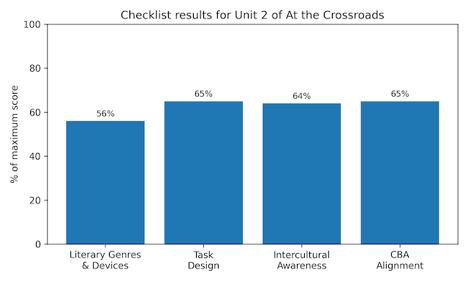
To provide a clearer visual synthesis of the checklist results, Figure 1 translates the four evaluative dimensions into percentage scores. This graphical representation makes it possible to compare the relative strength of each dimension and to identify the main areas in which literary competence is either supported or insufficiently developed in At the Crossroads. Rather than treating the results as isolated scores, the figure highlights the overall pattern emerging from the analysis: the textbook displays a moderate degree of pedagogical organization, especially in task design and CBA alignment, but remains weaker in the literary and intercultural dimensions that are central to the development of full literary competence.
Figure 1. Bar graph of checklist results for At the Crossroads
Source: authors’ checklist analysis.
As shown in Figure 1, the four dimensions range from 56% to 65%. The weakest area is Literary Genres and Devices (56%), followed by Intercultural Awareness (64%), while Task Design and CBA Alignment both score slightly higher, at 65% each. This pattern highlights a consistent but limited integration of literary competence across all areas.
When examined more closely, the results highlight critical imbalances. First, the low score for Literary Genres and Devices (56%) reflects the overwhelming dominance of prose, and the absence of drama and very limited poetry. Such imbalance prevents learners from experiencing the full aesthetic and interpretive range of literature. In particular, the exclusion of drama eliminates opportunities for performance-based activities such as role-play or dramatization, which are recognized for fostering creativity and collaborative learning.
Second, Task Design (65%) demonstrates that comprehension questions remain dominant (62.5%), while inferential (18.75%), critical (12.5%), and creative (6.25%) tasks are comparatively rare, and problem-solving tasks are entirely absent. This overemphasis on surface-level comprehension suggests that the textbook positions literature primarily as a tool for factual recall rather than as a catalyst for critical or creative engagement. As a result, learners may achieve basic understanding but remain insufficiently exposed to opportunities to analyze texts, justify interpretations, or produce imaginative responses.
Third, the dimension of Intercultural Awareness (64%) reveals an imbalance in representation. Anglo-American authors account for half of the texts, world literature appears in 25%, and the remaining 25% are presented in neutral contexts. Algerian authors, however, are completely absent. This exclusion of local voices denies learners opportunities to engage with their own cultural identity in dialogue with global perspectives. Instead, learners encounter a predominantly foreign worldview, which undermines one of literature’s key functions: the development of intercultural comparison and empathy.
Finally, Alignment with the Competency-Based Approach (65%) indicates that although the textbook gestures toward CBA principles, its implementation remains superficial. Traditional comprehension tasks account for 40% of the activities, while learner-centered approaches (20%), cross-skill integration (30%), and problem-solving (10%) are less frequent. Self- and peer-assessment are entirely absent. This confirms that despite curricular claims of adopting CBA, the textbook remains anchored in teacher-centered practices.
These results resonate with broader international patterns. In Europe, for instance, although the CEFR formally acknowledges the role of literature, textbooks often reduce it to comprehension practice rather than promoting critical or creative engagement (Calafato & Hunstadbråten, 2024; Paran, 2008). Similar patterns appear across Asia, where tasks emphasize factual recall rather than interpretation (Xie, 2024). In the Middle East, literary texts tend to be used as linguistic input, with little attention to aesthetic or cultural aspects (Al-Saeed & Alenezi, 2022; Calafato & Simmonds, 2022). In African contexts, textbooks often prioritize Anglophone canons while marginalizing local voices, thereby limiting learners’ ability to identify with the texts (Adejunmobi, 1994; Mehdaoui, 2022).
What makes the Algerian case distinctive is not only the imbalance within the textbook but also the structural inequity of curricular allocation. By assigning the Once Upon a Time unit exclusively to the literary stream, the national curriculum systematically restricts access to literature for students in scientific streams. This restriction creates an institutional inequity in access to literary learning. This curricular limitation echoes global recommendations advocating universal exposure to literature for all learners (Byram, 1997; Hofmeyr, 2022).
Moreover, the results show that literature is not being used to its full pedagogical potential. Instead of being harnessed to foster interpretive skills, aesthetic sensitivity, cultural reflection, and creativity, it is reduced to a supplementary element within language learning. This diverges from recent findings emphasizing that literature-based instruction can simultaneously enhance linguistic mastery, learner motivation, and creativity when implemented with more diverse texts and tasks (Altun, 2023). Case-based research also supports the potential of literature-based instruction to foster engagement when tasks are redesigned around creativity and critical inquiry (Haliem, 2017; Gómez Rodríguez, 2014). Therefore, At the Crossroads demonstrates partial success but requires diversification of genres and more robust intercultural scaffolding.
Taken together, the findings suggest that the underdevelopment of literary competence in Algerian EFL classrooms is the result of both textbook design and curricular structure. Pedagogically, At the Crossroads privileges comprehension over critical and creative engagement. Structurally, the curriculum restricts literature to a subset of learners, signaling that it is optional rather than essential for all. Addressing these issues requires systemic reform: textbooks must diversify their literary genres, integrate richer task designs, and include local and international voices, while curricular policy must ensure equitable access for all learners.
The specific contribution of this analysis is therefore to show that the problem is not simply the quantity of literary content. It is the configuration of access, genres, tasks, cultural reference, and assessment that determines whether literary competence can become a meaningful component of EFL education. In the case examined here, literature is present but not yet institutionally and pedagogically organized as a transversal competence. This distinction is important because it shifts the discussion from the mere inclusion of literary excerpts to the curricular conditions under which learners can interpret, evaluate, create, compare cultures, and develop a sustained literary disposition.
4. Pedagogical Implications
The findings of this study indicate several pedagogical reforms that could meaningfully strengthen the role of literature in Algerian EFL education. The recommendations provided are intended to deepen the educational and transformative potential of literature in language learning.
The first priority is the diversification of literary genres represented in the national curriculum. Current materials privilege narrative prose, resulting in narrow textual experiences. Future textbook design should include a broader selection of genres—poetry, drama, and short fiction—to enhance linguistic and aesthetic awareness (Krsteva & Kukubajska, 2014). A more balanced inclusion of such genres would broaden learners’ exposure to distinct forms of linguistic and aesthetic expression. As Paran (2008) and Carter (2010) argue, poetry develops sensitivity to rhythm, metaphor, and connotation, whereas drama fosters pragmatic competence, collaborative learning, and oral fluency through performance-based tasks. Crucially, Algerian and Maghrebi authors—translated into English where necessary—should be incorporated alongside global literature. Local texts can act as cultural mirrors that validate learners’ lived experiences, while literature from other cultures functions as a window onto empathy, intercultural openness, and global awareness (Byram, 1997; Hofmeyr, 2022; Jackson, 2023; Lașcu, 2023).
Just as crucial is the creation of instructional activities that go beyond rote learning and foster higher-order cognitive involvement. Tasks should be designed to activate analytical, evaluative, and creative thinking in line with the higher levels of Bloom’s taxonomy. Students should, for example, be invited to produce creative readings, dramatize key scenes, debate thematic conflicts, compare narrative viewpoints, and rewrite selected passages from alternative perspectives. Such dialogic and performative modes re-center students as meaning-makers rather than receivers of ready-made interpretations, a pedagogical shift that aligns with constructivist principles and CBA frameworks (Mart, 2021).
The cultivation of intercultural competence also needs to be treated as an intentional pedagogical aim, not merely an unintended consequence of reading literature. Educators might scaffold reflection by asking students to relate the moral, social, and ideological worldviews of texts with their everyday lives. This contrastive perspective fosters empathy and a critical sense of culture, assisting learners in challenging stereotypes and understanding diversity (Byram, 1997; Lașcu, 2023).
Assessment practices therefore need to be rethought as well. Literary competence cannot be tested through recall-based examinations alone; assessment should evaluate interpretive depth, creativity, and reflective capacity. In addition, rubrics are necessary to assess interpretive and creative outcomes rather than comprehension alone (Aziz & Makhtar, 2021). Clear criteria for interpretation, originality, textual evidence, and argumentation provide accuracy and formative feedback. Indeed, as Tomlinson (2018) argues, meaningful assessment frameworks do not merely measure outcomes; they also shape learners’ intellectual development.
Lastly, for literature to serve its intended function as a cultural and intellectual catalyst, its inclusion must be equitable and sustained across all academic streams. For Mehdaoui (2022), fair and balanced inclusion of literature in all academic streams is crucial to achieving the potential transformative impact of literary education. Limiting literary study to the literary stream marginalizes its humanistic and linguistic benefits for other learners. Regular, progressive exposure to literary texts throughout the secondary cycle ensures continuity, cumulative learning, and fairness. Such equity is not simply a curricular adjustment but a matter of educational justice.
Conclusion
Fostering literary competence is central to the future of EFL education because it signals a shift from a purely functional view of language to a more humanistic and intellectually demanding approach that values interpretation, creativity, critical thinking, and cultural empathy. Literature should therefore not be positioned as a peripheral addition to language instruction. It constitutes a powerful curricular resource through which learners can encounter complex linguistic forms, plural voices, aesthetic density, and unfamiliar worlds while also reflecting on their own cultural location.
The evaluation conducted in this article shows that At the Crossroads provides a meaningful but incomplete foundation for literary learning. Its strengths lie in the presence of authentic excerpts, a recognizable pedagogical sequence, and some project-oriented tasks compatible with the Competency-Based Approach. Its limitations, however, are equally clear: the unit privileges narrative prose, offers little sustained work on poetry and no real dramatic practice, excludes Algerian and Maghrebi literary voices, and only partially develops stylistic interpretation, creative response, intercultural comparison, and performance-based assessment. The overall result, 3.1/5 or 62%, therefore indicates partial integration rather than systematic curricular treatment.
The study also highlights a specifically institutional issue. By assigning the literature-focused unit to the literary stream only, the curriculum risks treating literature as a specialization rather than as a common educational resource. This allocation restricts access for students in other streams, particularly the scientific stream, and weakens the possibility of developing literary competence as a transversal component of EFL education. A more equitable model would ensure progressive exposure to literary texts across streams and levels, with tasks that combine comprehension, interpretation, cultural comparison, creative production, and reflective assessment.
These conclusions should nevertheless be read with methodological caution. The analysis is limited to the literary unit of a single nationally prescribed textbook and does not measure learners’ actual literary competence through classroom testing. The scoring procedure offers a transparent diagnostic profile, but it remains interpretive and would benefit from inter-rater validation, teacher interviews, classroom observation, and learner-response data. Further studies could compare several Algerian EFL textbooks across levels, examine how teachers adapt literary units in practice, and investigate whether redesigned tasks actually improve students’ interpretive, stylistic, creative, and intercultural performance.
In this sense, the article contributes to textbook evaluation by showing that the development of literary competence depends on the articulation between textual selection, task design, cultural representation, assessment practices, and curricular access. Re-centering literature in Algerian EFL education would not mean adding isolated literary fragments; it would require designing a coherent pedagogical ecology in which literature becomes a sustained means of linguistic development, intercultural understanding, and imaginative growth.