
Introduction
In contemporary economies, corporate reputation functions as a strategic intangible asset that supports competitive differentiation, stakeholder trust, and organizational legitimacy. In this sense, it is not reducible to a communicational “surface effect”: reputation crystallizes cumulative evaluations produced by multiple stakeholder groups over time, in relation to what organizations do, what they claim, and how they behave (Fombrun, 1996; Barnett, Jermier, & Lafferty, 2006).
Prominent global models that have thrived typically utilize media and advertising strategies as pivotal conduits for growth and success in their respective fields. By instituting robust communication policies, these models have cultivated reputations that foster a positive public perception and substantially contribute to the national economy. Given that an organization’s reputation is essentially its most valuable capital, irrespective of the nature of its offerings, it is critical for entities to strive toward fostering a stellar reputation and cultivating an image that is both respectable and persuasive.
Achieving a robust and enduring reputation management strategy necessitates meticulous management of a positive public image. This requires a comprehensive analysis of reputation-related information across all media channels, both traditional and digital, with the latter gaining dominance due to the widespread adoption of internet technologies, particularly through search engines and social media platforms.
This need gives rise to the practice known as “electronic reputation management” for companies, intricately linked to public relations functions. This strategic process is crucial not only for maintaining the company’s stature but also for ensuring its continued prominence and favourability among all stakeholders, especially clients. The concept of electronic reputation management emerged around the 1990s with the widespread adoption of the internet, marking a pivotal shift towards utilizing digital platforms in all sectors, especially in advertising and promotion.
The advent of search engines around 1998 further transitioned reputation management from traditional methodologies, which relied on interviews, radio, television, newspapers, and magazines, (Stradtman, 2012, p. 72) to a focus on online platforms. This shift was significantly bolstered by the emergence of the second generation of the internet in 2004, which introduced websites and programs specifically designed to assess and critique the reputations of organizations, emphasizing the importance of search engine results and social media content (Harold, 2014).
In light of the above, it has become essential for organizations to leverage the capabilities and services offered by the second generation of the World Wide Web to market their products and services online. This cannot be achieved without ensuring meticulous monitoring of their online presence and managing their brand through a thorough analysis of the digital content circulating about them, with a particular focus on correcting any misinformation or fake news that could damage their image and standing with their audiences. Ultimately, a customer’s willingness to pay depends on their trust in the quality of the service provided and their positive perception of the organization. This article explores the strategies organizations employ to manage their online reputation and answers the central question: How does an organization strategically plan to manage its online reputation?
The purpose of this article is to analyze contemporary mechanisms of reputation management in the digital sphere by examining technical and communicational tools and discussing the ethical and legal dimensions associated with them. It also provides a critical reading of current practices and proposes a holistic perspective in which technology is integrated with an institution’s strategic vision.
Methodologically, this study adopted a theoretical-analytical approach with a conceptual focus, aiming to develop a structured framework for e-reputation management strategies by analysing relevant scholarly literature. References were selected based on specific criteria, namely their direct relevance to the topic of corporate reputation in the digital environment, as well as their diversity across both Western and Arabic literature. The study began by analyzing key concepts (reputation, digital reputation, digital space, and digital brand image) by comparing different definitions and theoretical approaches, and identifying modern strategies for managing organizational reputation across digital platforms. Subsequently, given the theoretical nature of the study, it does not rely on field data or a specific sample, but rather presents a conceptual framework that can be tested and developed in future research, while acknowledging its inherent limitations inherent in theoretical analysis.
To strengthen conceptual coherence, the next section clarifies the definitional landscape of reputation and its operationalization in digital environments before mapping processes, tools, and stakeholder configurations.
1. Understanding electronic management of an organization’s reputation
To understand the electronic management of an organization reputation, we need first of all to deepen the notion of reputation.
1.1. Conceptualizing reputation
The term “reputation” is derived from the notion of renown, what is heard about an individual or entity, whether favourable or unfavourable. It is a general evaluation that encompasses both the merits and demerits of the subject, originating from the term for hearing, which implies widespread dissemination among people. For example, actions taken out of vanity for reputation aim to be seen and heard by the public (Al-Farabi, 1978). Reputation is not something that can be directly observed, but is a perceptual category that underlies the perceptions of different stakeholder groups depending on: the actual situation (what is actually done by the entity), the communication activities of the company, and the particular goals of the stakeholders.
Technically, reputation is defined as one of the pivotal indicators of an organization’s success. It is regarded as an invaluable intangible asset that forms the mental image held by people about various entities and organizations. This image could stem from direct or indirect interactions, may be rational or irrational, and could be based on solid evidence and documents or on mere rumors and unverified statements. In sociology, reputation is often understood as a form of social identity. And a social identity is something every entity needs to nurture to succeed in a social environment (Nguyen & Leblanc, 2001). Besides being seen as a social identity, reputation has an important role in status theory in sociology, where reputation is the main determinant of status in a given society.
Ultimately, it represents the perceived reality of the reputation held in stakeholders’ minds (El-Adawi, 2011). It is essential to acknowledge that there is no unanimous agreement on the definition of reputation, as the philosophy of public relations evolves over different eras.
Because definitions vary across disciplines, the literature emphasizes the “definitional landscape” of corporate reputation, ranging from image-based perspectives to evaluative and relational approaches (Barnett et al., 2006). This plurality is not a weakness but a reminder that reputation is multidimensional and must be operationalized with explicit theoretical choices.
1.2. Managing the reputation of the organization
The strategy of reputation management emerges as a crucial contemporary concept, executed through ongoing corporate communication aimed at fostering a favourable reputation for the organization such that its audience perceives it as an institution of positive repute (Al-Khaja, 2014).
This perception is cultivated through the services and facilities the organization provides, which in turn garners support and loyalty from its audience during challenging times or crises. Reputation management transcends the mere creation of a positive external image; it begins internally by nurturing close-knit relationships with employees at all levels, thereby fostering an environment ripe for creativity and innovation (Vicker, 2004).
Notably, many individuals and organizations utilize various social media channels to monitor and manage their reputation. Thus, effective reputation management answers several critical questions with precision to achieve its strategic objectives :
-
Who are we? This question focuses on defining identity and purpose. It involves understanding core values, mission, and what the organization or individual stands for.
-
What are our goals? This helps clarify the objectives, both short-term and long-term, that guide decision-making and strategic planning.
-
What sets us apart from others? This question identifies unique characteristics, strengths, or competitive advantages that differentiate an organisation or individual in their field.
-
How do we want to be perceived by others? This addresses the desired public image or reputation, ensuring that actions and communication align with the intended perception.. (Barker, 2010)
According to Barker, they serve as a foundation for developing a clear and consistent message about who they are and what they aim to achieve.
Reputation management is a strategic process articulated through continuous corporate communication and organizational conduct, aimed at cultivating and sustaining favourable evaluations of the organization among its publics (Al-Khaja, 2014). In line with foundational work, reputation may be treated as a source of value that can be developed through coherence between identity, image, and performance (Fombrun, 1996).
1.3. Online reputation management and digital identity
Online Reputation Management (ORM) closely mirrors the principles of the broader concept of reputation management but with a distinct focus on digital content. As Ali Farjani articulates(Farjani, 2018) ORM involves :
“a process of continuous research and analysis of information regarding personal, professional, commercial, or industrial reputations as they exist in digital forms across all media on the internet.” (Farjani, 2018)
This specialization provides a critical opportunity for organizations to shape and control their image online (Al-Haizan, 2013). It refers to the process of managing and influencing one’s online reputation. A person’s or a business’s online reputation is extremely important in the modern era, as it can significantly affect their credibility, trustworthiness, and overall impression (Pollák, 2019). Online reputation management (ORM) is the process of keeping tabs on and shaping the conversation about a company or person on the web, ensuring the importance of vigilant monitoring, content creation, engagement on social media platforms, and other essential practices in a context where brands’ digital footprints are constantly scrutinized and subject to change (Arjun Singh & others, 2023).
The concept is synonymous with various other terms, such as internet reputation management, web reputation management, and digital reputation management. Similar to traditional reputation management, where an organization’s reputation evolves based on stakeholder perceptions and their assessments of the organization’s ability to meet expectations, electronic reputation evolves through sophisticated “internet monitoring technologies” (Coombs, 2007).
The concept of electronic reputation is not limited to the public’s perception of an organization ; it also encompasses the information the organization itself leaves for internet users. It is worth noting that the term “digital identity” is often used interchangeably with “electronic reputation”, although they are distinct concepts. Digital identity refers to a set of accumulated characteristics or, more precisely, the information an organization uses to define itself on digital platforms. This identity forms the basis for interaction and communication with internet users. However, its content may not necessarily align with the organization’s actual identity in social reality.
In contrast, electronic reputation is shaped by internet users based on this digital identity and the information they discern. An organization’s image can be categorized into three levels :
-
The perceived image – how the public views the organization.
-
The actual image – the organization’s true identity.
-
The desired image – how the organization wishes to be perceived by the public.
These technologies provide early warnings to business owners about references made to them across the web, by tracking specific “E-words of the month” (Ben Yahia & Marabit, 2018) targeted phrases, company names, brand names, or the names of key individuals within the company. Following the tracking process, a comprehensive report is generated that highlights both positive and negative mentions of the company’s activities and public image (Barker, 2010).
Applying these principles to the electronic reputation management of an economic institution, whether it deals with tangible or intangible services, involves several critical stages :
-
Scanning the Name of the Institution: This involves monitoring and tracking mentions of the brand across various online platforms to gauge how widely and in what contexts the brand is discussed.
-
Scanning the Interests of the Audience and Linking Them to Financial Capabilities: This step includes tracking competitors’ promotional offers and advertising campaigns across digital media. It also involves understanding public demands in relation to their financial capabilities, enabling the institution to tailor its offerings to align closely with the majority of its audience.
-
Scanning Media Materials Mentioning the Institution or Competitors: This entails monitoring news and updates related to the institution or its competitors, categorizing this information based on its content, intent, the actors involved, and the targeted audience.
-
Scanning Groups, Forums, and Social Media Sites: Particularly those that focus on the institution’s field of activity. It’s crucial to prioritize platforms like YouTube and other popular video-sharing sites to present appealing offers that not only introduce the audience to the institution but also help form a positive perception of the brand, ultimately influencing their purchasing decisions.
These steps form a comprehensive framework for managing an institution’s online reputation effectively, ensuring that it maintains a favorable standing among its stakeholders and the broader market.
-
Furthermore, organizations can significantly enhance their reputation and visibility by leveraging services provided by digital platforms, outlined as follows:
-
Invite influential figures who have a significant impact on public opinion at local, regional, or international levels, especially those who have a large following and high viewership on these sites.
-
Attempt to open pages and channels across various online platforms, with a focus on regularly updating them to affirm the organization’s presence alongside the audience and to keep up with their interests and concerns.
-
Ensure presence and respond to user comments and questions.
-
Monitor what is broadcasted through the media about the organization’s field in general, analyze it, and provide recommendations to the officials of the parent sector, promoting the organization’s services and programs as part of the whole.
-
Focus on eliminating the causes of public and client complaints as they represent vulnerabilities that might affect the organization’s image and online reputation, taking into account directed observations and responding to them with care and positivity.
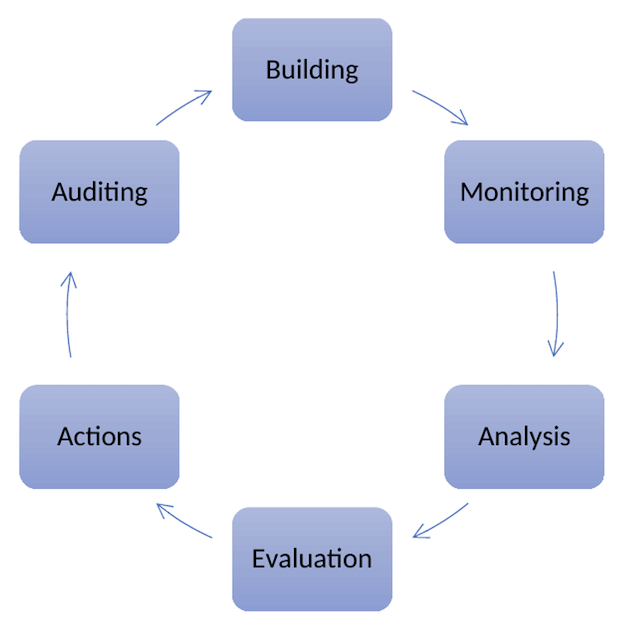
The foundational processes of online reputation management are depicted in the following figure :
Figure 1. The six processes of online reputation management
Source : Researcher’s preparation.
-
Building: Establish a dedicated entity to manage online reputation. This includes defining roles, setting clear objectives, formulating strategies, and adhering to ethical standards to achieve these goals.(Stradtman, 2012)
-
Monitoring: Implement specialized software to monitor digital content across the internet. This process should include comprehensive training for personnel responsible for these tasks.
-
Analysis: Filter and categorize data collected through monitoring. Proceed to both quantitative and qualitative analysis to derive meaningful insights from the data.
-
Evaluation: Prepare detailed reports that summarize the analysis, identifying key findings. These reports should guide the organization in planning and implementing actions to enhance its public image.
-
Actions: Improve areas of weakness by enhancing digital content, responding transparently to feedback, or rectifying any incorrect or misleading information about the organization (Mahnabi, 2017).
-
Auditing: Conduct thorough evaluations to ensure all actions are effective. Provide comprehensive reports that assess the organization’s digital reputation, ensuring continuous improvement.
These stages collectively aim to cultivate a robust online presence, disseminate high-quality content, and provide tools to facilitate its sharing with wider audiences.
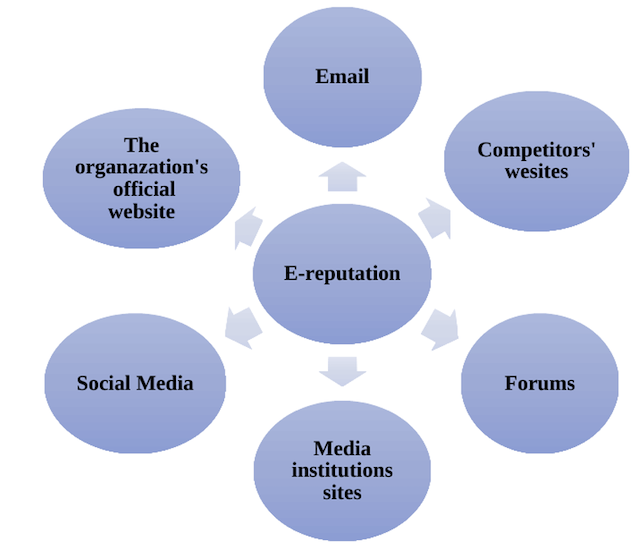
The following diagram summarizes the tools and programs available for effective online reputation management :
Figure 2. Tools for online reputation management
Source : Researcher’s preparation.
In addition to the tools outlined above, organizations can benefit from various programs that aid in monitoring and managing their online reputation. These include:
-
Google Search for Online Reputation Monitoring: Google serves not only as a search engine but also as a vital tool for monitoring mentions of an organization online. Every corporate entity should set up an account to receive alerts whenever tracked keywords or terms appear across various online platforms (Mahnabi, 2017).
-
Social Mention in social media: This feature allows organizations to search for mentions of their institution or competitors across social media platforms. It enables the classification of these mentions as positive or negative, allowing for professional and effective management. Additionally, tools like Mention.net, available as a Chrome application, monitor millions of sources in 42 languages (Beal, 2008, p. 41) and provide alerts when monitored keywords or selected terms are mentioned.
These strategies and tools are integral to maintaining a dynamic and positive online reputation, facilitating proactive engagement with the digital audience.
2. Strategies for effective online reputation management in organizations
The process of orchestrating online reputation management is methodically structured and encompasses a comprehensive analysis of all resources both material and human, that the organization has at its disposal. This approach is particularly pertinent for institutions operating within specific sectors or fields.
Online marketing expert and author Andy Beal (Farjani, 2018) in his publication “Monitoring and Managing Reputations Online”, outlines ten strategic tactics essential for safeguarding an organization’s online presence. These tactics are elaborated upon as follows :
2.1. Selecting your electronic voice with precision
Beyond merely maintaining a website, which acts as the primary interface with the public, the internet provides various platforms through which an organization can foster interaction with its audience. The selection of these platforms must be guided by thorough studies that assess the influence these platforms have on the organization’s reputation, such as social networks and forums where discussions pertinent to the organization’s field occur. In an article titled “Conditions of online stickiness in electronic retail : website quality, perceived risk and perceived value”, Monfared & al. (2023) have investigated using structural modelling by collecting 229 questionnaires from Iranian consumers who used electronic retail for their purchases. The research findings showed that perceived value and website quality, as well as all five dimensions of website quality (content quality, website design, privacy and security, customer service and reliability) have a positive and significant effect on stickiness. The effect of risk perception on stickiness is negative and significant, and website quality has a negative and significant effect on risk perception. Also, website quality has a positive and significant effect on perceived value.
The aim is to cultivate a favorable image of the organization, engender positive opinions and impressions, and amass a following that can actively engage and provide feedback on posted content.
2.2. Defining your institutional identity
It is crucial for an organization to define its identity through an in-depth analysis of the internal dynamics that influence its external interactions. This involves identifying the strengths and weaknesses of the organization, understanding the significant risks that could jeopardize its reputation, and analyzing the nature of relationships among staff, particularly those within the public relations team responsible for managing the organization’s reputation.
2.3. Dressing to Impress with Attractive Electronic Design
The design of the organization’s digital interface should be both compelling and user-friendly, with options to switch languages to cater to a global audience. This includes integrating images, visitor and customer testimonials praising the services, and videos that may feature advertisements aired across various media, or interviews with the organization’s officials (Beal, 2008, p. 52). This is especially true since, thanks to digital platforms, we are addressing a diverse audience, within which the number of virtual communities is growing daily and where interests differ from one community to another. These virtual communities can be classified as travel, technology, video game, educational, informational, entertainment, and so on. Communicating with them requires diversifying methods, formats, and presentations to ensure that members of these various virtual communities are interested in the published content (Samir et al., 2023).
2.4. Continuous monitoring of the organization’s reputation
Similar to the regular checking of emails, it is imperative to consistently monitor the organization’s online reputation. This includes showcasing positive reviews while swiftly addressing complaints to mitigate adverse perceptions. Moreover, it involves evaluating the effectiveness of the electronic design and the services provided. Adhering to a principle of transparency is crucial, ensuring that the information disseminated is a true reflection of the organization’s capabilities.
In today’s digital age, it is essential for organizations to actively engage with their consumer base on social networks and interact with influencers and brand ambassadors. The power of internet users to influence public perception through sharing their experiences and opinions online is significant and can profoundly affect an organization’s reputation and the level of digital trust it commands.
Proactive management of e-reputation is indispensable. Organizations and brands must not only monitor what is said about them but also actively engage in dialogues with internet users to bolster their credibility and authenticity. Transparency, responsiveness, and genuineness are core principles in establishing trust with users and converting them into devoted customers. Several research findings emphasize the importance of these principles (BrightLocal, 2023) :
-
A staggering 98% of consumers occasionally consult online reviews when exploring local businesses.
-
69% of consumers are more inclined to patronize a business if it displays consistently positive public feedback.
-
An overwhelming majority, 90% of consumers, trust recommendations from their friends, and 78% trust those from anonymous online users, significantly more than traditional branded advertisements, which only 16% trust.
The success and survival of any organization depend on the ability of its personnel to manage its environment. As an open system, the organization is often compelled to engage in continuous interaction with its external environment, which is widely recognized as dynamic and uncontrollable due to the diversity, multiplicity, and complex relationships among its components. This environment is also unstable, as developments do not follow a single trajectory or a fixed pattern ; at times, it becomes disruptive or disconnected from its previous state, placing the organization in a state of uncertainty. Extending this argument, Cang and Wang (2021) conducted a comparative study on the willingness of experienced and potential consumers to purchase fresh produce online, using an online survey of 202 experienced consumers and 192 potential consumers. The results showed that product quality, logistics, online word-of-mouth recommendations, and website information quality significantly influence experienced consumers to varying degrees.
Technological advancement is among the most significant environmental changes influencing organizational activities, ushering them into a new era where information becomes essential capital requiring precise management. In this evolving environment, the transition from early, predominantly static Web environments to interactive Web 2.0 infrastructures has increased participation, sharing, and platform-mediated visibility. This shift implies that reputational signals are co-produced by organizations and users through continuous interaction and feedback loops.
The sharing of information through digital media, particularly social media, varies in levels, depending on whether these platforms are used for communication, interaction, or service provision. This is influenced by the speed of information exchange in each generation and the degree of social connectivity or the number of individuals sharing this information.
Several entities play vital roles, either consciously or subconsciously, in shaping the online reputation of organizations. It is crucial for companies to conduct regular audits and establish robust strategies to prevent crises and rumors that could detrimentally impact their brand’s standing both online and in reality :
-
Employees: According to a study by Brussels University, 84% of business crises are linked to internal issues which may stem from organizational mismanagement. This can include selling defective products, engaging in questionable communications, or improperly releasing sensitive information.
-
Therefore, it is essential for an organization to nurture a healthy and productive internal environment, recognizing and mitigating its vulnerabilities. Employees can profoundly impact the institution’s image if they are not adequately trained in the professional use of social media in their roles. Their shared experiences on platforms like LinkedIn or specialized sites like Glassdoor can rapidly spread and influence the perceptions of potential future employees.
-
Internet Users: They are undoubtedly pivotal in shaping a company’s online reputation. Through comments on social media, reviews on platforms like Google, digital word-of-mouth, and information sharing, users increasingly dictate the narrative around an institution’s reputation. With the ubiquity of smartphones, a single tweet can ignite controversy in an instant, highlighting the need for continuous user engagement monitoring.
-
Influencers: In the digital realm, influencers are akin to community leaders. Present on platforms like Facebook, Instagram, Twitter, blogs, and YouTube, these individuals exert significant influence over public opinion. According to (Petein, 2020) An influencer is an individual who, by their status, position, or media exposure, can influence consumer behaviors in a given domain. They can sway their followers towards or against a brand based on their experiences and satisfaction levels. Thus, it is imperative for organizations to adeptly manage and incorporate influencers into their marketing strategies to maintain a positive online reputation. Most recent studies confirm the positive and significant impact of influencers on companies’ online reputation. This is due to the increasing importance of influencers as a key digital tool for companies and brands, especially when a brand seeks to enhance its presence and promote high-quality content to increase sales among its target audience (Iznasni, Bessouh. 2025). It is therefore unsurprising that influencers have become an essential part of most companies’ communication strategies. However, this must be approached with caution, as communicating authentically with the public, enhancing brand presence, and increasing sales is no easy task. In fact, some influencers can cause collateral damage, including genuine reputational crises, as happened in March 2024. Doritos appointed Samantha Hudson as its brand ambassador in Spain, but canceled the contract just two days later after she reposted old, controversial tweets (BBC news, 2024). The backlash led to online criticism and calls for a boycott, forcing Doritos to cancel the campaign.
-
Competitors: They are crucial players in the dynamics of reputation management. Competitors can negatively influence an organization’s reputation through tactics such as publishing misleading comments on search engines, negative remarks on forums, or using defamatory hashtags on social media.
-
Traditional Media: Despite the rise of digital platforms, traditional media maintains a significant influence over public opinion and, consequently, the online reputation of organizations. Opinion polls and articles from traditional media sources often rank highly in search engine results and can significantly sway public perception, either enhancing or damaging an institution’s reputation.
Recent academic work also underlines the role of influencer marketing in shaping electronic reputation, especially in contexts where visibility is co-produced by brands, creators, and platform algorithms (Petein, 2020 ; Iznasni & Bessouh, 2025).
Legal and ethical dimensions constitute an additional layer within the theoretical framework. Data protection regulations such as the GDPR impose explicit obligations regarding notification and transparency in the event of data breaches, thereby reducing the feasibility of “wait-and-see” strategies and reinforcing the duty of rapid disclosure. In the digital environment, such legal imperatives are closely intertwined with digital reputation management, as delayed or opaque communication can quickly erode public trust, amplify reputational damage online, and intensify negative narratives across digital platforms. Consequently, compliance with legal and ethical standards serves not only as a regulatory requirement but also as a strategic component in preserving and restoring digital reputation during crises. Simultaneously, balancing freedom of expression with efforts to combat misinformation generates ethical dilemmas concerning the boundaries of content intervention, particularly when countering rumors involves actions that may be perceived as constraints on public discourse (Zwitter & Božić, 2018).
An effective methodology for managing digital reputation, therefore, requires the integration of several components : a diagnostic framework capable of classifying the reputation, image-management tools, early-monitoring and alert mechanisms derived from network and data analysis, and legal-ethical policies guiding disclosure and the treatment of affected individuals’ data. Combining these elements within a unified model necessitates a cultural shift within institutions toward flexibility and transparency, as well as continuous training for communication teams in digital analysis tools and multi-channel dialogue techniques.
The theoretical framework of digital reputation management can thus be viewed as a synthesis of traditional communication theories and contemporary data-network theories, accompanied by explicit acknowledgment of the limitations of each tool individually. Effective practical application requires an adaptable institutional structure capable of rapid learning, along with collaboration among technical, legal, and media specialists to ensure a balanced response that preserves reputation while upholding ethical and legal principles.
Conclusion
The insights gleaned from our discussion underscore that in today’s digital and socially interconnected era, no institution can afford to overlook the critical importance of effective reputation management. This is not merely about maintaining a favorable image ; it’s about strategically navigating the complex web of social media to secure a competitive edge in an increasingly crowded market.
The internet, with its vast array of services and applications, plays a pivotal role in tracking and enhancing an organization’s digital presence, thereby exerting significant control over its perceived image among audiences and clients alike.
There is an undeniable need for institutions to possess a team proficient in the latest technologies and methodologies specifically designed for online reputation management. Such expertise is crucial for handling the intangible yet invaluable capital of electronic reputation.
Today, managing this facet of an organization’s identity presents a formidable challenge, particularly for those yet to comprehend the profound impact and reach of social media. The rapid spread of information, coupled with the risks of misinformation, necessitates robust systems for monitoring and managing an organization’s online persona.
These systems are essential not only for mitigating potential crises but also for anticipating and adapting to emerging trends. In this way, organizations can proactively shape their narrative in a manner that aligns with their long-term strategic goals, thereby ensuring sustained success in the digital age.
As a conceptual contribution, this paper proposes an integrated framework that articulates processes (building, monitoring, analysis, evaluation, actions, auditing), tools (alerts, social listening, analytics), and strategic levers (content, engagement, influencer governance, legal-ethical compliance). Future work may operationalize this framework through comparative case studies and measurement-based approaches—such as customer-based corporate reputation scales—in order to test effectiveness across sectors and cultural contexts (Walsh & Beatty, 2007).